"The only problem with diversification is that it's never been tried," said Mark Kritzman, president and CEO of Windham Capital Management, in a July 21 speech to the Boston chapter of the Quantitative Work Alliance for Applied Finance, Education and Wisdom (QWAFAFEW). If he gets his way, investors will apply his concept of turbulence to achieve truly diversified portfolios. Advisor Perspectives interviewed Kritzman after his QWAFAFEW talk to get details on how financial advisors can benefit from turbulence.
Classic diversification has failed, Kritzman said, because traditional, independent measures of volatility and correlation don’t provide enough information to indicate which portfolios will deliver the lower risk or higher returns that, at least theoretically, should come with investing in imperfectly correlated asset classes. To see the failure of classically diversified portfolios, one need not look any farther than the recent financial crisis, when correlations converged toward one and “diversified” portfolios plummeted.
Turbulence vs. VIX
“Turbulence is a measure of statistical unusualness that takes into account both the magnitude of returns and how they interact with one another,” said Kritzman. “A period is deemed turbulent if either the returns are different in magnitude from their norm or if the assets interact in an uncharacteristic way.”
In other words, turbulence is a statistical measure of both volatility and correlation. It differs from narrower metrics such as the VIX index, which measure only one asset class (the S&P 500 in the case of the VIX) and don’t take into account correlations across asset classes.
Volatility alone doesn’t capture enough information about interactions between assets, Kritzman said. Consider two portfolios with the same volatility. The first portfolio’s components could have high standard deviation and low correlations, while the second could have low standard deviation and high correlations. The investor who only considers volatility lacks important information about whether correlations are acting typically or not. “It’s like living in Boston and having just one set of clothes for the average temperature,” Kritzman said.
By incorporating information about correlations, turbulence indicates—in a way that volatility cannot—whether markets are decoupling or converging. This is important because when assets act uncharacteristically, hedging and other investment strategies that rely on consistent correlations may not work.
Measures such as VIX have additional shortcomings, according to Kritzman. They are only available for asset classes that have liquid option markets, and they are forward-looking measures, so they don’t measure what’s actually going on now.
Turbulence Suggests When to Trim Risky Assets
Turbulence’s characteristics lend themselves to some practical applications. First, once turbulence starts, it persists more than the conditions tracked by indicators such as volatility. This is an issue Advisor Perspectives discussed in November (Portfolios for Turbulent Times, Nov. 11, 2008). “Even if you can’t forecast when turbulence will begin, you know it will continue for a while. The other indicators are close to random, so you don’t know whether they’ll disappear,” said Kritzman. He is currently researching the usefulness of turbulence as an early warning signal.
Turbulence’s persistence and its capturing of relationships omitted by volatility measures make it more useful than volatility in predicting how different strategies will perform, said Kritzman. During turbulent periods investors flee to safety, and risk-adjusted returns are substantially lower than in non-turbulent periods. So it makes sense to scale back on risky investments in favor of assets like U.S. Treasury bonds when turbulence is afoot. Kritzman suggests moving gradually out of risky assets, rather than eliminating them—“I would never tell anyone to take a binary approach to investing, so that either you’re 100% one way or the other,” he said.
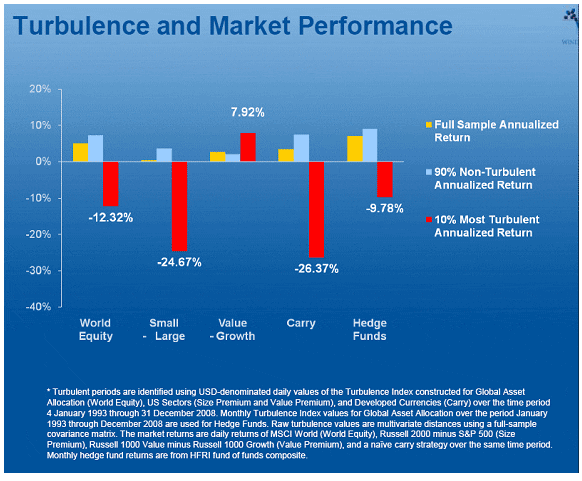
Increased risk typically results in the outperformance of certain assets – small caps outperform large caps, value outperforms growth, and the carry trade and hedge funds outperform broad market benchmarks. But some of those relationships break down as turbulence increases, as shown in the graph below.

More Implications for Advisors
Portfolio managers can also use turbulence to stress test their portfolios and get a sense of how they would perform during difficult times. For example, managers can calculate the correlations and volatility that prevailed during the most volatile periods of the past 30 years, and then armed with that information they can estimate the probability of loss and value at risk if such turbulence were to recur.
Turbulence can also improve mean-variance optimization of portfolios. Let’s assume a portfolio manager believes there’s a 50% chance of a highly turbulent period, rather than the average 10% likelihood. Then, when she optimizes her portfolio, she should weight at 50%—instead of 10%—the correlations and volatility associated with high levels of turbulence.
Kritzman himself, however, doesn’t worry much about forecasting turbulence. His top priority is building a portfolio that will be more resilient during turbulence. Such portfolios will have lower losses during turbulence, research has shown, but over the entire period they will give up very little return. Surely such a portfolio would appeal to many clients, especially in the light of recent events.
Turbulence may also help portfolio managers improve their relationships with clients, Kritzman said, because it enables managers to better match their clients’ risk tolerances with portfolios and gives clients a more reliable estimate of their portfolios’ risk.
Investors who ignore the unusual behavior captured by turbulence do so at their own risk. With portfolios that rely on traditional measures of volatility and correlation, “You’re getting diversification exactly when you don’t need it, and you’re getting unification when you don’t want it,” Kritzman said.
Advisors must go through Kritzman’s firm, Windham Capital Management, to obtain measures of turbulence. Windham offers software to advisors and manages separate accounts. The firm has also had discussions about offering its approach as a sub-advised mutual fund.
Susan Weiner, CFA, is a writer specializing in investment and wealth management. Contact her through http://InvestmentWriting.com.
Read more articles by Susan B. Weiner, CFA