Advisor Perspectives welcomes guest contributions. The views presented here do not necessarily represent those of Advisor Perspectives.
The following is in response to a letter to the Editor from Jerome Porter which appeared last week. That letter was in response to Dougal Williams’ article, A Crash Course in Investing: Six Lessons from the Market Meltdown, which appeared two weeks ago.
Mr. Porter outlines three areas in which he believes my analysis of asset allocation fund performance falters. Two of the shortcomings—for which I provide more in-depth research below—can be summarized as follows:i
- A comparison of fund performance vs. an equivalent index mix over just one year—2008—is too short a period in which to derive meaningful results. Results would have more significance if performance was examined over a longer period, say five or 10 years.
- Comparing actual fund performance, reduced by management fees and trading costs, to a mix of indices that have no such costs is unfair. Fund performance should be compared to a similar mix of investable index funds, the returns of which are also reduced by fees and trading costs.
Without question, these are valid points. Let me address them in order.
In keeping with the theme my original article, I chose to examine fund performance over just one year. The heart of the financial crisis was 2008, so I was interested to see whether fund managers succeeded in beating the market through tactical moves in that year as compared to other years. Certainly, conclusions drawn from just one year of data are likely to fail the test of statistical significance. Looking at results over longer periods, while far from a guarantee of future success, carries more weight.
If, as Mr. Porter suggests, we look at the performance of asset allocation funds over trailing 5- and 10-year periods, we find a similar story to what I presented in my article: The majority of asset allocation funds still fail to beat an equivalent index mix.
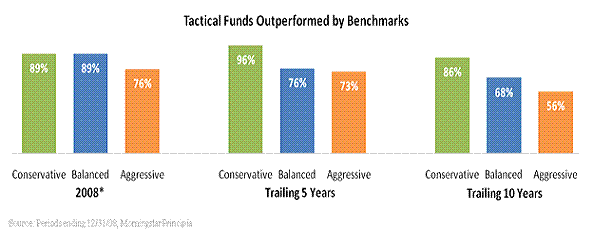
Across all three risk profiles (conservative, balanced, and aggressive) a total of 111 funds have 5 years of trailing performance. Of those 111, 80% failed to match the benchmark return. Of the 76 asset allocation funds with 10 years of performance, 70% failed to keep pace with the benchmark.
As Mr. Porter correctly points out, however, these results use indices, not index funds, as the basis for comparison. The indices have no management fees or trading costs associated with them. Comparing asset allocation fund results to actual investable index fund performance is a fairer comparison.
In his response, Mr. Porter suggests I choose two “long term surrogates” for the indices to better reflect the impact of fees and costs. Rather than be criticized for selecting two index funds “with the benefit of hindsight,” I decided to look at all total stock and bond market index funds with 10 years of performance. By taking an average of all these index funds (readily available to all investors) we can make an apples-to-apples comparison and address the following question: had you invested in a mix of the average total stock market index fund and the average total bond market index fund, how would you have fared vs. a choice of the average asset allocation fund? The results are below:
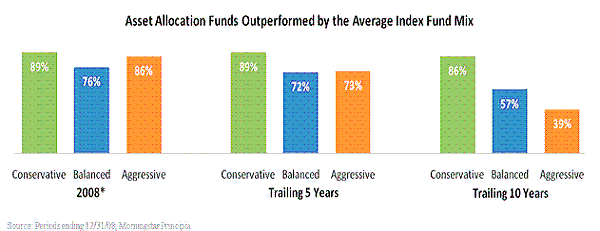
i The third shortcoming, in which Mr. Porter suggests a fairer comparison would pit the performance of two suitable index funds versus a set of the most “popular” funds used by advisors who participate in the Advisor Perspectives surveys, is beyond the scope of this paper. I believe I address Mr. Porter’s underlying concern here in the performance comparison of the “the average index fund” with “the average asset allocation fund.” The average of both groups is impacted by fees, trading costs and good/bad performers within each respective group.










