Advisor Perspectives welcomes guest contributions. The views presented here do not necessarily represent those of Advisor Perspectives.

This essay is excerpted from the most recent version of the HCM Market Letter. To subscribe directly to this publication, please go here.
“The biggest threat to America right now is not government spending, huge deficits, foreign ownership of our debt, world terrorism, two wars, potential epidemics or nuts with nukes. The biggest long-term threat is that people are becoming and have become disheartened, that this condition is reaching critical mass, and that if afflicts most broadly and deeply those members of the American leadership class who are not in Washington, most especially those in business.”
Peggy Noonan
Peggy Noonan’s recent column in The Wall Street Journal (“We’re Governed by Callous Children,” October 31, 2009) must rank among the best columns she or any other journalist has written in recent years. Ms. Noonan’s diagnosis for what ails us speaks to the sense of foreboding that many of those in the investment community feel about the current economic situation. It feels like the economic challenges facing the United States are growing by the day, and the powers-that-be are making very limited progress in addressing them. Marc Faber recently wrote a column in which he expressed his own view that, “even under the most optimistic assumption, I don’t believe that a bunch of government officials will be able to solve, by fiscal and monetary means, the very serious structural problems that exist in the global economy.”1 Recent activity on Capitol Hill can at best be characterized as disappointing in both form and substance. It is not simply a matter of bipartisanship trumping progress; the actual machinery of legislation is so clearly held hostage by financial interests that it renders meaningful change virtually impossible. The hope that President Obama brought to the White House as a catalyst for change is being steadily eroded by the ugly realities of a Nancy Pelosi/Harry Reid controlled Congress. There is no gentle way to adequately express the disappointment reasonable observers have to feel in the quality of these Congressional leaders, who appear to have no sense of the damage they are inflicting on this nation on a daily basis.
The approach being taken to financial reform is typical of the pattern that has followed each of the financial crises we have witnessed over the past thirty years. As the crisis atmosphere has dissipated, so has the urgency to enact the type of radical reforms necessary to prevent another financial crisis from unfolding in the near future. Now that the immediate crisis has passed, little is being done to address the underlying economic imbalances that led to it. As a result, these imbalances, which were permitted to build up as a result of poor policy decisions, will continue to grow larger until the next crisis, when they will again be treated by temporary measures. This is the pattern that has been in place over the past three decades and has resulted in a steady ratcheting up of risk in the financial system to the point that the imbalances have grown so large that only unimaginably painful measures would remedy them. And such measures are simply politically impossible in our short-term oriented world. Despite all of Rahm Emanuel’s bold talk about a crisis being a terrible thing to waste, the financial crisis of 2008 is largely being squandered in terms of its potential for meaningfully reforming the financial system away from one that favors debt over equity, speculation over productivity, and short-term thinking over long-term planning. This failure will come back to haunt us sooner than many people think.
This month’s newsletter was delayed (with apologies) because I was in the process of completing the manuscript of The Death of Capital, a book I have spent much of 2009 writing for John Wiley & Sons. In the book, I argue that the need for financial reform is more urgent than ever because the steps that the government took to avoid financial Armageddon are certain to cause even greater financial instability in the future. The book is based on the premise that traditional finance theory misconstrues the essential nature of capital, leading to flawed investment strategies and financial regulation. The book provides a blueprint for both intellectual and regulatory reform that is designed to provide the foundation for a stable financial system that will be able to withstand the future shocks that are certain to befall us as a result of the imbalances that are continuing to grow day-by-day. The book is scheduled to be published in the spring of 2010, by which time I am confident that little in the way of meaningful fiscal or regulatory reform will be in place. That worries me a great deal. Writing the book left me, in a word, disheartened.
Equity markets
- The glass is half empty
In conversations with other managers and investors over the past few months, there has been a consistent narrative that goes like this:
- The economy has avoided a depression and is starting to recover.
- This recovery, however, is almost entirely due to government stimulus and there are few signs of organic growth.
- Companies are beating relatively easy earnings estimates entirely through cost –cutting; revenue growth is non-existent (although we started to see some signs of it in the third quarter).
- There will be limited sources of organic growth when the government withdraws the stimulus.
- At that point, the stock market and credit markets could retrace.
- Post-stimulus, the economy will be left with trillion-dollar deficits as far as the eye can see and will experience a weak dollar and/or inflation.
- The glass is half full
There is more optimistic narrative as well that goes like this:
- The economy has avoided a depression and is going to recover.
- Companies are beating their earnings and there are starting to be signs of revenue growth. Earnings will explode once revenues start to grow since cost structures have been cut to the bone.
- The government will be able to gently withdraw stimulus and hand off the reins of growth to the private sector.
- Growth will be driven by exports to Asia and greater efficiency now that companies have cut their businesses to the bone.
- Third quarter GDP growth of 3.5 percent shows that the economy is healing.
- The stock market and credit market will remain around their current levels for a sustained period.
- Post-stimulus, the economy will grow steadily albeit at a below-trend rate of 2-3 percent.
1 Marc Faber, The Gloom, Boom & Doom Report, September 1, 2009, p. 2.
III. What is in the glass?
Both narratives must account for the following facts “on the ground” in the economy.2
• While third quarter GDP was up 3.5 percent, vehicle sales (‘Cash for Clunkers’) accounted for 1.6 percent of the growth; housing (the $8,000 first-time buyers tax credit) contributed another 0.53 percent; inventory restocking added another 0.9 percent. Government spending increased by 7.9 percent overall. According to John Williams (Shadow Government Statistics), one-time stimulus and inventory build represented 92 percent of third quarter GDP growth. By way of comparison, Bridgewater Associates, Inc. estimates the contribution from stimulus alone at between 1.0 and 1.5 percent.
• There are currently 18,843,000 vacant homes in the United States (out of a total of 130,302,000 homes). This is an increase of 395,000 over a year earlier. In the category of homes that are occupied year-round, there are 14,227,000 vacant homes compared to 13,707,000 a year earlier.
- The unemployment rate officially stands at just under 10 percent and when discouraged and underemployed workers are included, the figure is in the 16-17 percent range. The real figure is probably closer to 20 percent. Today, the U.S. employs the same number of people it employed in 2000 – 131 million.3 Our country has added no net new jobs in almost a decade. Unemployment remains a glaring weak spot in the recovery, although in fairness the most recent employment component of the ISM release showed a sharp increase from 46.2 in September to 53.1 in October. We will have to watch this figure closely to see if this jump was a statistical aberration or the beginning of a reversal in the steady stream of negative employment news.
- The American consumer continues to struggle. In August, consumer credit shrunk by $12 billion following a $19 billion decline in July. Revolving credit (i.e. credit cards) fell by $9.9 billion in August compared with $2.4 billion in July. Consumer credit was down 4.4 percent year-over-year as of the end of the summer, the biggest decline since June 1944. HCM views this as a coincident, not a lagging indicator.
- After every previous crisis since 1974, the U.S. current account deficit has increased dramatically as a result of a rebound in consumer spending. According to the folks at GaveKal research, the current account deficit will continue shrinking until the U.S. is in surplus within two years. This means that the U.S. is no longer providing liquidity to the rest of the world. The U.S. consumer is no longer serving as the spender-of-last-resort in the global economy.
- Large financial institutions are focusing their efforts and capital on risk-taking in the markets and intend to continue to engage in many of the same practices that led to the crisis.
- The global carry trade has migrated from the Japanese Yen to the U.S. dollar and remains alive and well, allowing investors to employ significant amounts of leverage in their investments.
- There is virtually no indication that the U.S. government will be successful in reining in spending or effectively reforming the financial system.
As one very smart investor posed the question to us recently, the question is whether these significant economic headwinds should result in the stock market trading at fair value or below fair value. It is difficult to believe that these headwinds will not catch up to the market sooner or later and terminate the historic rally that began in March 2009. Companies may continue to beat earnings estimates for the next couple of quarters (against historically weak comparisons and beat-down expectations), but the market looks to be at least fairly priced on a multiple basis in terms of the macro-economic risks. There remain individual stocks and bonds that offer attractive risk-return profiles, but on an overall basis the market remains very vulnerable to macroeconomic risk.
This vulnerability was apparent during the last week of October, when the stock market exhibited some good old fashioned volatility and ended the week with a 250 point loss. Many market observers view increased volatility as a sign of a change in market direction, but it is too soon to make that judgment. Liquidity remains robust and there are few other places to invest with interest rates as low as they are. The real question is how much higher the stock market can go from here in view of the considerable economic headwinds that are blowing, and that will depend on whether those headwinds maintain their velocity or begin to dissipate.
Armageddon may be off the table, but the table is standing on extremely shaky legs. Not to put too fine a point on it, but the fiscal and monetary situation of the United States is profoundly troubling. By 2020, the cumulative U.S. budget deficit will likely exceed $20 trillion. The Congressional Budget Office is currently projecting the budget to reach 76.5 percent of GDP over the next ten years. While there is considerable talk about this, it is difficult to point to a direct impact on the markets at this time. The demand for Treasury debt remains robust, and Treasury rates have continued to drop even while Treasury issuance has exploded (with little prospect of diminution in sight). Accordingly, fears about foreigners turning away from U.S. debt, legitimate or not, have simply not materialized to any meaningful extent despite evidence during the last quarter that foreign governments are diversifying their currency holdings.
The question remains when the long-term will become the short-term, and of course nobody can answer that question with any certainty. One thing can be said with certainty, however - by the time we find the answer to that question, it will be too late to do anything to prevent the instability that will follow. That is why, rather than push the problem off to the future, it remains incumbent upon our current leaders to promulgate a meaningful program for budgetary discipline as soon as possible. While the Obama Administration is promising that its next budget will include a program for deficit reduction, such promises are difficult to square with the premise of healthcare reform and the realities of dealing with Congress. Markets are psychological organisms, so at any time they could throw their hands up in frustration at the lack of progress on this front. Investors should keep this in mind as they decide how much risk they want to take with their capital.
2 Thanks are owed to The King Report for the following data.
3 In his new book, Wall Street Revalued Imperfect Markets and Inept Central Bankers (John Wiley & Sons, 2009), Andrew Smithers points out (p. 5) that that the S&P 500 index had, by early 2009, nearly halved from its 2000 peak in nominal terms and fallen more in real ones. Even after the post-March 2009 rally, the S&P 500 is trading far below its 2000 peak in both nominal and real terms. Coupled with the lack of employment growth during this period, the 2000s are proving to be a lost decade in economic terms.
Credit markets
Investors should also be asking how much further the credit markets can rally after the dramatic run-up in prices (and decline in spreads) they have experienced in 2009. Credit markets will remain stable as long as companies can continue to access financing in the bond market, and there is little indication that bond markets are going to back off. It also appears that the rating agencies (investors still pay attention to them even though they shouldn’t) have run out of companies to downgrade, which relieves pressure on the market as well. There will be more bankruptcies, including large ones like CIT Group, but by and large there are few surprises lurking in the credit markets to spook investors. Opportunities for investing in distressed credits will likely remain relatively unattractive in view of the run-up in bond and loan prices across the board and the excessive amount of capital available to pursue these opportunities. Overall, credit should remain a stable place to invest.
Banks
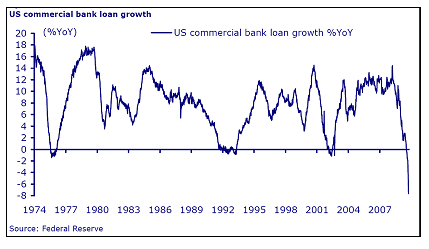
Credit markets are going to have to remain open if the economy is going to have a chance to sustain itself without government support. As Figure 1 below illustrates, commercial banks continue to flee the market. According to David Rosenberg, bank credit has declined for 21 straight weeks and dropped a huge $33 billion during the last week of October. During this 21 week period, $216 billion of bank credit has disappeared, which represents a 15 percent annualized decline. The decline is occurring across all business lines – consumer, real estate and corporate borrowing. In fairness, it does not appear that banks are merely not making credit available – it also appears that borrowers are more reluctant to access loans in view of their concerns about the future prospects of the economy. The Wall Street Journal’s front page article on November 2 entitled “Jittery Companies Stash Cash” discusses this phenomenon. Much of the new borrowing HCM is seeing in the bond market is being used to extend existing maturities, not to enter into new commitments. From the standpoint of minimizing defaults, this is a positive development, but it hardly bodes well for economic growth.
Figure 1
Disappearing Act
At the same time, according to Mr. Rosenberg, the cash on banking sector balance sheets soared by $160 billion during the last week of October to $1.3 trillion. This cash is increasingly being directed to Treasury purchases in a replay of the early 1990s when banks replenished their balance sheets courtesy of an Alan Greenspan-engineered steep yield curve. But we also know that large securities-oriented commercial banks are using their capital to speculate in the financial markets. Courtesy of the Federal Reserve’s zero interest rate policy, these institutions are raking in huge profits and setting aside (or at least attempting to set aside) billions of dollars to compensate their employees. They would be far better advised to reinvest the lion’s share of these profits back in their businesses to bolster their balance sheets since the steps the government has taken to bail out the financial system are undoubtedly going to create future instability.
HCM urges this conservative course of action despite the fact that the nation’s largest banks are wisely building up their cash balances to record levels. The four largest U.S. banks (measured by assets) – Bank of America Corp., JP Morgan Chase, Citigroup, Inc. and Wells Fargo & Co. – had increased their combined liquidity by 67 percent to $1.53 trillion as of September 30, 2009 from $914.2 billion in June 2008. This is equivalent to 21 percent of the banks’ total assets, up from 15 percent. While these are large numbers, they are hardly reason for complacency. The $914.2 billion in June 2008 was insufficient to keep these institutions from teetering on the edge of failure toward the end of 2009, and such a scenario is squarely within the realm of possibility again, particularly in view of their continued massive derivatives exposures and the failure of meaningful derivatives reform.
Accordingly, these institutions should not be permitted to use these large liquidity balances as an excuse to return to the asymmetric compensation policies of the past. The Obama Administration has wisely taken steps through the offices of its so-called “Pay Czar” Kenneth Feinberg to rein in the worst abuses at seven firms that remain wards of the state. Firms that are not subject to the direct oversight of the government, however, should exercise some far sight and understand that their current profitability is, as George Soros suggested, largely attributable to the government’s largesse rather than any brilliance on their part. Accordingly, these firms should use this opportunity to prepare themselves for withdrawal of the stimulus and the difficulties that will follow.
Stimulus withdrawal
The all-important question becomes, then, when the government will begin to withdraw its various stimulus measures. In fact, the government has withdrawn some of the smaller stimulus measures, but the most significant ones remain in place. By far, the most important stimulus measure comes from the Federal Reserve’s zero interest rate policy, which is likely to remain in place for a sustained period of time. In his recent most recent Investment Outlook, PIMCO’s Bill Gross (after waxing poetical about his fears of aging) predicted that the Federal Reserve would have to see 12 to 18 months of 4 percent or higher nominal growth before abandoning the zero percent benchmark.
If Mr. Gross is correct (and we give him far higher marks for his economics than his poetry), prospects for higher interest rates are far in the distance. The odds of the economy sustaining 4 percent nominal growth for a 12 to 18 month period in the current deflationary environment are extremely low in our view. We are aware that Paul Tudor Jones recently predicted that economic growth could peak at 5.5 percent in the first quarter of 2010 before tapering off sharply thereafter, but even this would be a far cry from the sustained 4 percent growth that Mr. Gross believes would be necessary to prompt tightening by the Federal Reserve.4
HCM has maintained that the central bank will not begin to hike rates until 2011 at the earliest. Mr. Gross has a far better hand on the pulse of the Federal Reserve’s thinking than virtually anybody else in the market, so we take his words very seriously. This will come as a disappointment, however, to those who believe that is time that the Federal Reserve begins to implement counter-cyclical policies rather than continue to pursue the pro-cyclical policies that have contributed to the financial mess in which this country finds itself. But political realities dictate against any near-term interest rate increases.
The China bubble
The last time I wrote about China, I found myself on CNBC debating a bullish fund manager who was urging investors to pile into the Shanghai stock market. This is a familiar role for me, although I don’t consider myself to be a particularly lugubrious sort. But once again I found myself in the familiar position of warning investors that the market – in this case, the Chinese equity market – had likely gotten ahead of itself and that they should proceed with caution. I took no pleasure in the fact that the market dropped sharply the next day.
The fact remains that the Chinese government is force-feeding more capital into the economy than the economy can put to productive uses. That is a recipe for a bubble not only in the stock market but in other asset classes. It is not a program for sustainable, organic economic growth. Investors who think otherwise are fooling themselves and are setting themselves up for a fall (again). There is every possibility that the Chinese market will continue to rise in the near-term as the bubble continues to expand. Some very smart people, including our friend Christopher Wood, are recommending Chinese equities on a short-term basis. Longer term, however, Mr. Wood is also anticipating a bubble.
Let’s face it. Much of the world is counting on Chinese growth to sustain a global recovery. They are praying that China can deliver or, to put it more precisely, that the Chinese government can continue to deliver. After all, China’s extraordinary growth is the direct result of a stimulus package that dwarfs those of the U.S. and European countries in size and scope (measured as a percentage of GDP). Chinese economic growth hit +8.9 percent in the third quarter of 2009 thanks to government stimulus and $1.27 trillion in bank lending. But unless the Chinese economy wants to keep stuffing ten pounds of baloney into a five pound bag, this is going to end badly.
Some China watchers, such as Morgan Stanley’s Stephen Roach, also warn that this growth is unsustainable. Mr. Roach warns that “China’s growth model is much more about supply than demand. It’s not a sustainable model for China. It’s not a sustainable model for any nation.”5 The Shanghai stock index swooned earlier this year at the first noises that the government would begin to cut back its stimulus, acknowledging that organic, non-government demand remains muted. Investors should remain cautious. While the Chinese government can continue to pour money into the economy, there need to be productive uses to which the money can be put unless it simply wants to run up a series of bubbles that will further distort both Chinese and global growth.
There are structural reasons that support the argument that China is creating the conditions for a bubble. The link between the U.S. dollar and the Chinese renminbi effectively requires these two countries to pursue similar fiscal and monetary policies despite their completely different economic postures. The U.S. is highly indebted and likely to run deficits far into the future, while China is a creditor country running large surpluses. If China’s currency weren’t linked to the dollar, it would make little sense for the Chinese to be running the same kind of expansionary economic policy as the U.S. This is apparent on its face from the fact that China’s economy simply can’t absorb productively all of the stimulus money that is being forced upon it. As long as the currency link between the two countries is maintained, China will be maintaining far lower interest rates than it should, which will continue to feed bubbles in virtually all asset classes. On the way up, investors may profit. But all bubbles burst, and on the way down investors will be hurt badly. While China will need to allow its currency to appreciate against the dollar, it is unlikely to do so quickly, which will keep in place the conditions for the bubble to blow up until it bursts.
4 Mr. Jones’ prediction was included in his “Third Quarter 2009 Performance Review and Current Market Outlook” dated October 15, 2009, which was widely circulated around Wall Street. We hope he will forgive us for the reference.
5 Bloomberg News, “China Economy May Slow Next Year, Stephen Roach Says,” October 24, 2009.
Why finance matters
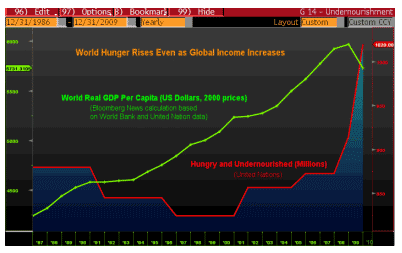
One of the reasons finance matters is because it enables man to feed, clothe and heal his fellow man. Without a viable financial system, it is far more difficult for man to meet these essential needs. A depressing and vivid illustration of this fact is the increasing number of hungry people that are populating the world.
October 15 was World Food Day, but it was hardly a day of celebration. In fact, it should have been declared a national and global day of mourning. After a 20-year decline, world hunger began increasing again in the mid-1990s. Today, there are one billion hungry people on our planet. This is occurring even as per-capital gross domestic product was rising significantly. It is difficult to argue that the world possesses a successful financial system when it is incapable of feeding almost one billion of its inhabitants.
Figure 2 shows these trends but can’t convey the human toll that hunger exacts every day, particularly on the young and infirm. One reason for rising hunger is the decline in government development aid for agriculture, which has fallen by 37 percent on an inflation-adjusted basis since 1988 according to the Food and Agriculture Organization.
Figure 2
World Hunger
As we approach Thanksgiving this year, readers should keep in mind that hunger is just one of the problems that we are failing to tackle and that requires a viable global financial system to address. It is going to be a very difficult holiday season for millions of our fellow Americans as well as hundreds of millions of people around the world. Each of us should give thanks for our own blessings by reaching into our pockets and helping to feed those who need our help.
Michael E. Lewitt
Disclosure Appendix
This publication does not provide individually tailored investment advice. It has been prepared without regard to the circumstances and objectives of those who receive it. This report contains general information only, does not take account of the specific circumstances of any recipient and should not be relied upon as authoritative or taken in substitution for the exercise of judgment by any recipient. Each recipient should consider the appropriateness of any investment decision having regard to his or her own circumstances, the full range of information available and appropriate professional advice. Harch Capital Management, LLC recommends that recipients independently evaluate particular investments and strategies, and encourage them to seek a financial adviser’s advice. Under no circumstances should this publication be construed as a solicitation to buy or sell any security or to participate in any trading or investment strategy, nor should this publication or any part of it form the basis of, or be relied on in connection with, any contract or commitment whatsoever. The value of and income from investments may vary because of changes in interest rates or foreign exchange rates, securities prices or market indexes, operational or financial conditions of companies, geopolitical or other factors. Past performance is not necessarily a guide to future performance. Estimates of future performance are based on assumptions that may not be realized. The information and opinions in this report constitute judgment as of the date of this report, have been compiled and arrived at from sources believed to be reliable and in good faith (but no representation or warranty, express or implied, is made as to their accuracy, completeness or correctness) and are subject to change without notice. Harch Capital Management, LLC and/or its employees, including the author, may have an interest in the companies or securities mentioned herein. Neither Harch Capital Management, LLC nor its employees, including the author, accepts any liability whatsoever for any loss or damage arising from any use of this report or its contents. All data and information and opinions expressed herein are subject to change without notice.
The HCM Market Letter
Michael E. Lewitt, Editor
The HCM Market Letter is published on a monthly basis by The HCM Market Letter, LLC. Offices at One Park Place, 621 NW 53rd Street, Suite 400, Boca Raton, FL, 33487. Telephone (561) 226-6199; Fax (561) 995-4946. Delivery is by electronic mail. Annual subscription rate is $395 for individuals and $995 for institutions. Visit our web site at www.hcmmarketletter.com. Copyright warning and notice: It is a violation of federal copyright law to reproduce or distribute all or part of this publication to anyone (with the exception of individuals within the same institution pursuant to the subscription agreement) by any means, including but not limited to photocopying, printing, faxing, scanning, e-mailing, and Web site posting without first seeking the permission of the publisher. The Copyright Act imposes liability of up to $150,000 per issue for infringement. Information concerning possible copyright infringement will be gratefully received.
Read more articles by Michael Lewitt