In 2007, the British artist Damien Hirst exhibited his sculpture, For the Love of God, a platinum-cast human skull adorned with over one million carats of diamonds. Its asking price, $100 million – more than three times the value of the diamonds – proved to be too steep for buyers.
The occasional diamond-encrusted skull notwithstanding, art has little intrinsic value, Yale finance Professor Will Goetzmann writes in his newly published study, Art and Money. Goetzmann’s study, which he co-authored with Luc Renneboog and Christophe Spaenjers of Tilburg University in the Netherlands, supports the view that art should play a minimal role in an investment portfolio.
Goetzmann’s most significant new contribution is to show that the changes in art prices over long periods of time are mostly explained by changes in income inequality. As income inequality – the percentage of income earned by the top 0.1% of the population – grows, so does the value of art.
For his study, Goetzmann constructed a database of art sales occurring at auctions (mostly Sotheby’s and Christie’s), and examined only repeat sales – where price appreciation could be measured by multiple sales of the same work of art. By calculating the rate of return earned between repeat sales, he constructed a unique database of art prices over time.
The key findings of the study are shown in this figure, which depicts art prices, total income, and income inequality, all adjusted for inflation:
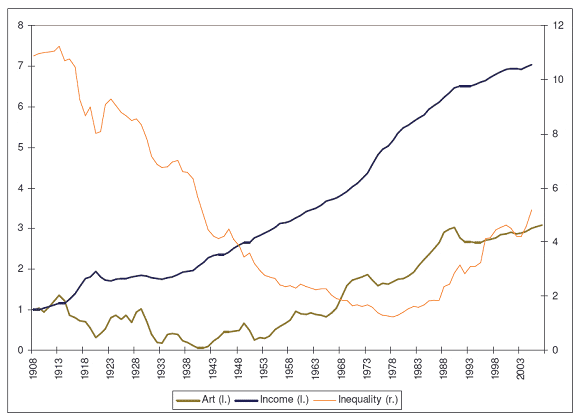
Art prices were relatively stable through most of the 20th century and did not begin to rise until the late 1960s. Total income grew almost fourfold over this period. Income inequality, however, decreased enormously during the first half of the 20th century, depressing art prices.
Conversely, the art booms at the end of the 1980s and from 2002-2007 coincided with sharp increases in income inequality.
Goetzmann has studied the art market for the last 20 years, and he told me that he is “skeptical” about the investment value of art and other collectibles.
The most important question for an investor, Goetzmann told me, is whether art is an effective hedge against distress in the financial markets – whether art increases in value in times of equity market decline, similar to the role commodities play. Goetzmann does not believe this is the case, and instead claims art prices are completely driven by demand and supply in the art market. When collectors have more money, he said, they demand more art.
This research lends important support his claim.
“The bottom line of the paper,” Goetzmann said, “is that when the rich get richer art prices go up.”
Don’t buy art as a diversifier, Goetzmann advises, because when markets go down, art is likely to go down as well, as demand diminishes from the ultra-wealthy. “The last thing those people will want to do in those times is to think about buying a $5 million painting,” he said.










