Advisor Perspectives welcomes guest contributions. The views presented here do not necessarily represent those of Advisor Perspectives.
It is axiomatic that investors in government bonds expect to earn a return in excess of inflation. Why invest in a bond if it does not increase the purchasing power of one’s capital? Hence, the current yield to maturity of a bond includes an expected real return element and a component for expected inflation1. Since 1926, long-term U.S. government bonds have had an annualized return of 5.6% comprised of a real return of 2.6% and an inflation component of 3.0%.
As yields plunge ever lower, the bond market appears to be anticipating a protracted period of low inflation. Fears of outright deflation have escalated as the economic recovery slows swelling the burgeoning legion of bond purchasers and further depressing yields. In turn, lower yields reinforce the notion that future inflation rates will themselves be lower. This self-reinforcing cycle, however, begs the question – how successful has the bond market been in forecasting future inflation rates?
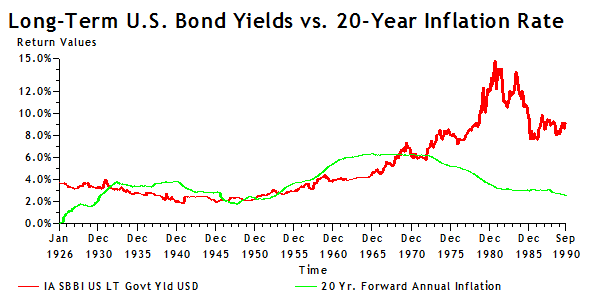
The answer is “not very”. As illustrated in the following graph, long-term government yields (in red) have almost consistently misestimated the subsequent long-term inflation rate (in green). During the late 1920s and the mid-1970s to 1990, the bond market chronically overestimated future inflation. This is evidenced by the fact that long-term bond yields were substantially in excess of the following 20-year inflation.

1. The yield of bond actually incorporates four elements: 1) a real return component for deferring consumption and assuming the risk of investment; b) an expected inflation premium; 3) an inflation uncertainty premium for the risk of changing inflation rates; and 4) a term premium for the risk of extending the investment horizon. For simplicity sake, I have combined the real return and term premia into a single real return element and the expected inflation and inflation uncertainty premium into an expected inflation component.
Conversely, from the early 1930s until the early 1970s, the bond market nearly always under-estimated subsequent inflation. In general, long-term bond yields were below the subsequent long-term inflation rate. Overall, the correlation between long-term bond yields and the subsequent long-term inflation was a negligible 0.20.
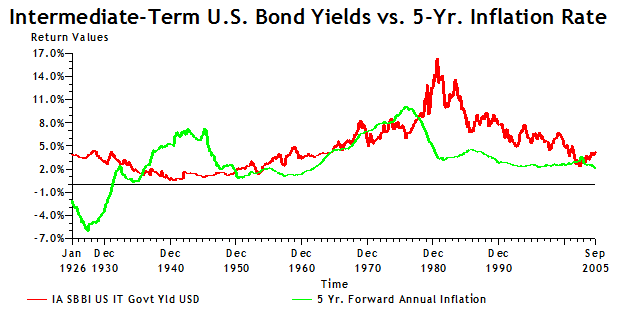
Mid-term bond yields also did a poor job of anticipating future inflation. The following graph illustrates how intermediate-term government yields (in red) failed to anticipate the subsequent five-year inflation rate (in green). As can be seen, intermediate-term bond yields tended to be either too high relative to the subsequent realized inflation rates (as occurred in the late 1920s and the late 1970s through to mid-2000s) or too low (as occurred in the late 1930s and 1940s and the 1970s).
The correlation between intermediate-term bond yields and the subsequent five-year inflation rate was a weak 0.27.
The bond market does a poor job of estimating future inflation rates over the mid- to long-term. Hence, investors should have little comfort that today’s low yields properly anticipate future inflation over longer time frames or properly compensate them for the risk of potentially higher inflation further down the road.
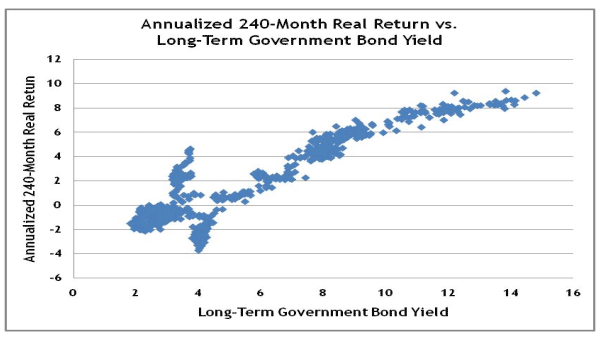
In fact, historically, low bond yields have not provided investors with sufficient reward for the risk of unexpected higher inflation. This is illustrated in the following graph which compares the monthly long-term bond yields from January 1926 to September 1990 to the annualized real (i.e. inflation adjusted) return actually earned in long-term bonds over the subsequent 20 years.
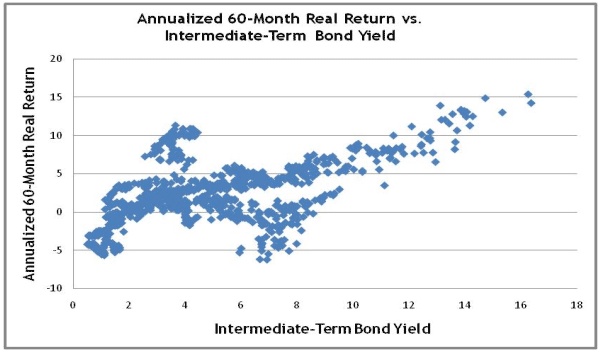
Low long-term government bond yields such as the 3.4% yield today have typically resulted in either low or negative real returns for long-term bondholders. The only exception was the mid-1920s when bond investors benefited from falling prices in the late 1920s and early 1930s as well as wartime price controls. Very low intermediate-term bond yields such as the 1.3% yield today have also resulted in either low or negative real returns over the subsequent five years (see Appendix I).
At today’s low yields, government bond investors are banking on a future of protracted low inflation or even outright deflation. They need to understand that, like Mr. Magoo, the bond market really doesn’t see clearly at a distance. Hence, although low inflation is the likely scenario over the several years, beyond that, the bond market has limited insight into mid to long-term inflation.
And the market is akin to Mr. Magoo in another respect. With yields so low today, it will also be prone to some nasty accidents in the future.
Appendix I
Source: Data from Morningstar Ibbotson covering the period January 1926 to September 2005; calculations by Tacita Capital. 60-month real return is the actual annualized inflation-adjusted return on intermediate-term bonds compared to the bond yield in month one.
Tacita Capital Inc. is based in Toronto, Canada and is a private, independent family office and investment counseling firm that specializes in providing integrated wealth advisory and portfolio management services to families of affluence. We understand the challenges of affluence and apply the leading research and best practices of top financial academics and industry practitioners in assisting our clients to reach their goals.
Read more articles by Michael Nairne