The following is in response to a letter to the Editor which appeared last week. That letter was in response to John Hussman’s commentary, Sixteen Cents: Pushing the Unstable Limits of Monetary Policy, which appeared on January 24.
Dear Editor,
It is correct that the fit between money demand and short-term interest rates is not well captured by a single variable equation (the log of the T-bill yield) at very high interest rates. What is striking, however, is the apparent notion that all concerns about monetary policy here can be summarily disregarded – not as a consequence of competing evidence, economic theory, or thoughtful rebuttal, but merely by the ability to draw a curve.
My “Sixteen Cents” commentary did use a single-variable equation in order to somewhat simplify what was already a complex discussion, but the commentary also included a more robust fit using lagged values of liquidity preference, which has a 96% R-squared with the observed data (note that two-variable fits typically do not plot as smooth lines when graphed against only one of the variables).
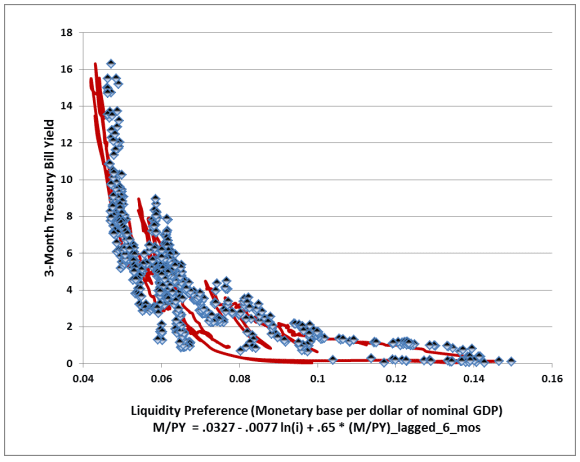
You can quickly calculate the “steady state” of the above relationship by treating M/PY as a constant, which gives you M/PY = 0.0934 – 0.022 ln(i), which is essentially the single-variable equation I presented in my commentary.
Of course, it is also possible to improve the fit at high interest rates by adding a quadratic term with an infinitesimal regression coefficient. I chose not to do this because the quadratic term would begin to exert excessively large effects if interest rates were to increase beyond the highest levels observed in the post-war period. Also, the theoretical basis for that sort of term is not clear. But for the chart below, I’ve added a quadratic factor to better improve the fit (not that it changes the analysis any).
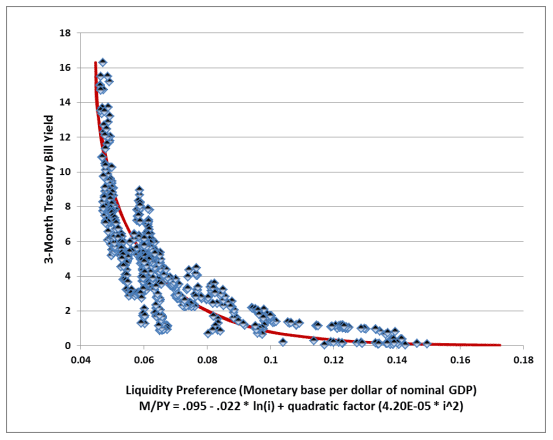
However one wishes to estimate the relationship, it is clear that the amount of cash that individuals hold here is highly sensitive on the requirement that short-term interest rates remain low indefinitely. Notice, for example, that individuals, banks and corporations in the U.S. economy have never demonstrated a willingness to hold more than 10 cents of monetary base per dollar of GDP when Treasury bill rates have been higher than even 2%. A reduced willingness to hold base money would inevitably force a change in the value of base money relative to goods and services, which is what we normally describe as “inflation.” The argument hardly revolves around the precision of the fit at low interest rates.
In short, nothing in the objection provides a basis to alter the conclusions of our analysis, or our significant concerns about the present course of monetary policy. But least now the charts might look more satisfying to the eye.
Sincerely,
John P. Hussman, Ph.D.
President
Hussman Investment Trust













