Advisor Perspectives welcomes guest contributions. The views presented here do not necessarily represent those of Advisor Perspectives.
 This essay is excerpted from a recent version of The Credit Strategist (formerly the HCM Market Letter). To obtain the complete issue, you must subscribe directly to this publication; Please go here. The Credit Strategist is on Twitter - @credstrategist
“The cumulative accretion of knowledge by specialists that allows us each to consume more and more different things by each producing fewer and fewer is, I submit, the central story of humanity. Innovation changes the world but only because it aids the elaboration of the division of labor and encourages the division of time. Forget wars, religions, famines and poems for the moment. This is history’s greatest theme: the metastasis of exchange, specialization and the invention they have called forth, the ‘creation’ of time. The rational optimist invites you to stand back and look at your species differently, to see the grand enterprise of humanity that has progressed – with frequent setbacks - for 100,000 years. And then, when you have seen that, consider whether that enterprise is finished or if, as the optimist claims, it still has centuries and millennia to run. If, in fact, it might be about to accelerate to an unprecedented rate.”
Matt Ridley1
August was the cruelest month, breeding losses out of the dead land of a weakening global economy. Stock markets suffered horrific losses: through August 26, the S&P 500 dropped by 9 percent while Germany’s DAX index dropped by 22.45 percent. Few other bourses in the world escaped without similar damage. Virtually every economic release revealed a slowing economy at risk of falling back into recession. Every major Wall Street firm sharply lowered its GDP estimates for the third and fourth quarters of 2011. The mood on Wall Street was somewhere between gloomy and desperate as computer-driven trading drove the markets to schizophrenic highs and lows. Moreover, the realization that many of the rallies and crashes that occurred during the month were driven by machines was at least as troubling as the decidedly downward direction of the market. There can be little question that investors are losing faith in the ability of the market to be a stable arbiter of values in the face of price swings that bear little relationship to company or economic fundamentals. This type of market action is decidedly hostile to capital formation and economic growth. The failure of regulators to address this issue is inflicting needless harm on both the markets and the economy.2
August’s threats weren’t limited to the manmade. Mother Nature also got into the act, inflicting a one-two punch on the East Coast of the United States - an earthquake and a hurricane. For those investors (usually quants) who like to explain away their losses by blaming them on 10th standard deviation events, here was a true statistical anomaly. TCS does not know whether any region in the modern era has ever been hit by both an earthquake and a hurricane in the same week, but the odds of such a combination have to be extremely low. TCS is waiting for the string of hedge funds trying to attribute their horrible August performance to these Acts of God.
I have recently been reading a book that I strongly recommend, Matt Ridley’s The Rational Optimist. Long-time readers may be surprised to see TCS recommend a book that finds the silver lining behind every cloud, but Mr. Ridley makes a compelling case that man’s fate lies largely in his own hands and that the collective efforts of mankind can conquer even the most severe challenges. He makes a compelling case that despite our current problems, the quality of human life today – even for the least privileged among us – is far superior to that of earlier generations. This, he believes, is the direct result of collaboration and innovation, two forces that heavily influence historical change. Moreover, Mr. Ridley views these processes as moral imperatives: “It is precisely because so much human betterment has been shown to be possible in recent centuries that the continuing imperfection of the world places a moral duty on humanity to allow economic evolution to continue. To prevent change, innovation and growth is to stand in the way of potential compassion.”3 In other words, we have a moral obligation to make the world a better place, and the most effective way to do that is by encouraging collaboration and innovation.
1. Matt Ridley, The Rational Optimist: How Prosperity Evolves (New York: Harper Perennial, 2011), p. 46.
2. About the only good news during the month was that the U.S. Congress was on vacation, rendering it impotent to inflict further manmade damage on the world.
3. Ridley, p. 28.
This argument is closely related to the one I made in The Death of Capital, where I contended that too much intellectual and financial capital has been devoted to speculation over recent years. Mr. Ridley writes that “[i]f…somebody takes out a loan just to support his luxury lifestyle or to speculate on asset markets…, then posterity will be the loser. That is what, it is now clear, far too many people and businesses did in the 2000s – they borrowed more from posterity than their innovation rate would support. They misallocated the resources to unproductive ends. Most past bursts of human prosperity have come to naught because they allocated too little money to innovation and too much to asset price inflation or to war, corruption, luxury and theft.”4 These words hit the proverbial nail on the head. The misallocation of capital in today’s economy is a severe threat to future prosperity and perhaps survival itself. Moreover, it is immoral because it deprives society of the productive investments that could improve the quality of human life for everybody, not just the elite.
There are still billions of people in the world who live below the poverty line and struggle to feed themselves and their children every day. In the United States alone, there are millions of people in the same situation. Record numbers of people are unemployed and dependent on food assistance. While our current economic discourse makes bold pronouncements about the urgent need to remedy the tragedy of unemployment, most policy prescriptions address the symptoms but not the underlying disease. That disease is the squandering of trillions of dollars of financial and intellectual capital on unproductive economic activities (and by “unproductive” I mean activities that do not enhance the productive capacity of the economy).
Politicians give plenty of lip service to the importance of providing the resources to promote innovation and productivity, but do little or nothing to alter the underlying policies that lead to precisely the opposite. Political and economic debates are framed in overly simplistic terms and based on discredited ideas. Thinkers like Adam Smith and business leaders such as Steve Jobs can lead the way if we open our eyes to their words and deeds. As Mr. Ridley writes, “[s]o long as somebody allocates sufficient capital to innovation, then the credit crunch will not in the long run prevent the relentless upward march of human living standards…so long as somewhere somebody is incentivized to invent ways of serving others’ needs better, then the rational optimist must conclude that the betterment of human lives will eventually resume.”5 The problem, as I have argued repeatedly in recent years, is that the U.S. economy is operating under a corrupt system of incentives that reward speculation and borrowing at the expense of innovation, solid financial foundations, and life-enhancing investments. That is why despite the lessons of history, I look around at our current state and struggle to find rational evidence that things will get better. But because I have faith in history and in mankind’s endurance, and because I study the examples set by the rare leaders and thinkers who have changed the world for the better, I choose to be an irrational optimist. If we depend on hope, we can still live by faith. We owe that to ourselves and to each other.
The economy
With all due respect to Mr. Ridley, it would require an irrational optimist to view the current state of economic and political affairs positively. An objective view of what we know – and what we can know – about the economy in both the United States and particularly in Europe leads to concerns that not only blow away hope but question our faith.
4. Ridley, p. 30. Emphasis added.
5. Ridley, 31-2.
United States
There are several reasons why U.S. economic growth remains so weak. The short answer is that this is what a balance sheet recession feels like. The U.S. economy never truly recovered from the 2008 financial crisis. Instead, the government – left with little choice – aggressively addressed short-term liquidity problems with Herculean Keynesian programs that were doomed to fail as a result of the massive excess capacity that weigh down the economy. Much of this capacity was financed with debt. As a result, the debt crisis and the overcapacity problem are linked. The Federal Reserve’s policy of sustaining interest rates at extremely low rates through the early and mid-2000s permitted the accumulation of too much debt and too much stuff built or purchased with borrowed money. And by responding to the 2008 crisis with the infusion of more debt-financed liquidity into the system, the Federal Reserve exacerbated the problem in the long-run. The Federal Reserve had few good policy options. While one can criticize the central bank (as TCS has) for sustaining low rates far longer than necessary, it probably had little choice since the concept of organic economic growth has proven to be a myth. Without this stimulus, the economy could have collapsed into a depression. Whatever recovery there has been from the last recession, however, was almost entirely fueled by government stimulus; had that stimulus been withdrawn earlier, the economy would likely have weakened sooner. And without question the economy would have run out of gas by now, since the post-crisis rebound in corporate spending has run its course and been replaced with a massive consumer and business paradox of thrift. However you slice it, the condition of slow growth was inevitable once the bubble burst in 2008.
This is one of the lessons of the work done by Carmen M. Reinhart and Kenneth S. Rogoff in their indispensable book, This Time Is Different: Eight Centuries of Financial Folly. Indeed, Professors Reinhart and Rogoff were describing the precise situation in which the United States finds itself when they wrote the following words on the first page of their book:
“[E]xcessive debt accumulation, whether it be by the government, banks, corporations, or consumers, often poses greater systemic risks than it seems during a boom. Infusions of cash can make a government look like it is providing greater growth to its economy than it really is. Private sector borrowing binges can inflate housing and stock prices far beyond their long-run sustainable levels, and make banks seem more stable and profitable than they really are. Such large-scale debt buildups pose risks because they make an economy vulnerable to crises of confidence, particularly when debt is short term and needs to be constantly refinanced. Debt-fueled booms all too often provide false affirmation of a government’s policies, a financial institution’s ability to make outsized profits, or a country’s standard of living. Most of these booms end badly.”6
The U.S. is currently in the early part of the “ends badly” phase. As the good professors write, “[Our] view of the way into a crisis is sobering; we show that the way out can be quite perilous as well. The aftermath of systemic banking crises involves a protracted and pronounced contraction in economic activity and puts significant strains on government resources.”7 The U.S. economy couldn’t be following the script any more literally. As this is being written, the economy is slowing and the federal budget is bursting at the seams.
The economic data describes a human tragedy. While there are occasional tidbits of good news that are pounced on by the media, overall trends are profoundly negative.8 About 44 percent of the unemployed have been job hunting for more than six months without success. More than 40 million households (including a depressing number of children) depend on food stamps. The personal consumption and housing component of the Chicago Fed National Activity Index (representing 75 percent of the economy) has been stuck below zero for 55 consecutive months. Housing data points to nothing less than a depression. Fifteen million homeowners have negative equity in their homes, according to The New York Times, with almost half more than 30 percent under water. Year-to-date 2011 home sales are down by a 17 percent annual rate; new home sales dropped at an 11 percent annual rate in June; resale prices are down 4-5 percent over the past year. Mortgage applications for new purchases have dropped by a 25 percent annual rate to levels last seen in the mid-1990s. Six million homeowners have already lost their homes, and another 3.5 million are caught in one stage or another of the foreclosure process. The much-watched Case-Shiller 20 city index has fallen in 11 of the past 12 months. However you try to dress it up, there is no way to put lipstick on this pig. TCS remains astounded whenever the media or commentators tout higher housing starts as a positive phenomenon. The landscape is scarred with millions of empty homes. There should be a moratorium on new housing starts; any construction job losses would be more than compensated for by accelerating a housing recovery.
6. Carmen M. Reinhart & Kenneth S. Rogoff, This Time Is Different: Eight Centuries of Financial Folly (Princeton, N.J.; Princeton University Press, 2010), p. xxv.
7. Reinhart & Rogoff, p. xxix.
8. We do not include in the parade of depressing statistics the appointment of another member of the Princeton University Economics Department to lead the Council of Economic Advisors, but at some point it would be nice to see some new blood. This appointment does nothing to alter our low expectations for the President’s Sept. 5 speech on the economy.
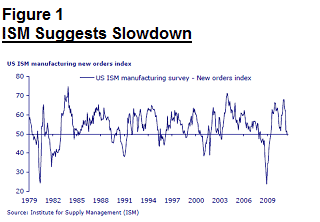
Outside of housing, conditions are scarcely better. While first half 2011 GDP growth was anemic, it appears to have taken a nosedive in late July and August. Among the most troubling signs of economic infirmity is the recent slowing in manufacturing activity. Second quarter 2011 real private investment rose by 5.7 percent, down from 8.7 percent in the first quarter and 23.2 percent in 2Q10. This was the lowest increase since 2Q09. The July ISM survey fell by 4.4 percent to a two-year low of 50.9 percent (see Figure 1 above). The most troubling part of this survey was the drop in new orders to 49.2 percent in July, the lowest level in more than two years and the first time this figure has been below 50 since June 2009. In other words, economic growth appears to have returned to the levels of the last recession (if one can even say that the last recession really ended).
While many profess to be surprised by the weak economic numbers, it is not news to those of us who believe that the U.S. is caught in a balance-sheet recession rather than a business cycle slowdown. In a balance sheet recession, businesses and consumers pull in their horns, so to speak, with respect to spending and hiring. As a result, while they are repairing their own balance sheets, their collective action leads to slower economic growth. If this were a business cycle recession caused by cyclical rather than structural forces, the economy would be growing at a much healthier rate. The reason this is not occurring is because huge debt at both the public and private level is weighing down the economy both literally and psychologically. On a literal basis, businesses and consumers are devoting their capital to servicing or reducing their debt burdens rather than new spending. On a psychological level, high levels of debt are reducing confidence for a number of reasons, including the difficulty many individual have had borrowing or refinancing (although conditions are supposedly easing). The debt-ceiling crisis may have been the straw that broke the camel’s back in this respect, highlighting the fact that the U.S. is living far beyond its means and appears unable to stop its spendthrift ways. TCS’s belief in the balance-sheet recession scenario is why we have been relatively cautious since the 2008 crisis. For us, the question was always when – not if - the U.S. would have to start paying the piper. It appears that time has come.
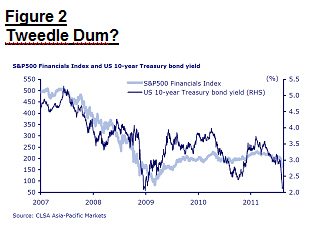
Recent market moves support a bearish view. The correlation between the S&P Financials Index and the 10-year U.S. Treasury yield is uncannily strong at 0.86. Important parts of both the equity and debt markets are pointing to further slowing.
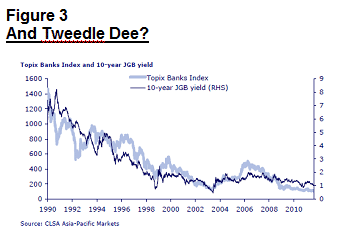
For those readers worried about the U.S. following the slow-growth example of Japan, this correlation will not ease your concerns. As our friend Chris Wood (who continues to forgive me for borrowing so many of his wonderful graphs and charts) suggests, Japan has experienced a virtually identical correlation between Japanese Bank Stocks and government debt market in recent years (actually it is slightly higher at 0.89).
Mr. Wood points out the importance of the relationship between 10-year government bond yields and financial stock prices. As he explains, “[t]he only bedrock of valuation for a stock in a deflationary world is where the dividend yield is comfortably above the 10-year government yield.”9 In view of the fact that a large number of S&P 500 stocks pay a dividend higher than the 10-year Treasury yield, this is a relationship worth paying attention to. With U.S. interest rates almost certain to remain low through 2013, investors are going to be forced into dividend-paying stocks to earn any yield at all. (Bonds are basically a bust and should be avoided). The close correlation between financial stocks and Treasury yields suggests, however, that investors should look in sectors other than financials if they want to earn a yield and protect their capital.
Concerns about economic growth are writ large in the corporate credit markets. August saw the worst performance for high yield bonds since the financial crisis with losses of more than 5 percent. The spread on the Barclays Capital High Yield Index has blown out by almost 200 basis points since the beginning of August, from 587 basis points to 760-770 basis points today. Some bonds have seen double digit price drops, such as those of Caesars Entertainment Corp. (formerly Harrah’s Entertainment). This has occurred with a default rate of only 2 percent in June; imagine what will happen if defaults rise significantly (which TCS does not expect to occur imminently).
Even more startling than high yield performance is the sharp drop in the prices of leveraged loans. Readers should note that until the 2008 financial crisis, bank loans generally never dropped in price below the high 90s (including during the 1998 and 2001-2 credit crises). But as of August 24, the S&P/LSTA Leveraged Loan 100 Index (which tracks the 100 largest dollar-denominated first lien loans) had fallen to 88.06 percent after dropping 6.3 percent during the month. This was the worst monthly drop since a 9.6 percent collapse in November 2008. There was obviously no such dramatic change in the underlying fundamentals of the borrowers in this index. The price drop was part-and-parcel of the wholesale flight from risk that hit all financial markets. But bank loans are different. When they dropped to an average price of 65-or-so during the financial crisis, they offered great bargains. That is likely the case today. Very few of the 100 loans in the S&P/LSTA Index are likely to default in the foreseeable future since many borrowers were able to refinance and/or extend their loans beginning in late 2009, 2010, and early 2011. Moreover, as the senior-most securities in the borrowers’ capital, these loans are likely to enjoy full recoveries in the event of a default. The fact that these loans have traded down so sharply illustrates just how fearful investors are today.10 In this case, however, fear is creating opportunity.
To read the complete essay, you must subscribe to The Credit Strategist.
9. Christopher Wood, GREED & fear, August 11, 2011.
10. It is also likely a reflection of hedge fund liquidations, since hedge funds like to borrow money to purchase these loans. It is highly unlikely that John Paulson was the only hedge fund manager getting his head handed to him in August.
Read more articles by Michael Lewitt