The Power of Dividends ? And What They Say About Future Returns
Membership required
Membership is now required to use this feature. To learn more:
View Membership BenefitsAdvisor Perspectives welcomes guest contributions. The views presented here do not necessarily represent those of Advisor Perspectives. The views of this article represent those of the author and do not necessarily represent the views of Capital Advisors, Inc.
The return on equities is driven by dividends, since companies must ultimately distribute their hard-earned cash to shareholders. Given that reality, recent history of dividend yields portends a disappointing future for US equity investors, one of sub-par returns relative to historical averages.
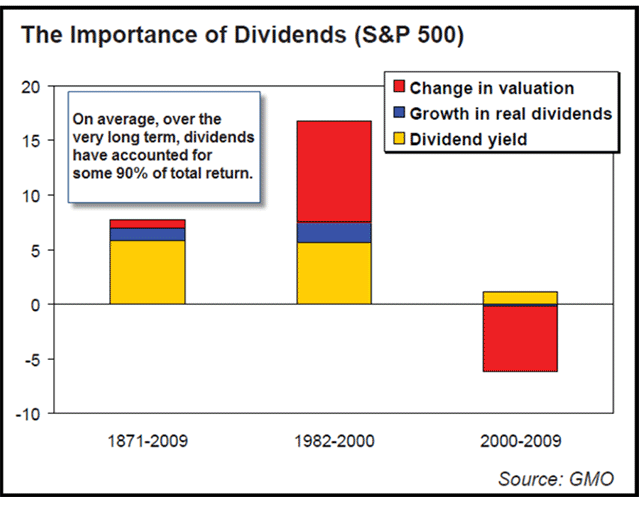
A recent Wall Street Journal article noted that stock returns don’t typically consist of “exciting price gains with dinky dividends tacked on.” Over the 80-year period ending in September 2010, dividends contributed 44% of S&P 500 returns, despite a stretch during the 1980s and 1990s when valuations bloated and dividend yields shrank.
That is all true, but it actually understates the importance of dividends. Over the long term, dividends have constituted more than 80% of the real return (above inflation), and they were more than 100% of the real return during the 1970s. James Montier provided these charts to illustrate:
The next chart averages all one-year returns in the US since 1871:
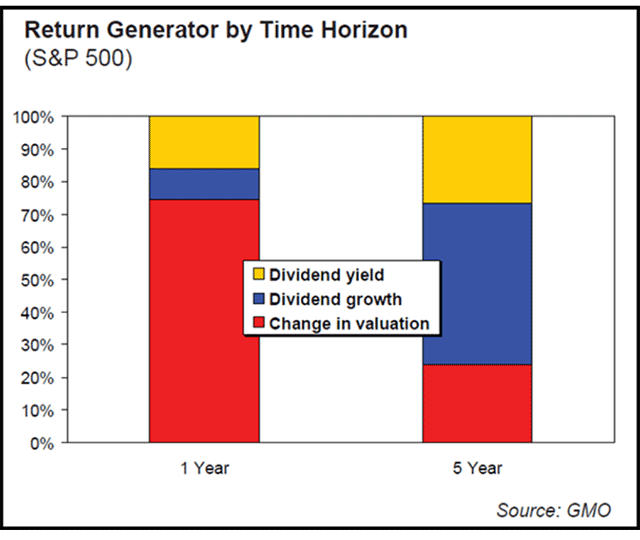
This is as it should be. Investors often talk as if dividends don't matter as long as they get capital appreciation, but that view is extremely short-sighted.
Certainly we want fast-growing companies to reinvest their earnings at high rates-of-return. The bar should be high, however, since management and analysts are often overoptimistic about companies’ ability to generate the earnings they predict. More fundamentally, the point of owning stocks is ultimately to receive dividends.
Casual readers might reply that people have made fortunes investing in companies that do not pay dividends, but they would be missing the point. Why do they make a fortune? Why do investors (at least over time) reward growing companies with a higher stock price? If it is just because earnings are going up, we have to ask the question, "How does that help the investor?" They receive no cash from that growth. Is it just a game? We all just sit around bidding up companies that grow even though we see no direct benefit? Are we all just making side bets, hoping subsequent investors will bid up the price of the stock? Investors often think and act that way, and the market becomes divorced from dividends, free cash flow, or any tangible benefit for the investor. That leads to bubbles and busts and investor losses.
Things should not be that way though. There are only two reasons why a company should not distribute its earnings:
- Because some of those earnings are needed for ongoing operations. All companies need to maintain and replace existing equipment and other assets.
- Because we want them to grow (and accrete their book value) to be able to pay a larger dividend in the future. Warren Buffett's Berkshire Hathaway is an example of a company that has focused entirely on that metric, since Buffett still believes Berkshire can earn a high enough return on retained earnings to justify doing so.
The second reason is the key. If a company can retain a dollar and reinvest it to grow future income at a rate of, say, 15% per annum, it would make more sense for them to do so than give the dollar to us. That said, investors need cash at times, and they can sell shares (which appreciate due to growth). Without the promise that at some point in the future a dividend will be paid, owning stocks would be no better than betting on horses. Prices would not go up!
Wonderfully, over time the return investors earn equates to the dividends distributed, as the charts above illustrate. The market does get out of whack from time to time, but it eventually corrects those discrepancies, which is what the awful returns of the last 11 years have been all about. JJ Abodeeley calls it The Value Restoration Project. We call it a secular bear.
Here is a July 2011 chart from Doug Short that shows just how correlated dividends and growth are over time:
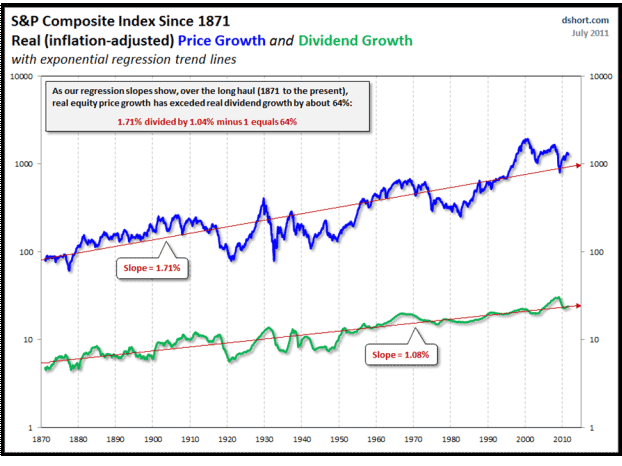
This chart shows the trend growth in both the real (after-inflation) price of stocks and the real growth of dividends. Trend-real growth in earnings has been approximately 1.5%, between the slopes of the two lines above.
Trend growth in the S&P index has been 1.7% a year, which is far lower than people realize. The rest of the return from stocks has been inflation and dividends, as discussed earlier. Growth has been a minor component.
Stock returns are driven by the dividend yield, the growth in real earnings, inflation and a rise in P/E ratios. One could argue for real dividends as a better guide than reported earnings, but over time those should even out. There is nothing else. If someone argues for higher returns than implied by estimating each of those numbers, they are wrong. If they argue for faster growth than the 1-2% above inflation mentioned above, they are saying things will be much better than they have been in the past. Maybe so, but it is certainly unlikely.
Since 1982, the gap has grown between price and dividend growth in the graph above, as evidenced by the price growth being above its trend line. In all fairness, some of this is because dividend payouts have shrunk, and that may mean we can expect larger payouts in the future. Some of the divergence is because prices, since 1982, have gone way too high. This gap will likely shrink as payouts from stocks increase and prices come down.
Wall Street has been busy disguising the lack of cash actually returned to investors by getting us to focus on forward operating earnings. How has that worked out? John Hussman shows us:
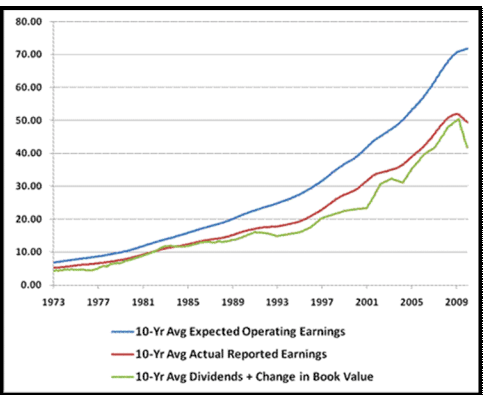
Hussman noted that reported earnings for the S&P 500 have averaged a mere 72% of analysts’ one-year forward estimates. Dividends and increases in book value together have averaged just 60% of those estimates, representing only 84% of earnings reported to investors. “The remaining portion of ‘earnings’ reported to investors goes the way of the Dodo,” Hussman wrote.
Since dividends have been given short shrift in recent decades, it would be wrong to say that stocks were as overvalued in July as the 64% gap between the growth in real price and real dividends would lead one to believe (since, with the market price well above trend, the overvaluation would have been a lot more that 64% without that caveat).
Using the normal assumption that growth will be 1-2% above inflation plus dividends (about 2.12% today), however, stocks are priced to deliver over the long-term only about 3-4% above inflation.
Not exactly inspiring.
Throw in about 0.5% to account for low payout today (assuming the retained earnings are not squandered – a big if), then we get 3.5% to 4.5% above inflation. If we set fair value at a projected return of 6% above inflation, stocks would need to fall by about 58% at a 1% real-growth rate and 25% assuming a 2% real growth rate.
A 2% growth rate is not only above long-term averages, it is also unlikely, since we are already at peak profit margins. From peak profit margins, long-term real growth rates have generally averaged between 0% and 1%. Because companies are loath to cut dividends, barring a major financial crisis we should expect the floor to be closer to 1% on dividend growth (that rate might be higher as payouts increase), though earnings would likely be much more volatile.
As the Wall Street Journal article I cited at the outset pointed out, there are reasons to believe broad-market returns will be less than they were historically. The Journal cited a study by Bradford Cornell, a finance professor at the California Institute of Technology, who argues that stock returns are tied to economic growth, which is “necessarily slowing around the developed world.” Investors, Bradford warned, should count on dividends plus 1% in inflation-adjusted growth.
The connection between the growth in earnings and dividends we have been discussing and long-term economic growth is exactly why Cornell's paper is important. Growth will be lower than we think and not nearly as important as dividends in explaining your long-term return.
What about stock buybacks? While they are a way for companies to return cash to shareholders, their worth is highly exaggerated, and they are not equal on a dollar-for-dollar basis to dividends.
What buybacks don't do is increase the value of the S&P 500 as a whole.First, the index is already adjusted for share buybacks. So adding them into the index numbers to assume a higher return is double-counting. Second, the value of share buybacks is they reduce the share count, meaning each individual share can receive more of the dividend, even if delivered far in the future.
If dividends are low, then returns will be low once speculative mania has reversed. The positive side of that is negative overreaction will eventually arrive, and stocks will be yielding 4-6% at some point, usually because of financial disorder or inflation. When that happens, long-term real returns can be far above 6% (such as in 1982 or 1974).
At that point the Value Restoration Project and the secular bear market will be finished. Then we can actually be long-term investors in the US stock market and not speculators hoping for historically unusual outcomes to bail us out.
Lance Paddock is CEO of Thompson Creek Wealth Advisors, a Louisiana-based Registered Investment Advisor.
Membership required
Membership is now required to use this feature. To learn more:
View Membership BenefitsSponsored Content
Upcoming Virtual Events View All










