Advisor Perspectives welcomes guest contributions. The views presented here do not necessarily represent those of Advisor Perspectives.
Investors can be excused for their preoccupation with short-term Investment results. Amidst a cascade of dismal economic news, the trauma of a precipitous fall in stock prices and the overhang of a decade-long drought in equity returns, the idea of “taking a long-term view”, to many, seems hopelessly pollyannaish. Yet, long-term planning has never been more essential. Aging “Baby Boomers” today are grappling with retirement funding challenges that span multiple decades at a juncture where interest rates are at dismally low levels not seen since World War II.
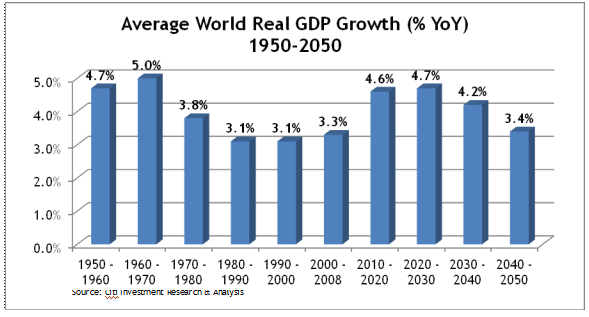
Fortunately, just as the excessive optimism of the tech boom was so misguided at the turn of the millennium, the excessive pessimism of today’s “new normal” may be similarly misplaced. According to a comprehensive report by Citi Investment Research and Analysis1 (CIRA), global GDP growth over the next several decades is likely to enjoy a pace not seen since the post WWII reconstruction and growth boom of the 1950’s and 1960’s. This faster growth is illustrated in the following graph which compares the annual average world real GDP growth for the decades since 1950 with CIRA’s forecasts for the coming four decades.

The 4.6% and 4.7% annual real GDP projections for this and the next decade, respectively, harken back to the 4.7% and 5.0% growth rates after WWII.
1. Willem Buiter and Ebrahim Rahbari, “Global Growth Generators: Moving beyond ‘Emerging Markets’’ and ‘BRIC’”, Citi Global Economics View, February 21, 2011.
Capital investment, technological imitation, institutional development, human capital availability and industrialization were the key factors in the post WWII boom. Notwithstanding the strong real annual GDP growth rate of 3.9% in the US from 1950 to 1973, it was the 9.3% and 5.5% respective annual growth rates2 of Japan and the European Union-15 that really lifted world GDP growth.
These same fundamental drivers of growth are at work again in the emerging economies and this is expected to replicate the brisk global growth achieved after WWII. In particular, CIRA forecasts that developing Asia will continue its ascent in the world economy. Developing Asia grew from 14% of real world GDP in 1990 to 27% in 2010 – a nearly doubling of its share of global GDP - and is forecast to reach 44% of real world GDP by 2030.
The CIRA is not alone in projecting more robust long-term global growth. The Conference Board Global Economic Outlook 20113 has forecast a 4.4% real annual growth in world GDP over the next decade while Goldman Sachs4 has projected a 4.1% real annual growth rate over the next twenty years. In general, the developed nations are forecast to expand at a tepid pace while emerging markets grow robustly. As emerging economies become a bigger share of the world economy, their faster growth accelerates total world GDP growth.
Long-term GDP growth is ultimately a key determinant in the growth in corporate earnings which, in turn, drive stock price appreciation and dividend increases (See our commentary – The Real Deal). For example, during the period 1991 to 2010 when the world real GDP grew by a more moderate 3.2% per annum, the real price appreciation of the MSCI All Country World Index5 was similar at 2.9% per annum. Hence, an increased real annual growth rate for the global economy of 1.0% to 1.5% per annum in coming decades would, all other things being equal, enhance real capital appreciation by an equivalent amount.
2. Bart van Ark, Mary O’Mahony, and Marcel P. Timmer, “The Productivity Gap between Europe and the United States: Trends and Causes”, Journal of Economic Perspectives, Volume 22, Number 1, Winter 2008, Pages 25–44 and Satoshi Koibuchi, 2010, “Lessons from Japan’s 30 Years”, Future Direction of Financial Liberalization in India, New Delhi, India
3. Available at http://www.conference-board.org/data/globaloutlook.cfm
4. Timothy Moe, Caesar Masaary and Richard Tang, “EM Equity in Two Decades: A Changing Landscape”, Goldman Sachs Global Economics Paper No:24, September 8, 2010.
5. In US$. The conversion to US$ has no material impact as local and U.S. returns are virtually equal over the 20 year period. Also, global stock valuations were virtually unchanged at the end of the period from the beginning.
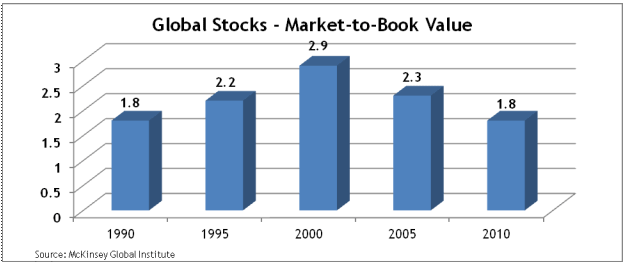
Economic growth is only one part of the return equation. One of the lasting lessons of the tech boom is that stock returns are highly dependent on the valuation at the point of entry. Fortunately, according to a recent report6 by McKinsey Global Institute global stock valuations have fallen over the past decade to a level not seen since 1990. This is illustrated in the following graph which compares market-to-book value ratios for global stocks for selected years from 1990 to 2010.
Valuations skyrocketed in the 1990’s as the “new era” paradigm and tech bubble propelled prices to manic levels. By 2000, investors were prepared to pay $2.90 for every $1.00 of book equity of global stocks. Due the tech bust and the crunch of the global credit crisis, valuations have since been in constant decline. They have now returned to the fairly priced levels of 1990 – not cheap, but not expensive either.
Reasonable stock valuations and faster world economic growth offer the potential for higher real returns from global equities. Based on assumptions that reflect brisk global growth (see Appendix I), we have forecast a long-term, expected real total return from global stocks of 6.3% per annum - only modestly below the 6.6% annual real return of U.S. stocks since 1926. Importantly, this expected return reflects an equity portfolio that is invested globally including emerging market stocks.
With the current fixation on the gloomy “new normal” in the US and Europe, many investors are overlooking the full global picture. The drivers that propelled post WWII growth to vigorous levels have emerged again. Certainly, the world economy will be subject to the normal dynamics of the business cycle, swinging between periods of contraction and expansion. Over the longer-term, however, these forces create the potential of a global “old normal” of resurgent growth and for patient investors, the prospect of higher real returns from stocks globally than has existed for several decades.
Tacita Capital Inc. is based in Toronto, Canada and is a private, independent family office and investment counselling firm that specializes in providing integrated wealth advisory and portfolio management services to families of affluence. We understand the challenges of affluence and apply the leading research and best practices of top financial academics and industry practitioners in assisting our clients to reach their goals.
6. Susan Lund, John Piotrowski, and Charles Roxborough., “Mapping global capital markets 2011”, McKinsey Global Institute, August 2011.
APPENDIX I
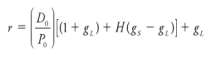
We use a variation of an H-model to first project the expected return from global stocks prior to any stock dilution. The equation is as follows:
Our assumptions reflect the lowest growth estimates of the studies reviewed and are as follows:
D/P = 3.1% based on the estimated current dividend yield of the MSCI AC World Index
Gs = 4.1% real growth over the next 20 years
Gl = 3.4% real growth over the following years
H = 10 (based on 20 years divided by 2)
The above assumptions and formula result in an expected annual real return of 6.8% prior to stock dilution. As laid out in William Bernstein’s and Robert D. Arnott’s 2003 article “Earnings Growth: The Two Percent Dilution” in the Financial Analysts Journal, stock dilution reduces capital appreciation for existing stockowners. Their analysis, however, does not correct for the reduction in dividend payout levels over time or the counterbalancing effect of heightened stock repurchases in recent years.
We calculate a net stock issuance of 0.5% globally since 2005 (derived from statistics of McKinsey’s Mapping global capital markets 2011 report) and deduct 0.5% from the 6.8% to arrive at our 6.3% expected annual real return forecast.
Read more articles by Michael Nairne