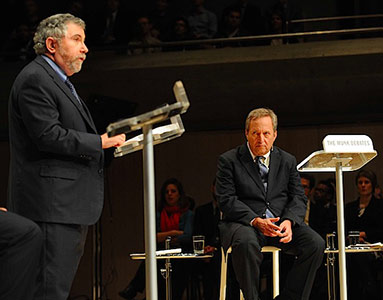
Larry Summers and Paul Krugman may share ideological leanings, but they disagree sharply about our economic prospects. Both agree that political gridlock is responsible for the failure to grow our economy, but is that impasse is so severe that the US is destined to endure the slow growth, high unemployment and deflation that has plagued Japan for the last two decades?
It depends who you ask.
The two squared off over that question as part of the Munk Debates in Toronto on November 12, where they were joined on the debate stage by David Rosenberg, Gluskin Sheff’s chief economist and investment strategist, and Ian Bremmer, the author and political consultant.

Paul Krugman and Larry Summers
Summers, a professor at Harvard who held top posts in the Clinton and Obama administrations, took the position that the problems facing the US are far less severe than those that plagued Japan. Krugman, the 2008 Nobel Prize winner in economics and a professor at Princeton, disagreed, contending that our problems are far more severe and are likely to worsen.
Politics are not the issue, according to Rosenberg, who said that the debt-deleveraging cycle in the US must run its course before a recovery will begin. Bremmer sided with Summers, and argued that – despite its weaknesses – the US economy is far stronger any other developed nation’s.
Prior to the start of the debate, an audience poll found 56% agreed with the proposition that we are headed to a “lost decade,” 26% disagreed and 18% were undecided. We’ll see how those numbers changed after the debate, but first let’s look at some of the key points from each participant.
Japan redux?
“This is what a lost decade looks like,” Krugman said, “except the US is sourer than Japan ever was.”
Japan never had as drastic a slump in employment or as sharp a decline in GDP as the US has experienced since 2008, when we were stuck by a bigger shock to our economy than Japan was when its bubble burst, Krugman said.
Every country that has recovered from a financial crisis did so through export-driven growth, Krugman said. But there is “no hope” for the rest of the world to bootstrap the US, he said, because all other developed economies face similar crises.
Krugman acknowledged that Japan’s fiscal and monetary policies were imperfect, but he doubts those of the US will be any better. He said our fiscal policies have been “stop-and-go, much like Japan’s,” and that it is unlikely policy makers will agree on any comprehensive solutions.
“There is absolutely no reason the US will do better than Japan,” he said.
Rosenberg sided with Krugman, citing empirical data. Despite the heroic efforts of policymakers – three years of zero interest rates, monetary easing, and fiscal deficits in excess of 10% of GDP – the US economy is growing at barely 2%, he said. FDR, Rosenberg said, never ran deficits of more than 6% of GDP.
“Our policy makers are bumping up against a debt-deleveraging cycle,” Rosenberg said. He cited a McKinsey study, which found that the US has undergone $1 trillion of deleveraging thus far, but another $3 trillion remains – which Rosenberg said will take another five years.
Summers said the US suffers from a demand deficiency, which he compared to the “magneto” problem John Maynard Keynes described in the early stages of the Great Depression. The magneto – what we now call the alternator – was a single part that could be solely responsible for the failure of an automobile to operate. All that was needed was to fix the magneto (demand deficiency) and the car (the economy) would run, according to Keynes in the 1930s and Summers last week.
Krugman said the magneto analogy could be interpreted differently. If you don’t fix the problem of insufficient demand, he said. “Nothing else will make the car go.” There is no realistic prospect of a solution until there is a fundamental shift in the “political alignment,” by which he meant an abandonment of policies advocated by the Republican Party, which he called “destructive.”
It is wrong to compare Japan to the US, Summers said. Japan’s problems were much worse; if the US markets duplicated the fall of those in Japan, Summers said the Dow would now be at 2,600. Japan, he said, suffered from structural problems that do not afflict the US: an aging population, anti-immigration policies and little capacity for entrepreneurship.
Japan faced a “more profound difficulty,” Summers said, which was “basically a permanent problem.”
The US is better off on a relative basis as well, he said. When Japan’s economy went into decline, the rest of the world was growing, amplifying Japan’s demise by comparison. Today, the US economy is growing, he said, and faces fewer problems than other countries’.
The US is “uniquely resilient,” Summers said. “We have seen this before.” He noted that in 1991, after the end of the Cold War, the Harvard Business Review routinely proclaimed – incorrectly, in retrospect – that Japan and Germany would dominate global commerce.
Bremmer echoed many of Summers’ points, adding that the US will benefit from a much more stable government than Japan, which has had 17 premiers in 22 years. “The US,” he said, “has its share of problems, but we are far better off than Japan, China or Europe.”
“The relative game matters in terms of where you put your money,” he said. Far more Chinese want to move to the US than vice versa, he said, and he predicted that “the next big thing” will come from the US.
What is the solution?
While all four agreed that the US economy faces big challenges, no consensus emerged as to the correct solution.
Summers agreed with Krugman that the central problem is a lack of demand, which Summers would solve through a combination of fiscal policies, monetary policies, and “export promotion.”
Krugman said the US experience has paralleled that of Japan, except playing out in compressed time. Our demographics are more favorable than Japan’s, but he said GDP growth solely from population growth will “not be good enough.”
Krugman said the US suffers from a “deeply polarized, dysfunctional political system.” Nothing will happen, he said, unless a single party controls Congress with 60 seats in the Senate.
Summers disagreed, and said the political system is not fundamentally blocked for the long term. US politics were similarly gridlocked in 1933-34 and 1965-1966, when major pieces of highly controversial legislation were passed. Indeed, he said, such was the case with the legislation passed in 2009-2010, such as the TARP program.
Rosenberg argued against continued fiscal stimulus measures – and, in so doing, positioned himself squarely against Krugman’s Keynesian viewpoint. He said total debt in the US is 350% of GDP, only slightly less than that of the OECD, which is 375%. “The solution to a credit collapse is not more debt,” he said. “Debt must be destroyed, but ‘how?’ is the question.”
Two solutions would do the trick, Rosenberg said: nationalizing the banks or printing money to inflate our way out. He also argued for a “coherent energy policy” and a strategy to reduce housing debt, possibly through a “jubilee” of mortgage forgiveness.
Wealth inequality is impeding growth, although to different degrees according to the participants. Krugman said it is a “weakness” that plays an indirect role in slow growth, and has “warped the perspective of our policy elites.”
Rosenberg said wealth inequality plays a greater role, and has left people feeling disenfranchised. “The longer the employment problem lingers,” he said, “The more the risk of social instability.”
Summers downplayed wealth inequality as a problem, and said that having “30 more Steve Jobs” would be good for the economy. “Some of the great fortunes have been made doing things that have helped the US and the rest of the world.”
But Krugman countered that almost none of the top 1% of the wealthiest are entrepreneurs like Jobs. He said the Occupy Wall Street was “entirely positive” and has changed the discussion in a favorable way. “Maybe there is hope for the political system.”
“This era will be remembered as hugely painful,” Summers said, “but not like the declines of Britain or Japan.”
Krugman’s pessimism is rooted in his belief that we are unlikely to get the right policies. “We could end this quite quickly,” he said, with “radical monetary and fiscal stimulus, but that is not going to happen.
“Nobody has ever done what we need to do,” Krugman said. “To be an optimist is to believe America will do something that has never been done before.”
“The transition from inconceivable to inevitable can be very rapid,” Summers countered.
Summers said the political solution lies in the need for each party to abandon its traditional policy agendas; Republicans must give in to tax cuts, and Democrats have to concede on parts of their “green” agenda, for example. Citing Keynes, he said it is “critically important to raise demand and enhance business confidence, which would increase investment.” Those precepts span the political agenda and should be embraced by both parties, he said.
To believe we are Japan redux amounts to writing off our prospects, Summers said, which would only be a catastrophic self-fulfilling prophecy. “These problems can be solved,” he said. “They will be solved.”
In the post-debate poll, Summers’ optimism swayed the undecided vote. Those agreeing that we are on the verge of a lost era decreased by 1% to 55%, while those opposed increased by 19% to 45%.
Read more articles by Robert Huebscher