Advisor Perspectives welcomes guest contributions. The views presented here do not necessarily represent those of Advisor Perspectives.
 This essay is excerpted from a recent version of The Credit Strategist (formerly the HCM Market Letter). To obtain the complete issue, you must subscribe directly to this publication; Please go here. The Credit Strategist is on Twitter - @credstrategist
“Recovery is sound only if it does come of itself. For any revival which is merely due to artificial stimulus leaves part of the work of depressions undone and adds, to an undigested element of maladjustment, new maladjustment of its own which has to be liquidated in turn, thus threatening business with another crisis ahead. Particularly, our story provides a presumption against remedial measures which work through money and credit. For the trouble is fundamentally not with money and credit, and policies of this class are particularly to keep up, and add to, maladjustment, and to produce additional trouble in the future.”
Douglas V. Brown1
The drinks are on us
This just in from Bloomberg (with thanks to ZeroHedge): “The Bank of Israel will begin today a pilot program to invest a portion of its foreign currency reserves in U.S. equities…A small number of central banks have started investing part of their reserves in equities. About 9 percent of the foreign-exchange reserves of Switzerland’s central bank were invested in shares at the end of the third quarter, the
Swiss bank said on its web site.” Israel initially plans to devote 2 percent of its $77 billion of reserves to equities but hopes to ultimately allocate about 10 percent of its assets to the riskiest asset class. When two of the world’s soundest central banks start investing their reserves in stocks (the Bank of Israel is run by the highly respected Stanley Fischer for God’s sake!), one has to wonder what the world is coming to. Apparently the global saloon is expanding its boundaries. No doubt we will soon hear the European Central Bank (ECB) is merging with the London Stock Exchange.
Europe
While it was not a Greek but a German waiter that accidentally poured four tall glasses of beer down the back of German Chancellor Angela Merkel at a Christian Democratic Union meeting last week, it should not surprise anybody that one of her own countrymen was guilty of the deed. First of all, a bathing the Chancellor in beer is fitting in view of the fact that the European Central Bank (ECB) is bathing European banks in money. Further, Germans aren’t very happy with their Chancellor these days The heat is rising on Frau Merkel for her support of the second in what is certain not to be the last bailout of Greece. Even her own Interior Minister, Hans-Peter Friedrich, is taking issue with her seeming obsession with keeping Greece enslaved within the Euro. “The chances that Greece can renew itself and become more competitive are surely greater outside the currency union than within it,” Herr Friedrich told Der Spiegel, the German weekly magazine. The Minister, obviously a fan of The Godfather, added that while Greece shouldn’t be booted out of the European Union, it should be given incentives “that they can’t refuse.” Herr Friedrich is the first minister to publicly break ranks with Frau Merkel, but opposition to the financial risks that Germany is running is increasing within her party. An increasing number of politicos are coming to believe that a Greek departure from the union would not be the financial cataclysm once feared. The Bundesbank is also getting extremely edgy. Bundesbank Chairman Jens Weidmann sent a very public private letter to ECB Chairman Mario Draghi “suggesting” that the ECB rethink its December decision to accept a wider variety of collateral from borrowing banks and to consider the wider risks this is storing up in the financial system (apparently Israel and Switzerland were not copied on this letter). German opposition to the ECB’s promiscuous monetary policy is hardly surprising, and Mr. Draghi himself indicated this week that European banks should not expect any more gifts like the LTRO. Of course, the next time the global financial system is greeted with a beer shower, we will have an opportunity to test Mr. Draghi’s resolution.
Despite winning approval of the €130 billion bailout by a significant majority, 496-90, the Chancellor failed to win a so-called chancellor’s majority in the Bundestag. By failing to gain the necessary 311 votes from her own party that would have represented an absolute majority of the 620 seats in Parliament, Frau Merkel failed to win a symbolic victory that weakened her political position. She acknowledged her difficulties as she spoke to the Bundestag: “Some people ask whether Greece isn’t a bottomless pit, a hopeless case, whether it wouldn’t be better for all if Greece just reintroduced the drachma. The opportunities outweigh the risks of turning away from Greece now. I believe these risks are incalculable and therefore irresponsible.” In other words, she believes it is better to embrace the devil she knows instead of the devil she has not yet met. She is increasingly likely to meet that other devil, however, is she persists on her current path. Her failure of imagination is likely to haunt her and the rest of the European Union (EU) for years to come. For the moment, however, her parliamentary victory allowed her to negotiate the final details of the bailout package and inflict large losses on bondholders but leave Greece on a steady path to becoming not only a ward of her own country but a failed state.
To give just a small idea of how bad things are in Greece, the Markit Greece Manufacturing
Purchasing Manager’s Index has been in sub-50 territory for 30 straight months and fell to a survey low of 37.7 in February. Markit described an economy in shambles: “Underlying the steep deterioration in operating conditions in February were the most severe reductions in output and new orders recorded in nearly 13 years of data collection. Respondents commented on shortages of working capital at their plants and amongst clients, while austerity measures continued to undermine demand. Sales of Greek manufactured goods were down from both domestic and foreign sources: new export orders fell for a sixth consecutive month and at the steepest pace since May 2010.” (bold in original)2 Markit also reported significant job losses, reduced working hours, vendors demanding cash payment for the delivery of raw materials, and higher raw material costs. The Greek economy is in the midst of a total meltdown and, in the latest twist in this melodrama, the German-led coalition decided to hold back half of the €130 billion of promised aid until they are certain Greece can deliver on its austerity commitments. They are shooting bullets into a corpse.
The real question is why European officials remain intent on pursuing policies that are virtually certain to be unsuccessful. German Finance Minister Wolfgang Schauble warned in a letter to legislators late last week that “this may not be the last time” that Europe (i.e. Germany) would be asked to extend a lifeline to Greece. He might have added that the next time won’t be the last time either because Greece is a black hole of liabilities. And the parts of the black hole not created by the Greeks are being created by the European authorities imposing such stark austerity measures that Greece’s economy can never hope to generate sufficient tax revenues to meet its obligations. Bond spreads may be tightening in Italy and
Spain, but they remain too high. Spain just reported that it will miss EU-mandated deficit limits by a larger than expected 1.4 percent while EU officials debate whether they will “allow” the country to breach its deficit target of 4.4 percent of economic output in 2012. As for Portugal, that country remains next in line for a bailout. Finally, Ireland has announced that it will hold a referendum on the Eurozone fiscal pact, a decision that could cast a pall of uncertainty over the region for months. The Irish have twice already rejected EU treaties only to approve them in second referendums, and this vote will prove to be politically divisive and distracting to European leaders as they deal with more severe challenges to the south. It is fair to say that the Eurozone debt crisis, and the drama surrounding it, is far from over despite politically-driven sound-bites to the contrary by political candidates like Nicholas Sarkozy.
1. Douglas V. Brown, The Economics of the Recovery Program (New York: McGraw-Hill, 1934), reprinted in Sylvia Nasar, Grand Pursuit: The Story of Economic Genius (New York: Simon & Schuster, 2011), p. 337.
2. Markit Economics Limited, Markit Greece Manufacturing PMI, “Operating conditions in Greek manufacturing deteriorate at survey-record pace,” March 1, 2012.
Europeans are not only inept at managing their affairs; they are so deeply divided that they don’t even bother to cover their tracks. The latest “leaked” document, entitled “Greece: Preliminary Debt Sustainability Analysis” dated February 15, 2012, should have been entitled “Debt Unsustainability Analysis.” Greece’s inability to pay its debts ranks as the world’s worst kept secret (except among Eurocrats). A dissenter from the bailout plan (maybe it was a supporter, who knows, does it matter?) felt obliged to state the obvious in this “confidential” paper that was virtually ubiquitous on the Internet. The document is filled with such subject headings as “Estimated bank recapitalization needs have increased,” “Market access prospects have become more adverse,” “Stress tests continue to point to a number of sensitivities with the balance of risks mostly tilted to the downside,” “The Greek authorities may not be able to deliver structural reforms and policy adjustments at the pace envisioned in the baseline,” and “The debt trajectory is extremely sensitive to program delays, suggesting that the program could be accident prone, and calling into question sustainability.” In other words, a serious analysis of the plan shows it doesn’t have a chance of working.
The rest of the world is showering praise on Mario Draghi for the success of his LTRO program, which weighed in at more than €1 trillion euros before it was done. While this excretion of liquidity clearly eased European banks’ constipation, it did little to fertilize European economies. It appears that much of the money was put to work buying short-maturity sovereign debt in carry trades and the rest was parked back at the ECB.3 For that reason, The Credit Strategist renews its initial view that the banks that borrowed this artificially cheap money will be unable to repay it when it comes due in three years and will end up refinancing it at higher rates or asking the ECB for some kind of relief. Maybe the next time the ECB will pay them to lend them money. We can say with a high degree of certainty that these banks, many of which were already overleveraged and insolvent, will not be profitable enough in a recessionary European economy between now and then to be able to repay this debt out of profits. The LTRO will leave them more leveraged than they were before and the European economy no further on the road to recovery since there is little sign that sufficient pro-growth reforms are going to be passed. Carry trades often end in tears, and this one engineered by the ECB may well turn out to be another crying game.
Finally, a word about the Greek credit default swap debacle. As noted in the George Bernard Shaw story found at the beginning of our February issue, debating whether Greece has defaulted or not is an exercise in absurdity. The fact that the so-called “committee” of self-appointed and grossly conflicted doyens of credit that decides these matters (ISDA) can emerge from smoke-filled rooms and state with straight faces that Greece did not default makes one wonder why contracts even exist. The fact that they may change their minds next week when Greece invokes a “collective action” clause renders the exercise even more ridiculous. ISDA’s decision deprives credit default swaps of any value where clever lawyers can twist the language to avoid its clear intent. Coupled with the ECB’s move to subordinate other bondholders to its own sovereign debt holdings, the rule of law has effectively been neutered in Europe. But once the rule of law is abrogated, there is no telling where the road to anomie will lead. Europe, and in particular Germany, is well schooled in such matters and should never forget the lessons of the 1930s. The United States is supposed to be a nation of laws yet the Obama administration, run by a Harvard-educated former Constitutional law professor, saw its bankruptcy and contract laws thrown out the window during the General Motors bankruptcy in order to achieve a politically-desired result that in part was designed to favor labor unions. These shows of raw political power demonstrate the fragility of the rule of law in the face of dire economic circumstances and serve as a warning of what might occur in other situations where might is considered right. They establish dangerous precedents that should deeply alarm free men and women everywhere. Nobody is going to cry about purchasers of credit default swaps (least of all me, as my readers well know), but today it will be them and tomorrow it will be us. Principles are meant to be general; they are not case specific. Once they vary with the facts, they are no longer principles but expedients.
United States
As the “leaked” memorandum on Greek debt sustainability suggests, at least someone in Europe is realistic about what is happening, just not the people in charge. Sort of like – no, exactly like – the situation in the United States.
Let’s begin the discussion with politics, since politics rather than economics is driving fiscal and monetary policy these days. In the wake of President Obama’s sadly misguided budget proposal and his perhaps well-intended (we are trying to give him some benefit of the doubt) but still completely garbled and deeply flawed tax reform proposal, another four years under his stewardship bodes poorly for the types of changes that this economy desperately needs. Those changes include pro-growth tax reform that would direct capital toward productive uses and away from speculative and non-productive uses, and genuine spending discipline starting with meaningful entitlement reform. I have looked hard and found nothing of the kind in his proposals. For example, the president obviously misses the point that taxing corporate profits twice – once at the corporate level and a second time when they are paid as dividends – subjects them to near confiscatory tax rates. The issue is not that the corporate tax rate is too high or too low – the issue is that few if any corporations pay anywhere near the statutory rate and instead pay millions upon millions of dollars to lawyers and accountants to reduce their tax bills. That is unproductive. Lower the rate, remove the loopholes, and make corporations pay the full tax rate. The solution is obvious but execution is near impossible because special interests own our lawmakers. Until this country can gather a constellation of Senators and Representatives who are willing to tell the special interests to shove it and place the interests of society ahead of those of individual constituencies, meaningful tax and economic reform will remain impossible. Look at the results of the so-called grand reforms that the 2008 financial crisis were supposed to spawn. Dodd-Frank is a joke, although it is difficult to tell whether the bigger joke is the content of the bill or the fact that it is named name after two lawmakers who inflicted untold damage to the economy with their corrupt sponsorship of large financial interests.
One of the reasons that four more years of the current administration would be antithetical to economic growth was laid out by former Federal Reserve Governor Lawrence B. Lindsay in a recent editorial. Entitled “Geithner and the ‘Privilege’ of Being American,” Mr. Lindsay dished out a Constitutional law lesson to the former Constitutional law professor Obama that the president should take deeply to heart. Rightly offended by the Treasury Secretary’s comment that the “most fortunate Americans” should pay higher taxes for the “privilege of being American,” Mr. Lindsay placed this comment in the context of “a very destructive instinct that seems to permeate the Obama administration about the respective roles of citizens and their government.” As he argues, “the concept that being an American is a ‘privilege’ upends the whole basis on which America was founded. Privileges are things granted to one individual by another, higher-ranking, individual…One presumes Mr. Geithner believes that the “privilege” of being an American is granted by the presumably higher-ranking, governing powers that be.”
3. This is apparent from falling yields of 1-3 year Italian and Spanish paper and the fact that the intermediate and longer end of these sovereigns’ curves have hardly moved at all since inception of the Draghi Put, er, the LTRO program.
That view, of course, was one that was directly rejected by the Founding Fathers. The basic rights of life, liberty and the pursuit of happiness are natural rights with which all human beings are endowed by God, not by government. Moreover, it is not government that grants these rights to citizens, but citizens that grant government officials their “just powers.” Jefferson wrote in the Declaration of Independence that governments are instituted among men based on their consent in order to secure the rights of life, liberty and the pursuit of happiness. “The notion that a governing authority grants privileges to those it governs,” writes Mr. Lindsay, “directly contradicts Jefferson’s declaration.”
Mr. Lindsay recounts several instances in which the Obama administration turned the Constitution upside down based on its backwards view of who grants whom privileges in American government. Among the examples he cites is the requirement in Obamacare that every American buy a product from a private business that the government deems necessary for our well-being. No doubt this argument will be raised when this issue reaches the Supreme Court in the current term.
The Obama administration is certainly not the first and will no doubt not be the last to abuse the Constitution. The Bush II administration did so in the name of protecting us from terrorists, and the Patriot Act (which the current administration and Congress has perpetuated) is used as an excuse for numerous violations of our rights by law enforcement. Just as democracy may be the worst form of government except for all other forms of government, the United States may have become the least free country in the world except for all other countries in the world. But that is no reason not to fight to make it freer.
Economics and freedom go together. All of us should remember that in view of the fact that the Federal Reserve is the main player in the U.S. economy. That has probably been the case for a long time, but it seems to have been more apparent than ever since the central bank was forced to come to the rescue of the financial system in 2008 after letting it run wild under its (and other regulators’) watch in the early and mid-2000s. The U.S. economy is heavily influenced by both monetary and fiscal policy today, which renders investors’ ability to understand these areas more important than ever.
Figure 1
Hope springs eternal
While the employment picture is thankfully improving, there are still millions of fewer jobs than there were prior to the recession. The lower unemployment rate is primarily a matter of optics resulting from the departure of millions of discouraged workers from the work force. The truth is that there are fewer jobs in a larger population and everyone agrees (even politicians!) that far more work needs to be done. Unfortunately, not everyone agrees what needs to be done. The recent ISM disappointment (52.4 versus an expected 54.6) suggests that the right things aren’t yet being done. The 2011 year-end Case-
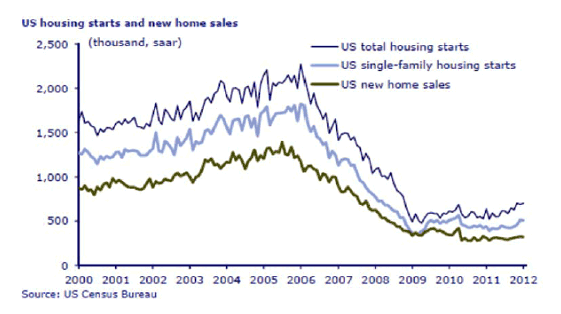
Shiller 20-city index furthered that view as December declined for the eighth consecutive month and the last three months of the year fell at a -7.6 percent annual rate. Figure 1 shows that reports of a housing recovery are clearly premature as most indicators remain abysmally below levels that could remotely be considered healthy (although we are happy to report anecdotal evidence of improvement in the luxury market in Palm Beach County, Florida!). The lack of a fiscal policy response to what ails the U.S. economy is increasingly obvious. There seems to be increasing talk of mortgage principal debt relief, although objections to this idea seem to be focused on the bugaboo that it would somehow send the wrong message to those who have been paying their mortgages. Why not consider a plan in which banks forgive a portion of a mortgage and take an ownership position in the property equivalent to the percentage of the mortgage that is forgiven? When the house is ultimately sold, the bank will then stand a chance of recovering its loss and/or making a profit, and the borrower will have given up something real in exchange for debt relief? This is the same model used in corporate debt restructurings and has worked relatively well (with the usual Wall Street compensation abuses for management built in, of course).
Figure 2
Neither a borrower nor a lender be
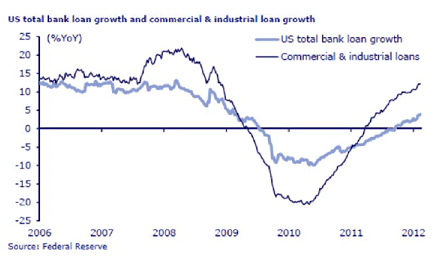
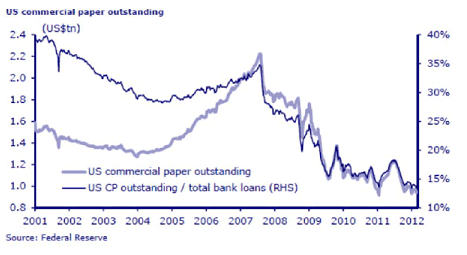
While the health of U.S. banks continues to improve, friend Christopher Wood tells us (as he teaches us so many things) that one reason may be that they are not ramping up lending as some are trying to argue. As Figure 2 illustrates, total loan growth is only creeping higher. Total loan growth rose by 4 percent year-over-year in the week ended February 15 and the commercial paper market is still contracting quite drastically as Figure 3 shows (see below).
Commercial paper outstanding fell by 2.5 percent week-over-weecck and 10.4 percent year-over-year to $938 billion during the last week of February and now accounts for only 13 percent of U.S. bank loans compared with 35 percent in mid-2007. The financial crisis clearly put a seemingly permanent dent in this market as corporations are loathe to depend on short-term financing to run their day-to-day businesses. This used to be a vital market for corporate finance and its disappearance is a major change in the markets. Instead, corporations appear to be more comfortable borrowing overnight in the repo markets, which may turn out to be a questionable decision when one considers the risks involved with collateral chains, rehypothecation, credit default swaps, and Lord knows what else lurking in the shadows. The Credit Strategist has written about these risks in earlier issues. The powers-that-be assure us that we shouldn’t worry about such things – all the more reason to worry!
Commercial and industrial loan growth looks more impressive than total loan growth, but as David Rosenberg points out (pointedly we might add, calling the Wall Street Journal reporter a neophyte who interpreted this news completely out of context) that this was entirely the result of inventory refinancing which is by nature short-term. Since companies stockpiled inventories in the fourth quarter (inventory stockpiling accounted for 2 percent of the now 3 percent of fourth quarter GDP growth), they obviously needed inventory financing in recent weeks. But this is short-term and will tail off shortly as they re-stock. As Mr. Rosenberg points out, “[t]his is not about capital outlays, which we know from yesterday’s [Feb. 28’s] durables data are actually on a declining trend!” Mr. Rosenberg is often accused of being perpetually bearish, but we prefer to accuse him of being one of the sharpest interpreters of economic data on the planet, a wonderful writer, a realist and a moralist. We are proud to call him our friend, and we still don’t understand how he survived at Merrill Lynch for all those years!
Figure 3
Shrinking commercial paper market
Investment recommendations
This section is available only to paid subscribers.
Michael E. Lewitt
Disclaimer
All opinions and investment recommendations expressed by Michael E. Lewitt in The Credit Strategist as well as on Twitter under the Twitter name @credstrategist are solely the opinions of Mr. Lewitt and do not reflect the opinions of Cumberland Advisors or its affiliates or employees, managing directors, owners or principals.
Disclosure Appendix
This publication does not provide individually tailored investment advice. It has been prepared without regard to the circumstances and objectives of those who receive it. This report contains general information only, does not take account of the specific circumstances of any recipient, and should not be relied upon as authoritative or taken in substitution for the exercise of judgment by any recipient. Each recipient should consider the appropriateness of any investment decision having regard to his or her own circumstances, the full range of information available and appropriate professional advice. The editor recommends that recipients independently evaluate particular investments and strategies, and encourages them to seek a financial adviser’s advice. Under no circumstances should this publication be construed as a solicitation to buy or sell any security or to participate in any trading or investment strategy, nor should this publication or any part of it form the basis of, or be relied on in connection with, any contract or commitment whatsoever. The value of and income from investments may vary because of changes in interest rates or foreign exchange rates, securities prices or market indexes, operational or financial conditions of companies, geopolitical or other factors. Past performance is not necessarily a guide to future performance. Estimates of future performance are based on assumptions that may not be realized. The information and opinions in this report constitute judgment as of the date of this report, have been compiled and arrived at from sources believed to be reliable and in good faith (but no representation or warranty, express or implied, is made as to their accuracy, completeness or correctness) and are subject to change without notice. The editor may have an interest in the companies or securities mentioned herein. The editor does not accept any liability whatsoever for any loss or damage arising from any use of this report or its contents. All data and information and opinions expressed herein are subject to change without notice.
The Credit Strategist
Michael E. Lewitt, Editor
The Credit Strategist is published on a monthly basis by Michael E. Lewitt. Address: 5030 Champion Blvd., G6 #161 Boca Raton, FL 33496. Telephone: (561) 239-1510. Email: . Delivery is by electronic mail. Annual subscription rate is $395 for individuals and $995 for institutions. Visit our web site at www.thecreditstrategist.com. Copyright warning and notice: It is a violation of federal copyright law to reproduce or distribute all or part of this publication to anyone (with the exception of individuals within the same institution pursuant to the subscription agreement) by any means, including but not limited to photocopying, printing, faxing, scanning, e-mailing, and Web site posting without first seeking the permission of the editor. The Copyright Act imposes liability of up to $150,000 per issue for infringement. Information concerning possible copyright infringement will be gratefully received.
Read more articles by Michael Lewitt