Advisor Perspectives welcomes guest contributions. The views presented here do not necessarily represent those of Advisor Perspectives.

This essay is excerpted from a recent version of The Credit Strategist (formerly the HCM Market Letter). To obtain the complete issue, you must subscribe directly to this publication; Please go here. The Credit Strategist is on Twitter - @credstrategist
“Of course stable money will not be a panacea, a cure for all business problems, any more than the stable bushel basket was a panacea. Yet besides reducing social injustice, social discontent and social inefficiency, as already described, stable money will help indirectly in solving other great problems simply by making it easier to get at the facts, without any illusions. Before action upon alleged evils can be based on sure ground, it is essential to find out the facts; but the fluctuating dollar hopelessly conceals the facts. It blinds the eyes of the mass of men whose duty it ultimately is, under our democratic form of government, to choose one or more remedies for such evils as exist. The fluctuating dollar keeps us all in ignorance; whereas a stabilized dollar would lay bare the facts.”
Irving Fisher, The Money Illusion (1928)1
If Goldman Sachs wants to look for Muppets in the email, that is the firm’s prerogative. But the exercise strikes us not only as a monumental waste of time, but as an inexcusable bow to political correctness and public ignorance of how business is conducted in modern financial markets. People may wish that Wall Street were different, but they should not confuse wish fulfillment with reality. Goldman is not only a fiduciary serving clients; it is a market-maker with counterparties to whom it owes a duty of disclosure that falls far short of any fiduciary standard. If the firm’s employees want to call their counterparties or clients childish names, that may well be disrespectful or unprofessional, but it hardly amounts to the commission of one of the Seven Deadly Sins.2 Greg Smith’s story has received far more attention than it deserves, and anybody who ends up purchasing the book he is pandering to some cynical publisher is throwing money out the window. If the media had any shame, it would embarrassed by its incessant harping on this non-story. But the media has no shame, and my desire is just an example of how I am just as guilty of wish fulfillment as anybody else.
Markets and the economy
Investors enjoyed strong stock market and credit market gains during the first quarter of the year, but storm clouds may be forming on the horizon. The tech-heavy (i.e. Apple Inc. and Priceline.com Incorporated heavy) Nasdaq led the way with an 18.7 percent quarterly pop, while the S&P 500 rose by 12 percent and the Dow by 8 percent. Forgive an old Luddite, but the moves in some of these tech stocks reminds us uncomfortably of the tech stock bubble, particularly in the media adulation in which these companies are being drenched. The last we checked, the laws of mathematics had not been repealed and stocks cannot keep rising forever. Technology progresses in fits-and-starts, not in straight lines, and investors should not expect these stocks to continue to rise at double digit rates every month or two, regardless of whether their products are insanely great or not.
The primary reasons for these across-the-board gains were the fact that Europe didn’t slide into the sea, U.S. employment data (mightily assisted by the warmest winter in recent memory) was better than expected, and overall U.S. economic data (again helped by the weather) contained enough tidbits of good news for the bulls to grab onto and ride into the sunset for a while. On all three counts, celebrations should be limited to what just happened and not extend to what comes next.
Corporate profits have likely peaked. This does not mean that corporate balance sheets are in ill health – quite the contrary. Corporations have bolstered their cash positions, refinanced their debt with longer maturity and lower cost debt, and are well prepared for any slowing in economic growth. But corporate profits have been slowing down since the fourth quarter of 2011, when the total reported net income of S&P 500 companies declined year-over-year by 2.3 percent (and by a greater 5.7 percent if Apple is excluded) according to Bloomberg. Moreover, despite the many pundits who continue to argue that the United States is enjoying a “self-sustaining recovery,” much of the pre-4Q11 record corporate profitability was attributable to non-organic factors such as (a) loose central bank policy; (b) cost cutting (i.e. job cuts or non-hiring); (c) low interest rates on their borrowings; and (d) low effective tax rates that are far below the statutory rate (which at 34% is the highest in the world now that Japan has lowered its rate to 28%). These forces are reaching their limits as was apparent in the 4Q11 corporate profit figures. With first quarter 2012 GDP growth likely to be 2% at best, corporate profitability is likely to decline a bit further. Stocks have already exceeded in 2012’s first quarter many analysts’ year-end S&P targets of 1400. Stocks may be the best house in a bad neighborhood, but houses in that neighborhood appear to be fully priced for now.
There are also some troubling signs in the bond markets, particularly the long end. Operation Twist, in which the Federal Reserve has been purchasing longer maturity government bonds, is coming to an end in June and may have done most of its work already. Accordingly, we may well see some pressure on long term government bond yields in the weeks and months ahead if the central bank does not institute another quantitative easing move. Of course, Federal Reserve Chairman Ben Bernanke has made it clear that he won’t hesitate to pull another quantitative easing rabbit out of his hat if the economy falters again, but until he actually performs another monetary magic trick the markets will react very badly to his keeping his top hat on his head. The recent jump in shorter maturities (10 years of less) appears to be over, and there is little in the way of inflation pressure to justify higher rates.
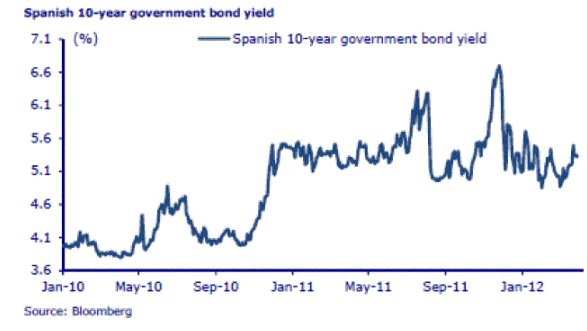
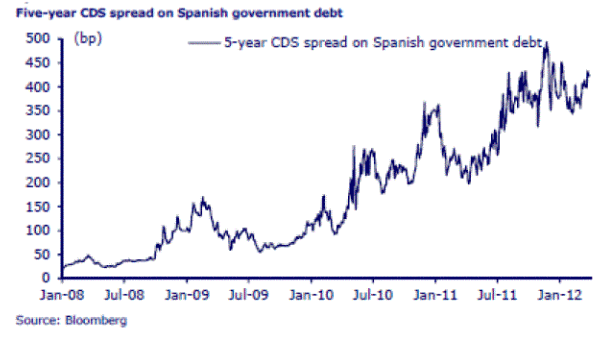
The biggest storm clouds on the horizon remain those in Europe. News from a recent conference hosted by the Global Interdependence Center in Paris reminds us that the Eurocrisis is far from over. In particular, there are troublingly large volumes of deposit flight from banks in peripheral Europe (the PIIGS). Moreover, Spanish 10-year bond yields have risen by about 50 basis points very recently to about 5.5% (see Figure 1 below) and appear headed higher. The market for insurance on Spanish credit is also signaling greater distress (see Figure 2 below), although as usual credit default markets should be read more for the direction of credit sentiment than an actual measurement of default risk since they are illiquid and easily manipulated. The Spanish people have taken to the streets to protest recent austerity measures (much like the Greeks did before them), and unemployment continues to eat away at the political and economic health of the country. Portugal is surely going to default, but that is small potatoes compared to Spain. The European Union cannot handle a Spanish default, but being unprepared by no means renders such an event impossible.
Europeans meeting in Copenhagen on Friday, March 30 announced that they are capping additional rescue lending at €500 billion ($666 billion) after a German-led coalition opposed a larger expansion of the so-called European firewall. Needless to say, €500 billion is not going to be enough. Austerity policies across the troubled periphery guarantee that economic growth will be non-existent, forcing a continuing downward spiral in tax revenues that will force Portugal and Spain deeper into distress. This circle needs to be broken, but the current policy regime is guaranteed to achieve precisely the opposite. I have used the term “periphery” here although it must be noted that there is no such thing as a “periphery” in today’s interconnected global economy. As Spain goes, so goes the rest of Europe. As Europe goes, so goes the United States and the rest of the world. U.S. investors who fail to heed this lesson do so at their own risk. The Eurocrisis is still far from over. Accordingly, as we discuss in “Investment Recommendations,” it is time to take some chips off the table.
Figure 1
Spanish Bond Retreat
Figure 2
Spanish Bond Insurance Premiums Rise
The last point of concern is slowing growth in China. Why investors pour over Chinese economic statistics like Zen masters interpreting koans is beyond me. There is absolutely no reason to believe that these statistics are any more accurate than those that issue from the U.S. government, yet our markets still move based on small divergences from so-called market expectations of growth or other statistics. It appears that China will slow to somewhere between 7 and 8 percent growth this year, which means that a combination of slower Chinese growth and negative European growth will put more pressure on the U.S. to pick up the slack. What that means to us is that Ben Bernanke will be that much more likely to engage in further quantitative easing if the U.S. falters later this year.
1. Irving Fisher, The Money Illusion (New York: Adelphi Company, 1928), pp. 181-82.
2. Anybody who has spent any time on a trading floor understands that this type of juvenile behavior occurs at every securities firm without exception and is simply a deeply embedded part of industry culture. Nobody said capitalism had to be pretty.
Another attack on the rule of law
While the media pretends to speak truth too power, too often it is drafted in writing the narrative that serves the interests of those in power. One of the rare voices of conscience in the financial press who refuses to be duped is The New York Times’ columnist Gretchen Morgenson. On Sunday, March 25, she wrote about recent proposals to provide mortgage relief to underwater homeowners that would benefit the nation’s large banks at the expense of U.S. taxpayers (The New York Times, “A Bailout by Another Name,” March 25, 2012). In speaking out, Ms. Morgenson drew attention to a rare honest voice in government (Sheila Bair, please come back), Edward DeMarco, the acting head of the Federal Housing Finance Agency that oversees Fannie Mae and Freddie Mac. Readers will remember that these two insolvent agencies are owned by the U.S. government, which means that their bills are being paid by U.S. taxpayers (and last we checked, those bills are still growing). In typical fashion, politicians are trying to protect their patrons – the large U.S. banks – and hoist the costs of mortgage relief upon the backs of their constituents who, without the good work of Ms. Morgenson, might never learn of the latest back-door bailout.
There are some elementary principles in corporate finance. One of them is the principle of subordination. Subordination means that one lender is to be paid off before another – the senior lender before the subordinated lender, or in this instance, the first mortgage holder before the second mortgage holder. When a lender agrees to make a second mortgage, it agrees to be paid off only after the first mortgage holder is repaid. This is a matter of black letter contract law as well as sheer common sense. In the situations discussed by Ms. Morgenson involving a homeowner with a first (senior) mortgage and a second (subordinated) mortgage, the first mortgage is held by Fannie Mae or Freddie Mac and the second mortgage is held by a major U.S. bank. If the homeowner were to default and the home to enter foreclosure and sold, the first mortgage would be paid off first. The second mortgage would be paid off next, but only if any money was left over.
Instead of adhering to this legal and common sense regime, however, the Obama administration, Congress and the Federal Reserve are applying pressure on Fannie and Freddie to write down their mortgages without requiring any reduction in the second mortgages held by the banks. These government officials are seeking to reverse the priority between a first and second mortgage. This would blatantly place the interests of the banks that hold the second mortgages ahead of those of the American taxpayers that own the two housing agencies. This would effectively improve the chances that the subordinated second mortgages would be repaid while wiping out some of the debt owed to Freddie and Fannie.
Why does this willingness to trample on the law of contracts sound familiar? Because it is being pushed by the same Democratic brain-trust that sacrificed the rule of law to jam through the General Motors restructuring: Treasury Secretary Tim Geithner, New York Fed President (and Goldman Sachs alum William Dudley), and the insufferable Barney Frank (the latter of whom has of course called for Mr. DeMarco’s resignation for resisting this plan). Having trampled on the rule of law to bail out the automakers (a successful plan that could have been accomplished legally), the government should not be permitted to do so again with respect to the housing crisis. There is simply no reason why mortgage principal relief cannot be achieved with the cooperation of the large banks (many if not all of which still would be working their way through bankruptcy court were it not for the support of the American taxpayer). In last month’s issue of this publication, I made one proposal that would exchange mortgage relief in return for equity ownership for mortgagors – a solution that would adhere to longstanding principles of corporate finance and corporate law. The end does not justify the means.
Until very recently, Mr. DeMarco, whose sole responsibility is to minimize taxpayer losses from the government’s 2008 bailout of the GSEs, was resisting this pressure based on the argument that this approach would constitute a transfer of taxpayer wealth to the lenders holding the second mortgages. He has said, far more politely than the subject deserves, that, “certainly the environment of the last number of months have shown substantial attempts to influence or direct an independent regulator.” American crony capitalism has thrived on the abuse of the rule of law;3 this is just another example of the banks getting one over on the American people and this plan should not be permitted to proceed as proposed. The latest twist in this drama is an offer from the Obama administration (the deeply cynical Obama administration whose leader is a former Constitutional law professor who conducts himself like a former district attorney who now defends the types of people he used to prosecute) to have the U.S. Treasury subsidize write-downs of Fannie and Freddie mortgages in an effort to get Mr. DeMarco to change his mind. Now Mr. DeMarco’s resistance appears to be weakening. “[W]e said all along, if money came from another source, we’d have to reconsider our position,” he said late last week. Mr. DeMarco is being asked to stick his head in the sand. The money for any such subsidy would still come from the American taxpayer, and the plan would still result in write-downs of first but not second mortgages, giving the banks holding those second mortgages an undeserved benefit. We can only hope that Mr. DeMarco can hold firm in the face of what must be unimaginable pressure.
U.S. banks are doing very well right now. As readers of this publication know, The Credit Strategist has been recommending bank stocks for the last six months. The banks are liquid and well-capitalized. They can afford to write-off some of the ill-advised second mortgages they made during the housing bubble. It would be both legally and morally improper to give these institutions – Bank of America, JPMorgan Chase, Citigroup, Wells Fargo and others – another back-door bailout while disguising it inside a politically popular mortgage principal reduction plan. The country was repeatedly told during the financial crisis that what is good for Wall Street is good for Main Street. That was bullsh*t then and it is bullsh*t now. This is an opportunity for Wall Street to finally give back some of the help it was extended by the American people and participate in a solution to the housing crisis. Instead of sitting around giving interviews like some great statesman while working behind the scenes to undercut financial reform and refuse to take write-downs on second mortgages, Jamie Dimon should man up and start behaving like a real statesman and start doing the right thing for America. Mortgage principal reduction would be a great place to start.
3. There are some laws, however, that our legislators still treat as sacrosanct. Take, for example, the laws on dress and decorum in the House of Representatives. On March 28, Rep. Bobby Rush (an African American Congressman) was reprimanded for violating House rules when he donned a hoodie during a speech on the House floor in which he spoke out against racial profiling in reference to the murder of Trayvon Martin. The presiding officer at the time, Mississippi Republican Gregg Harper, told Mr. Rush that the wearing of hats is not allowed on the House floor and had him escorted from the House floor. It apparently escaped Mr. Harper’s attention that Mr. Rush was engaging in a form of symbolic political speech in a place that above all should be tolerant of such expression. Apparently Congress is willing to trump the rule of law to protect big banks, but is unwilling to bend its own rules of decorum to defend the memory of a murdered child of color? Who said the good old days are long gone?
Some real muppets
Private equity compensation and taxation
Congress would rather beat up on Goldman Sachs than deal with genuine issues of Wall Street abuse like the carried interest tax because, after all, it is Congress that has allowed this egregious tax break to continue for far too long. In the tax treatment of the compensation paid to the leaders of publicly-held private equity firms such as The Blackstone Group (BX), Apollo Global Management, LLC (APO), and KKR & Co. LP (KKR), we see some of the grossest inequalities of the financial system at work. If someone on Wall Street wants to look for a bunch of Muppets, they should look at the public shareholders of these companies on the one hand and the limited partners on the other. While nobody put a gun to the heads of either group and forced them to invest in these companies, both sets of investors are getting taken to the cleaners. The funny thing is, not only don’t they seem to mind, but in the case of the limited partners they can’t seem to get enough abuse.4
Every year one or more media publications make a big show of ranking the “best” and “worst” CEOs based on how the performance of their company’s stock compares to their annual compensation. Can anybody remember reading about the CEOs of BX, APO or KKR showing up on the “worst” CEOs list? They certainly belong on the highest paid lists since all of them earned at least $100 million in 2011. But if one looks at the performance of their respective stocks not only in 2011 but since their companies went public, their performance would land them on the financial media equivalent of the “Worst Dressed” list. BX came public at $18.00/share in June 2007 (at which time The Credit Strategist correctly called the peak of the private equity market – before Barron’s did, by the way), traded up briefly to $35.00/share, and has since spent the rest of its public existence trading well below its IPO price. APO came public in May 2011 at $19.00/share and almost immediately traded down below its IPO price where it has stayed (it is current trading below $15.00/share).5 Only KKR is trading higher than its July 2010 IPO price of $10.50/share, although its affiliate KKR Financial Holdings LLC (KFN) is trading far below its 2005 IPO price of $25.00/share.6
There are several things wrong with this picture other than the obvious problem of paying executives (who also happen to be large – very large – shareholders of these companies) hundreds of millions of dollars in compensation for producing such poor returns for public shareholders (in the case of BX and APO) or mediocre risk-adjusted returns for limited partners (in the case of all of the above). As I have written elsewhere,7 private equity returns must be adjusted for leverage, concentration risk, fees and liquidity (or lack thereof) to be properly measured and compared to those of other asset classes. By that standard, even the stated returns (which require a great deal of interpretation and should never be taken at face value) of the best private equity firms are far less than stellar. These are no longer the pioneering firms of the 1970s and 1980s that pushed Corporate America to become more efficient and competitive and produced genuinely outstanding returns. Beginning in the 1990s and continuing in the 2000s on wave after wave of cheap money supplied by the Federal Reserve, large private equity firms have done little more than lard otherwise healthy companies with inordinate amounts of debt. The result has been the diversion of untold amounts of financial and intellectual capital toward the servicing of debt and away from research and development, product development, innovation, job creation, and economic growth. The private equity industry and its paid lap dog, the Private Equity Council, will of course tell you differently. These interested parties argue that private equity companies create jobs and build new facilities and create new products. Not only is that a misrepresentation of what is going on, but it completely begs the question of what these businesses would have achieved without the albatross of debt that was hung around their necks. Historians will look back and measure the opportunity costs of the private equity wave and wonder what we were thinking when our public policy provided enormous tax incentives that allowed a small cadre of clever financiers to engage in an activity that directly coincided with this country’s loss of competitive advantage. And even worse, our demise was funded by institutional capital whose beneficiaries – working Americans – were the parties most directly harmed by the activities in question!
Michael’s stores – An LBO case study
We don’t have to look at the many failed private equity deals to illustrate my point – let’s look at a transaction that is considered to have been highly successful: the leveraged buyout of arts-and-crafts retailer Michael’s Stores Inc. (whose debt I have invested in for several years as a portfolio manager). Michael’s Stores was taken private by Blackstone Group GP, Bain Capital LLC and Highfields Capital Partners in late 2006 in the middle of the biggest LBO boom in history. On Friday, March 30, the company filed for a $500 million IPO. Unlike many large buyouts of that era, Michael’s is considered a success story. After all, it never defaulted on its debt. Since the transaction, the company has added about 160 stores (for a total of 1,064 locations) and hired an additional 2,200 employees and boosted revenues and profits. The company reduced debt from $3.728 billion on Feb. 2, 2007 to $3.363 billion on Dec. 31, 2011 (it should be noted that it had no long term debt before the buyout). Along the way, in addition to the fees that they earned on the capital invested in their buyout funds, the three private equity sponsors were also paid another $125 million in management and transaction fees and will also receive a “termination fee” of approximately $50 million when the company goes public based on the fact that their management contract will end.8
While the private equity world and the media would treat this buyout as a success, I would argue that it was a tremendous waste of intellectual and financial capital. Why was it necessary for private equity to lead the company to expand its work force and store count? If a private equity transaction is the way that American companies are going to achieve meaningful expansion, the U.S. economy is going to continue to lose ground to Asian and other competitors. Think about how many more stores and employees Michael’s could boast of right now if the $1.467 billion of capital that was devoted to debt service9 and the $400 million of debt repayments over the past six years had instead been applied directly to hiring workers and building out new locations (in addition to the capital the company actually did spend on those activities)? The company would likely be much larger and have a much healthier balance sheet today. More important, its equity would be worth far more than it is going to be worth when it goes public.10 The 2200 people who have jobs because of Michael’s expansion benefitted, but what about the thousands who could have been employed with the almost $2 billion of capital that was sopped up by the banks? If this LBO spells success in America, I would respectfully suggest that we are on the wrong course. The challenge America is facing is how to grow the economy rapidly without the utilization of huge amounts of debt. We’ve already figured out how to grow slowly while borrowing ourselves into oblivion, and we can see all around us evidence that this approach isn’t working very well: high unemployment; below-trend growth; a diminished manufacturing base; a disappearing middle class and with it a shrinking tax base; and a growing division between rich and poor. The only ones who succeeded in this transaction, I would argue, are the private equity sponsors and the institutional investors who loaned them the money.
The carried-interest tax
Changing this unproductive regime would start with the tax code, which continues to create enormous incentives that favor debt over equity. But inevitably we are also forced to confront the political hot potato of the carried interest tax, which further rewards this type of unproductive activity. Is a leveraged buyout the type of activity that contributes to economic growth in a way that entitles its promoters to keep 85 percent of the fruits of their labor? For make no mistake – and I welcome a public debate with anybody on this point – the compensation private equity partners receive as a percentage of their limited partners’ profits results from labor, not from the investment of capital. To the extent they invest their own capital and earn a profit, private equity executives are certainly entitled to capital gains treatment like anybody else (that is what happens when legal principles are applied consistently). But to the extent they are paid for their labor, there is no intellectual justification in the tax law for treating that income as a gain on capital. Moreover, in view of the fact that their labor in performed in an activity that is not contributing to the productive capacity of the economy when measured in terms of actual results or, more importantly, is imposing an enormous opportunity cost on the American economy, it is time to recognize that there is no public policy justification for the carried interest tax.
The policy argument often proffered to support this tax break (and believe me, I have heard every argument imaginable to support this tax) is that it provides an incentive for private equity firms to take risk. That argument holds no water when large private equity firms earn enormous amounts of money not from their profit participations but merely from their management fees.11 Moreover – and this is particularly true of the publicly-held private equity firms – these firms’ managements are risking nothing. If they are sued, their legal expenses are covered by their firms, not by them personally (see, for example, the lawsuit by Huntsman Chemical against APO and its principals that was settled a few years ago). Just like Lloyd Blankfein or Jamie Dimon are not personally liable if they are sued civilly, neither are the CEOs of BX, KKR or APO. As a result, these executives who pretend to be taking risk are inhabiting a tails-we-win, heads-you-lose universe with respect to both their public shareholders and limited partners. Private equity executives are playing with a coin that comes up their way no matter how many times you flip it while paying a de minimus tax on their winnings. The fact that Congress has permitted this regime to flourish as long as it has speaks to either a lack of honesty or intelligence on the part of our legislators.12 Either way, this tax break needs to be repealed now.
Syria
For the moment, it appears that the fighting in Syria has calmed down. But over the past several months, Syrian President Bashar al-Assad has been carrying out one of the bloodiest episodes of genocide in recent memory. Reports out of Syria have been truly horrifying. The fact that both Russia and China vetoed United Nations action back in February to stop Assad from butchering his own people suggests that both countries have agendas far different than those of truly civilized nations.13 Senator John McCain has been one of the few voices courageously calling for military support for the Syrian rebels, while President Obama and his administration has been working behind the scenes but far too slowly to stop the bloodshed. American leadership is diminished when our government allows innocent people to be killed, whether it occurs in the streets of Sanford, Florida or in the streets of Homs, Syria. Humanity is diminished when anti-semitic butchers like Assad are permitted to hide behind their armies and butcher women and children in order to cling to power that they did not earn and do not deserve. Obama claimed he was a principled man when he ran for office – this is an opportunity to demonstrate that his principles extend to protecting innocent human life from a tyrant who opposes the interests of not only the United States but of all of humanity. The time for talking is over. Assad is an enemy of both the United States and Israel and a client state of Iran. He has no redeeming human or political value. He must go, by violence if necessary, and the United States should become actively engaged in expediting this result.
Investment recommendations
This section is available only to paid subscribers.
Michael E. Lewitt
4. I recognize that public pension funds and the like are desperate for higher returns to meet their obligations. I just wish they would do their homework and figure out that private equity isn’t the way to get them. There is more than enough evidence to demonstrate that highly illiquid, leveraged, and concentrated investments for which they have to pay egregious fees are not the optimal way to increase the yield on their capital. And if these funds want to know if I have an alternative, the answer is a resounding “yes.”
5. History has demonstrated that investors should never buy when Leon Black is selling, whether it is the stock in APO or debt in one of his portfolio companies. On the other hand, it can be extremely profitable to purchase the debt in his portfolio companies after it has traded down sharply as it so often does. There are few sharper traders of capital structures than Mr. Black and his partners.
6. As long-time readers of this publication know, I have been recommending KFN since it traded at about $1.00/share – it is now trading slightly below its year end $9.41 book value and I continue to recommend it.
7. See The Death of Capital, Chapter 5.
8. As I explained in Chapter 5 of The Death of Capital, I view the payment of such fees as analogous to a hedge fund charging its investors 2 and 20 and then charging additional fees every time it does a trade. These fees are one example of why private equity is a great deal for private equity firms and a lousy deal for their investors.
9. This data was taken directly from the company’s SEC filings. The company paid interest since going private as follows: 2011- $254 mm; 2010 - $276 mm; 2009 - $257 mm; 2008 - $302 mm; 2007 - $378 mm.
10. Needless to say, I would urge readers to avoid investing in this IPO. The company remains highly leveraged and has yet to demonstrate any real ability to generate meaningful cash flow that will allow it to deleverage. Of course, it will benefit from no longer having to pay those egregious management and transaction fees to its private equity sponsors, but I am sure it can manage to survive that hardship.
11. In fact, there are a number of unbiased studies – i.e. not bought and paid for by the private equity industry – that show that the lion’s share of the fees earned by private equity firms come from management and not from performance fees.
12. I was recently sitting in my office, working and minding my own business, when the phone rang. I picked it up and said hello and was told it was Democratic Senator Diane Feinstein’s office. I said, “Believe me, you don’t want to talk to me,” and hung up.
13. As for President Obama’s open-mike whisper to the Russian president that he will have more flexibility once he is re-elected, we will just repeat something we quoted a couple of months ago: “Character is what you do when nobody is looking.”
Disclaimer
All opinions and investment recommendations expressed by Michael E. Lewitt in The Credit Strategist as well as on Twitter under the Twitter name @credstrategist are solely the opinions of Mr. Lewitt and do not reflect the opinions of Cumberland Advisors or its affiliates or employees, managing directors, owners or principals.
Disclosure Appendix
This publication does not provide individually tailored investment advice. It has been prepared without regard to the circumstances and objectives of those who receive it. This report contains general information only, does not take account of the specific circumstances of any recipient, and should not be relied upon as authoritative or taken in substitution for the exercise of judgment by any recipient. Each recipient should consider the appropriateness of any investment decision having regard to his or her own circumstances, the full range of information available and appropriate professional advice. The editor recommends that recipients independently evaluate particular investments and strategies, and encourages them to seek a financial adviser’s advice. Under no circumstances should this publication be construed as a solicitation to buy or sell any security or to participate in any trading or investment strategy, nor should this publication or any part of it form the basis of, or be relied on in connection with, any contract or commitment whatsoever. The value of and income from investments may vary because of changes in interest rates or foreign exchange rates, securities prices or market indexes, operational or financial conditions of companies, geopolitical or other factors. Past performance is not necessarily a guide to future performance. Estimates of future performance are based on assumptions that may not be realized. The information and opinions in this report constitute judgment as of the date of this report, have been compiled and arrived at from sources believed to be reliable and in good faith (but no representation or warranty, express or implied, is made as to their accuracy, completeness or correctness) and are subject to change without notice. The editor may have an interest in the companies or securities mentioned herein. The editor does not accept any liability whatsoever for any loss or damage arising from any use of this report or its contents. All data and information and opinions expressed herein are subject to change without notice.
The Credit Strategist
Michael E. Lewitt, Editor
The Credit Strategist is published on a monthly basis by Michael E. Lewitt. Address: 5030 Champion Blvd., G6 #161 Boca Raton, FL 33496. Telephone: (561) 239-1510. Email: [email protected]. Delivery is by electronic mail. Annual subscription rate is $395 for individuals and $995 for institutions. Visit our web site at www.thecreditstrategist.com. Copyright warning and notice: It is a violation of federal copyright law to reproduce or distribute all or part of this publication to anyone (with the exception of individuals within the same institution pursuant to the subscription agreement) by any means, including but not limited to photocopying, printing, faxing, scanning, e-mailing, and Web site posting without first seeking the permission of the editor. The Copyright Act imposes liability of up to $150,000 per issue for infringement. Information concerning possible copyright infringement will be gratefully received.
Read more articles by Michael Lewitt