Uncovering the Mystery Behind Innovation
Membership required
Membership is now required to use this feature. To learn more:
View Membership Benefits Ever wonder why Americans enjoy a substantially higher standard of living than any other large country? According to Matt Ridley, it is because the liberal democracy we have nurtured over the last 250 years is the essential catalyst to foster innovation.
Our high standard of living is the result of economic growth. The economy grows not just through putting more people, resources, and capital to work. That’s the easy part and it explains a little, but not the 30-to-1 (or 100-to-1, depending on whose data you believe) increase in well-being since the Industrial Revolution.1 That kind of hypergrowth comes from innovation. Innovation is what enables you to do more with less: more production using fewer materials, more results achieved in less time, more satisfaction with less effort.
In How Innovation Works, Matt Ridley, the author of The Red Queen, The Rational Optimist, and many other works on biology, evolution, the economy, and progress, turns his attention to the anatomy of technological advancement. (Ridley, properly the Fifth Viscount Ridley, is a hereditary peer of the House of Lords and was trained as a biologist.)
Even more than the esteemed Stephen Jay Gould, Ridley has been the inspiration for my writing . The first paragraph of How Innovation Works is a fine example of how Ridley’s mind functions:
An idea pops into my head as I [photograph a duck]: a riff on the second law of thermodynamics… The idea is this: the electricity in my iPhone’s battery and the warmth in the eider duck’s body are doing roughly the same thing: making improbable order (photographs, ducklings) by expending or converting energy.
And then I think that the idea I’ve just had itself, like the eider duck and the iPhone, is also an improbable arrangement of synaptic activity in my brain, also fueled by energy from…food…but made possible by the underlying order of the brain, itself the evolved product of millennia of natural selection acting on individuals, each of whose own improbabilities were sustained by energy conversion.
Ridley concludes: “Improbable arrangements of the world, crystallized consequences of energy generation, are what both life and technology are all about.” Whew! That’s quite a string of connections, all sparked by a photograph of a bird.
How Innovation Works isn’t consistently that good, but it’s pretty close. Much of it is a retelling of familiar stories about invention and innovation. But it is a compelling, short and easy-to-read book because, tucked into the vignettes and reflections that make it up, we find “Ridleyisms” – unexpected connections like the one about the bird – on almost every page.
There are two parts to the book. The first consists of Ridley’s vignettes, short tales averaging five pages, recounting how a particular innovation came to be. They are classified into seven categories: energy, public health, transport, food, low-tech innovations, communication and computing, and prehistoric innovation. (Yes, human beings invented the dog. More about that later.) I found low-tech innovations to be the most fun of the categories, because I knew the least about them.
The second part is more philosophical. Ridley asks where innovation comes from, why it sometimes blossoms or fades, and how we can get more of it. The book’s subtitle, “and Why it Flourishes in Freedom,” is telling.2 He outlines a vision of innovation that he describes thus (I condense somewhat): “Innovation is gradual… different from invention… often serendipitous… recombinant… involves trial and error… is a team sport… is inexorable… [involves] a hype cycle… prefers fragmented government… [and] increasingly means using fewer resources rather than more.”
This list is very powerful and comes close to being a complete theory of human progress. It is, of course, only a theory, which means that it could be tested and found wanting. I am also fascinated by “prefers fragmented government,” because Joel Mokyr, an economic historian of great renown, favors this as an explanation for the rise of Europe in early modern times, a concept I also cover in my book, Fewer, Richer, Greener.3
Ridley’s vision of technological improvement, then, goes something like this:
- Teamwork and parallel efforts, not heroic individual achievement, are the principal source of innovation;
- Incremental innovation is the ingredient that, when accumulated over time, results in profound change;4 and
- The democratization of technological benefits, not invention or scientific discovery per se, is what drives the growth of the economy.
This point of view echoes those of Sir Isaac Newton, who said that if he has seen farther it was because he stood on the shoulders of giants, and Thomas Edison, who (Ridley emphasizes) benefited from the incremental innovations of forebears going back centuries. Edison famously summed up the process as “Genius: one percent inspiration and 99 percent perspiration.”
Let there be (much cheaper) light
Exhibit 1
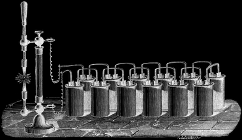
Early carbon arc lamp (Humphry Davy, 1802)
Source
To give a flavor of Ridley’s vision of innovation as a process, rather than the more widely told tale of heroic invention, let’s look at the most familiar invention story ever told: Thomas Edison and the light bulb.
Electric lighting began not in 1879 with Edison’s tungsten-filament, incandescent bulb but in 1802, when Sir Humphry Davy ran current from a battery of batteries5 (see Exhibit 1) through a device consisting, originally, of two carbon electrodes separated by air. The continuous spark between the electrodes produced a bright light. This “carbon arc lamp,” later familiar to moviegoers as a source of very intense light for projectors, was also the forerunner of the fluorescent bulb, which uses metal electrodes and mercury vapor instead of air.
The usefulness of electricity for lighting was obvious to everyone by the 1870s. Tinkerers as well as organized teams of researchers worked on a myriad of ways to replace the arc, or spark, with a tangible filament that would use less electricity per unit of light produced and be durable enough for practical use. The outlines of a solution were obvious to Edison and his many competitors; the exact specifications were not.
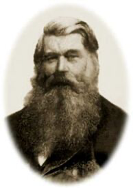
Sir Joseph Swan (1828-1914), British co-inventor of the incandescent light bulb
Source
At least 21 people made contributions to the light-bulb design significant enough to justify the claim of light-bulb inventor. Other than Edison, Joseph Swan had the strongest claim. Twenty years Edison’s senior, and sporting a luxuriant beard and a knighthood, Swan was quite a contrast to the faux-humble country boy from Ohio who just happened to be an electrical engineer.
And, of the 21 inventors, Ridley writes, “Swan was the only one whose work was thorough enough and whose patents were good enough to force Edison to go into business with him.” The two men’s joint venture, called Edison & Swan or Ediswan for short, prospered in Britain. Amazingly, the firm still exists: “Ediswan still survives as a manufacturer of valves (located in Bromsgrove, England),” reports Wikipedia.6
Yet I’ll bet not one American schoolchild in 1000 has heard of Joseph Swan.
Better, easier, cheaper
Of course, the whole point of innovation is not to demonstrate one’s cleverness, but to help other people (and make money thereby). The incandescent light bulb really bent the curve of lighting cost, which had been headed downward for a long time, but accelerated after the light bulb became commercially successful near the end of the 19th century.7 The Ediswanian miracle bulb is a shining example (sorry) of doing more with less, in this case producing more light with less energy and, more importantly, less labor to pay for the energy. Ultimately, that is what innovation is for: to make life easier.
The Ediswanian rule
The many-fathered light bulb is, Ridley argues, not the exception but the rule: “Six different people invented or discovered the thermometer, five the electric telegraph, four decimal fractions, three the hypodermic needle, two natural selection.” The science writer Logan Chipkin notes that “even Einstein’s theory of relativity… may have been discovered shortly thereafter by Hendrik Lorenz.”8 Henri Poincaré was also hot on the trail of relativity at the same time, and there were many other participants in the story. Importantly, critics and skeptics of relativity theory did not hurt the cause: They helped by showing where the blind alleys were, just as with the light-bulb developers who failed to find a usable filament material, and (this is important) documented their work.
Computers
Ridley’s little vignettes have a family resemblance, all pointing to the idea that innovations are a “team sport” and achieve worthiness only when they become democratized: cheap and widespread. The electronic computer is a case in point. The computer was the result of so much collaboration, achieved over two centuries (Lady Ada Lovelace, the first coder, was born in 1815), that no specific person can be said to have invented it. Charles Babbage’s mechanical (not electronic) “difference engine,” designed but probably never built, dates from his collaborator Lady Lovelace’s time, but it took another 100 years before Alan Turing, Claude Shannon, and John von Neumann, working independently but at about the same time, realized that an electronic machine could be taught to compute.
John Horgan, a science writer, explains:
Shannon showed how an algebra invented by the British mathematician George Boole in the mid-1800s – which deals with such concepts as, “if X or Y happens but not Z, then Q results” – could represent the workings of switches and relays in electronic circuits.9
In a previous Advisor Perspectives article, I said Shannon’s insight meant that, “if you wanted to construct a machine that could perform operations involving Boolean logic, you could build it out of electronic circuits. That is what a computer is. Consequently, Shannon’s paper has been described as the most influential master’s thesis ever written.”
Add that to the myriad of innovations in electronics, math, and code-writing taking place around that time and you eventually got – in 1945 – a team-built and hand-assembled monstrosity called ENIAC. It weighed 30 tons, was the size of two buses parked end to end, and contained 18,000 vacuum tubes and five million hand-soldered joints.
Computers have since gotten smaller and more powerful (but you knew that). The one in your iPhone, taking up but a small fraction of the device’s volume, has more computing power than a $30 million Cray-2 supercomputer from the 1980s, and 100,000 times the power of the computer in the Apollo 11 moon landing craft. Now that’s democratization! And it was all done one step at a time, mostly by people who were trying to make marginal improvements to some aspect of it, not by heroic inventors jumping out of the bathtub and shouting “Eureka” when they made their discovery. Computers are the best example of incrementalism in innovation: “There is no day when you can say: computers did not exist the day before and did the day after, any more than you can say that one ape-person was an ape and her daughter was a person,” writes Ridley, ever the evolutionist.
Man invents dog. Dog domesticates man
Low-tech innovation, one of Ridley’s specialties, is fun to study because we perceive it as background noise. The sanitary disposal of human waste is a story of gradual innovation and democratization. The ancient Romans had toilets and one Sir John Harington, the godson of Queen Elizabeth I and an amateurish poet,10 invented the flush toilet in 1596 but made only one of them (for the Queen). Almost four centuries later, Thomas Crapper made flush toilets commercially practical and thus widespread.11 Slow, incremental progress, not heroic achievement.
You think toilets are low-tech? Let’s go back farther in time…about 30,000 years. Humans sitting around a campfire, eating the catch of the day. Wolves approach the camp, hungry for leftovers but wary of the humans, who have been known to shoot at wolves with bows and arrows.
One wolf dares to approach the camp closely enough to actually snare some leftovers and finds the humans not entirely hostile. Over time, a population of wolves becomes associated with such camps, and fairly quickly (in evolutionary time) they become “dogs,” domesticated wolves shaped by selection pressure from humans to be friendlier, more docile, and more helpful in tasks like hunting than wild wolves. A new species, Canis familiaris, has become genetically, behaviorally, and physically distinct from the wolf, Canis lupus. It is the first large-scale (bigger than a bacterium) organism that has been genetically modified by humans, and the first one modified intentionally.12
The genetic engineering of dogs by humans did not always work out well. A proud and beautiful wolf of 30,000 years ago would be embarrassed to admit that the creature in Exhibit 2 is a direct descendant:
Exhibit 2

Wolf genetically modified by humans, 30,000 years after first contact
Amazingly, as Ridley reports, research by the Russian geneticist Dmitry Belyaev (1917-1985), showed that foxes can also be turned into “dogs” in just a few generations through selection pressure from humans, by breeding for friendliness and docility. While the fox-dogs do not closely resemble wolf-dogs genetically, they do behaviorally and even physically, with floppy ears, curly tails, foreshortened faces, and pleasant dispositions.13 Who knew?
Ridley also points out – although he is not the first to do so – that dogs also modified the behavior, if not the genetics and physical bodies, of people. They trained us to tolerate their presence, feed them, and protect them from harm. If an alien species visited us, they would think that people are slaves to dogs and horses. We pick up their scat. That is no mean accomplishment on their part! Of course, it is a fair trade. We get companionship, help with hunting, and, in the case of horses, rides. Why should the economics of exchange apply only to people?
Thinking about innovation
The second, philosophical section of the book merits a separate review. Like the first section, it is composed of vignettes, but they are of altogether a different character. They are what Blaise Pascal called pensées, thought bites.
Democratization
Ridley’s single most important thought-bite is that invention is only worth the time and trouble if it leads to an improvement in the lives of many people. A recurring theme in Ridley’s books is that technology makes it possible for ordinary people to enjoy benefits and luxuries that only the rich could previously afford. Even in ancient times, the wealthy could afford enough candles to provide adequate light, and servants to attend to them; today almost anyone can afford electric lighting. A rich Roman could have servants warm up water for bathing; today, hot and cold running water are ubiquitous. In Mozart’s Vienna, live music was available to the fortunate; today the same music can be heard on a very cheap radio. In How Innovation Works, Ridley fully develops this theme, noting, “it is the people who drive down the costs and simplify the product who make the biggest difference.”
Yet there are limits to what even a rich person can do without modern technology. Until the late 1800s, a king or a president couldn’t call his mother unless she was in the next room. Nobody could take penicillin if they got sick; they either died or got better naturally. Technology does bring truly new products and services to the marketplace.
Does science lead to technology, or the other way around?
One of Ridley’s more heterodox ideas is that basic scientific research is not the fount from which technology springs; it more often works in the opposite direction. Practical people tinker with real-life problems, and then scientists try to figure out why the solution works and only then make more general discoveries.
For example, variolation (deliberate infection with a small amount of the pathogen) was practiced for smallpox as early as 1700 and was promoted by Lady Mary Wortley Montagu, a young mother who was herself a smallpox victim early in the 18th century. Yet the reason for it working was not known until Louis Pasteur, in the 1860s, proved the germ theory of disease correct. Moreover, smallpox was caused not by a bacterium (which was visible in Pasteur’s microscopes) but by a virus, which is much smaller and its existence was not known until 1892. Technology – variolation, which led to a better procedure, inoculation – led science, in this case by more than a century.
Likewise, nobody knew what an electron was when Edison (and many others) ran trillions of them through wires to produce light and heat, and to power every gadget imaginable. Electrons were discovered in 1897 by a scientist who was curious to understand why electricity “worked.” The same story can be told about many other pairings of science and technology – or, should we say, technology and science?
Why innovation flourishes in freedom
Innovation occurs whenever people use resources (including their own human capital) more fruitfully today than they did yesterday, which is always and everywhere. But when does innovation flourish, with one advance quickly building on another and materially increasing well-being? Ridley argues:
[T]he secret sauce…is freedom. Freedom to exchange, experiment, imagine, invest, and fail; freedom from expropriation or restriction by chiefs, priests, and thieves; freedom on the part of consumers to reward the innovations they like and reject the ones they do not.
Liberals have argued since at least the eighteenth century that freedom leads to prosperity, but...they have never…found the mechanism, the drive chain, by which one causes the other. Innovation, the infinite improbability drive, is that drive chain, that missing link.
This is the punch line of the book. Ridley started out by Climbing Mount Improbable (Richard Dawkins’ memorable phrase)[14]: the duck, the iPhone, his own brain, our lives as we know them – all arrangements of elementary particles that shouldn’t be arranged that way but are. He finishes by claiming that innovation is the reason these improbable arrangements do exist. Ridley even claims that life itself is an innovation, albeit unintended (like many other, more humble and human innovations):
That it happened four billion years ago, when there were no living creatures, let alone intelligent ones, and that we don’t know very much about where and how it happened, does not detract from its status as an innovation. We do know that it was all about energy and improbability, both of which are crucial to innovation today. And the fact that nobody planned the origin of life is also a key lesson.
Advice for investors and general readers
Investors rely on innovation for that most basic factor in determining asset returns: economic growth. The growth model is this: Output equals the number of hours worked times the amount each worker produces per hour (called productivity). Since one can work only so hard, and we don’t directly control the population or the fraction that is working, increasing productivity is the most natural way to increase the quantity of goods and services produced and available for consumption.
Innovation is definitionally the principal source of growth in productivity. If you find a way to do more with less, that’s how we’ve defined innovation – and that is how people and economies become more productive. Thus, investors need to be keenly aware of the sources of, and obstacles to, innovation in their search for prospective returns.
Unlike some of Ridley’s other books, How Innovation Works is a quick, easy read – 396 pages of large print. It does not provide the liberal arts version of a technical education in a new field, as his books Genome (about human genetics) or The Red Queen (about sexual selection) do. It is not, as Ridley claims, his best book – I’d give that honor to The Rational Optimist, which sets out the case for human progress in both the past and the future. But Ridley’s third or fourth best book, explaining the mechanics of said progress, is a more enriching experience than most authors’ very best. Read it.
Laurence B. Siegel is the Gary P. Brinson Director of Research at the CFA Institute Research Foundation, the author of Fewer, Richer, Greener: Prospects for Humanity in an Age of Abundance, and an independent consultant. He may be reached at [email protected]. His web site is http://www.larrysiegel.org.
1 The capital accumulation explanation for growth, which is valid for small improvements, fails at a large scale because of diminishing marginal returns to capital (you have plenty of capital but nothing profitable to invest in).
2 The book’s original subtitle, “Serendipity, Energy, and the Saving of Time,” probably aimed at British readers, is actually more revealing of the book’s contents.
3 Page 294 in chapter 17.
4 See the excellent article on incremental and process innovation, “Reviving America’s Forgotten Innovation System: Fostering US Growth through Incremental Product and Process Innovation,” by Dan Breznitz and Peter Cowhey, in Adler, David E., and Laurence B. Siegel, editors, The Productivity Puzzle: Restoring Economic Dynamism, Charlottesville, VA: CFA Institute Research Foundation, 2019. The authors demonstrate that such innovation is largely brought about by line workers and rank-and-file engineers.
5 The etymology of the word “battery” for an electrical cell is Davy’s design that hooked together multiple cells in a battery, like a battery of armaments.
6 https://en.wikipedia.org/wiki/Edison_and_Swan_Electric_Light_Company, accessed on September 23, 2020.
7 The lighting cost curve over time is shown in my book, Fewer, Richer, Greener, on page 150. The cost per lumen-hour fell by a factor of about 10,000 between the year 1300 and today.
8 https://quillette.com/2020/05/29/how-innovation-works-a-review/
9 Horgan, John. 2016. “Claude Shannon: Tinkerer, Prankster, and Father of Information Theory.” IEEE Spectrum (April 27).
10 Harrington is responsible for the familiar bit of doggerel, “Treason doth never prosper/ What’s the reason?/ For if it prosper/ None dare call it treason.” It’s not Shakespeare, but there is some wisdom in it.
11 Crapper’s biography, by Wallace Reyburn, is entitled Flushed with Pride.
12 Prey animals may also have been genetically modified by humans through selection pressure, but it is harder to tell. Bacteria are continuously genetically modified, by humans and other animals, to be helpful servants in our guts.
13 See also Goldman, Jason G. 2010. “Man’s new best friend? A forgotten Russian experiment in fox domestication.” Scientific American guest blog (September 6),
14 Dawkins, Richard. 1996. Climbing Mount Improbable. New York: W. W. Norton & Co.
Membership required
Membership is now required to use this feature. To learn more:
View Membership BenefitsSponsored Content
Upcoming Virtual Events View All












