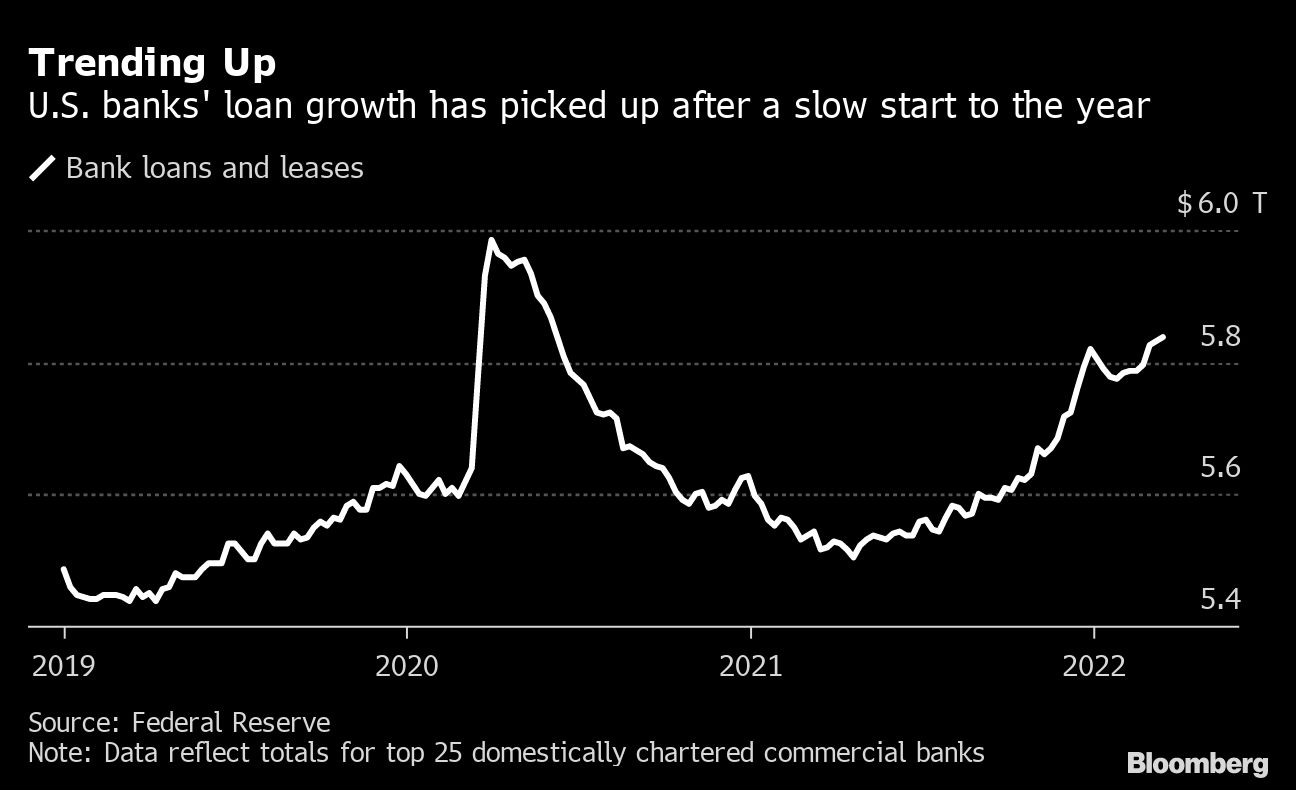
Loan growth at the largest U.S. banks is finally staging a comeback after being absent for much of the pandemic, but investors are eager for signs the rebound is strong enough to withstand rising interest rates and economic uncertainty following Russia’s invasion of Ukraine.
Wall Street executives have long promised lending would return as the economy recovered and government stimulus programs ended, and there is evidence that’s starting to materialize. Borrowing at the 25 biggest U.S. firms rose for seven consecutive weeks, with loans 5.8% higher as of mid-March than they were a year earlier, according to Federal Reserve data.

But the pickup may not be enough to satisfy investors who want to see a dramatic improvement in core lending profits. Firms are deploying just half of their deposits -- compared to 70% before Covid-19 -- and continue to spend excess cash on low-risk assets like U.S. Treasuries. Lending is coming back in fits and starts -- it dipped at the start of the year -- and while commercial debt has strengthened in recent weeks, consumer loans have stalled.
“There’s certainly a ways to go,” said Barclays Plc analyst Jason Goldberg. “Should the economy slow, whether it’s geopolitical situations or growth slows quicker than expected as the Fed hikes rates -- that could certainly weigh on loan growth.”
Analysts expect first-quarter net interest margins -- a measure of what banks profit from lending -- to increase for the first time since 2019 at Citigroup Inc., Bank of America Corp. and Wells Fargo & Co., according to data compiled by Bloomberg. The biggest banks are set to report results next month.
Borrowing accelerated at the end of last year, and analysts and executives say that’s likely to continue as stimulus cash wanes. Companies grappling with supply chain snarls and labor shortages are expected take on debt -- whether that’s to boost inventory, change suppliers or invest in technology. And consumers may need to borrow once their savings dwindle.
“There is a pent-up demand,” said Terry Dolan, chief financial officer of regional lender U.S. Bancorp, during an investor conference. “We continue to see the economy being relatively strong and consumer spending -- and actually, business activity -- starting to pick up.”
As the Fed raises benchmark interest rates, banks stand to profit from higher net interest income, or the revenue collected from payments minus what depositors are paid. That’s especially meaningful at regional lenders, where traditional lending accounts for a greater share of revenue.
But higher rates also mean more expensive loans, which could deter some consumers.
“First-quarter earnings will be very telling,” said Piper Sandler & Co. analyst R. Scott Siefers. “We just want to make sure that what appears to be, on the surface, a very strong outlook is indeed going to play out.”
Bloomberg News provided this article. For more articles like this please visit
bloomberg.com.
Read more articles by Jo Constantz