Cloudy with a Chance of Technological Breakthrough
Membership required
Membership is now required to use this feature. To learn more:
View Membership BenefitsWill the cloud drive massive increases in productivity and wealth – as the internet did before it? That is the central question asked by Mark Mills in his stunning new book, The Cloud Revolution.
Little changes sometimes morph into very big ones by stealth: you don’t see the big change coming until it has enveloped you. This is how ARPANET, an obscure Defense Department project started in 1966, came to infiltrate every aspect of civilized life as it expanded into the global wireless internet.
More often, little changes fizzle out or have a gradual, evolutionary influence. Which path will the emergence of the cloud, the latest “new new thing” in information technology, take?
 In The Cloud Revolution, the physicist and venture capitalist Mark Mills says that the cloud is “as different from the Internet as the [Internet] was different from telephony.” He argues that it has already started to spark an economic boom that will transform life more profoundly than the internet did. If he’s right, the implications for investors are remarkable: a continuation of the long bull market and spectacular returns for the most directly affected companies. If his forecasts are exaggerated, investors need to be more careful.
What’s the cloud?
Before exploring the merits and demerits of the cloud, it behooves us to ask: What is it?
The internet, parent of the cloud, was famously described as “everybody’s computers, connected”;1 actually, it’s that plus the infrastructure that allows them to be connected. There’s a physical Internet “backbone,” but the distinctive part of the infrastructure is a set of standards or protocols, such as TCP/IP, that make it possible for these computers to “understand” each other’s “languages.” The Internet fell together almost by accident, and it’s a remarkable piece of collective engineering.2
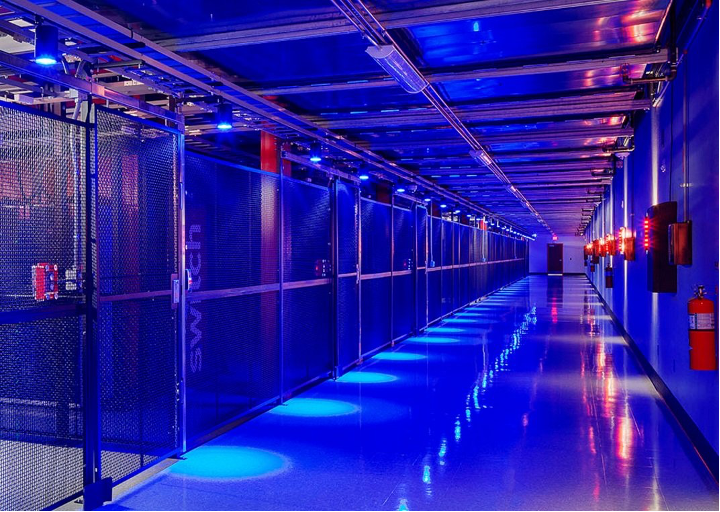
Unlike the internet, which is the combination of all these physical and ethereal parts, Mills writes, “The cloud is not an ethereal thing; it’s a physical infrastructure. By all measures – dollars, physical equipment, square feet of buildings – it’s the biggest infrastructure humanity has ever built.”3 A piece of this infrastructure, located in Las Vegas, is shown in exhibit 1.
Exhibit 1
Switch Inc. data center in Las Vegas
 Mills continues,
One square meter of a typical cloud data center has about a thousand times more comput[ing] horsepower than the whole world had in the early ’80s, and we’re building out data centers at … the rate of about 10 million square feet a year. And data centers, interestingly, cost about the same to build [in dollars per square foot] as a skyscraper like the Empire State Building or the World Trade Center.4
In other words, the cloud is very un-cloudlike in the ordinary sense of the world; it’s a thing. It is not the internet. It interfaces with and acts as part of the internet. It consists of data centers like the one shown above, in every part of the world, along with wired and wireless means of transmitting data from users to these centers and back again. The cloud is an energy and materials hog on a mammoth scale. Mills predicts that it will be the largest infrastructure project ever.
Obviously, an infrastructure investment on this scale has profound implications for investors. On the construction side, trillions of dollars will flow to the energy and materials sectors. (Cumulative costs have already passed $1 trillion.5) On the usage side, the cloud’s proponents argue that radically more abundant, faster, and cheaper information will have beneficial effects on almost everything. I’m not entirely sure, but it’s possible.
Recentralization
In the last generation, we’ve been sold hard on the virtues of decentralization. The internet is decentralized and has benefited us beyond measure. DeFi (decentralized finance), an emerging blockchain-based set of technologies for storing, verifying, and transacting financial and real assets, has promise.
As with any new technology, some of the claims regarding “decentralized everything” are exaggerated. Some things are done better when decentralized (love and marriage); some are done better when centralized (clearing of financial transactions). Bitcoin is the ultimate decentralized “currency”; TIME Magazine warns us that “because there is no centralized authority that manages Bitcoin, transactions cannot be reversed and mistakes cannot be rectified.”6 When my bank screws up, I talk to the manager, someone with the authority to fix the problem. Central authority in some settings is very valuable.
The cloud swims against the tide of history – it’s centralized. Unlike the traditional Internet, the cloud needs only one copy of every piece of software. It needs only one copy of every piece of data. In fact, the cloud started out as a way to provide “software as a service” (meaning: software for which you have to pay a recurring subscription fee, because you don’t own it). To that, the cloud adds remote data storage as a service, so you don’t have to buy, maintain, and keep track of storage devices.7
These centralized attributes cause everybody’s computer to be exactly the same. OK, “exactly” is an exaggeration because keyboard layouts and screen specifications differ, as well as some other details. But, as long as you can identify yourself to the cloud, you can use your data, as well as the software to which you’re entitled, on any computer. You don’t need to own a device at all! The one at the public library is fine. We may be headed toward “hardware as a service.”
So much for decentralization being the only trend we need to follow.
Rematerialization
Mills is in part a materials scientist, and he devotes three chapters to materials, a much-neglected component of technological change. He writes,
… [A] popular notion has it that society is “dematerializing” … The proposition is that, as economies become increasingly service-dominated, accelerated by the Amazonification and Uberization of everything, “the need for resource-intensive manufacturing is not inevitable.” Materials and materials-centric industries are, in this worldview, passé.
The quote-within-a-quote is from Andrew McAfee’s More from Less, the gospel of dematerialization, which I reviewed in favorable terms here. My book, Fewer, Richer, Greener, also has a chapter on dematerialization, drawing on McAfee’s and others’ work. I pointed out (in the article, not the book) that a $1,000 smartphone has capabilities that, as best you could replicate them, would have required equipment costing $32,136,910 as recently as 1985. “Drop the $32 million Cray-2 supercomputer (which has the same processing power, 1.9 gigaflops, as a good smartphone) and it’s $136,910,” I wrote.
Since I finished my book, the Apple A13 Bionic chip, which powers the most recent iPhones, has been released and can do 732 gigaflops. That’s a 385-fold improvement in about five years.
Dematerialization is thus the main trend, and it is not going away. But let’s give Mills’ rematerialization hypothesis a fair hearing. It has merit and, while his narrative below digresses from the cloud a bit, it’s fun to read about the progress in a field, materials science, that few of us know anything about:
A century ago, cars were manufactured only using a handful of materials: wood, rubber, glass, iron, copper, vanadium, and zinc … Today a car … is built from other three dozen different nonfuel minerals, including increasingly a mélange of the 17 so-called “rare earth” elements. Similarly, while a cellphone circa 1980 contained a couple of dozen elements from the periodic table, today’s smartphones exploit the properties of over 70 different types of atoms …
Mills then lists (and describes, but I’ll leave out the descriptions) some new kinds of materials:
Electronic textiles … biocompatible materials … transient electronics … adaptive materials … self-healing materials … programmable materials … self-assembling materials.
Then there are biomimetic (life-imitating) materials, such as artificial skin. With materials science leaping ahead in these ways, we should not expect just the dematerialization that dominates the popular-economics headlines, but also some rematerialization. Nor are these advances going to save on energy: finding, mining, processing, and using these exotic materials are all energy-intensive activities.
Finally, Mills reminds us, the cloud itself is extremely energy intensive: “The pattern-learning phase for a single artificial intelligence application can consume more compute energy than 10,000 cars do in a day.”8 Wow. Maybe we ought to weigh the costs and the benefits of cloud-based AI applications more carefully.
And, according to Mills, the cloud is so productivity-enhancing that it is subject to a Jevons problem. William Stanley Jevons, a nineteenth-century British economist, found that the cheaper coal became, the more total spending on coal (P x Q, the price times the quantity of coal purchased) grew instead of shrinking as one might guess from the lowering of price. The reason was that the low prices spurred new uses for coal, and caused coal to displace competing energy sources, so that Q grew faster than P shrank. Mills believes that the cloud’s energy use will increase substantially, despite energy becoming cheaper as renewable and nuclear power sources come onstream. If he’s right, we should invest in energy producers. But investing in advanced materials producers is more fun and might even be more profitable.
How big is it?
Like the friends of the legendary fisherman who let the really big one get away, we want to know, “How … big … is … it?” How big is the cloud now? How big is it likely to get?
The most salient way in which the cloud differs from previous computing environments is data storage capacity, so let’s answer the question in those terms. A decade ago, reporter Tuan Nguyen impressed even himself by noting that the total data storage capacity of the world was 295 exabytes, which is 295 billion billion bytes.9 By 2025, with cloud build-out expected to be nowhere near complete, total cloud capacity (about half of the world’s overall data storage capacity) is expected to be 100 zettabytes.10 A zettabyte is a thousand exabytes.
A word has already been coined for 1,000 zettabytes – “yottabyte” – and, given the growth rate I just documented, it will be needed before the end of this decade. Linguists and wags are busy inventing words for new powers of 1,000: a hellabyte (a hell of a lot of bytes) or brontobyte stands for 1,000 yottabytes. (I’m not joking, although maybe the inventor of these words was. But you can bet they’ll be used.) And 1,000 brontobytes, that is, 1030 bytes, is a geopbyte; I can’t even pronounce it.11
What is the cloud for?
What good is all this data storage?
It was said about the Internet that no one initially knew what it was for; you just had to connect everyone’s computers together and see what happens. We can say the same thing about the cloud.
Here are some examples of very large data storage requirements: photography, medicine, geolocation. We’ll go through these very quickly.
Photography
There are more than five billion smartphone users, all wanting to save their photos and videos. Five billion phones, times 10 photos a day, times 365 days per year, times two megabytes per picture is 36 quintillion bytes (36 exabytes) of data recorded each year, plus all the forwards and downloads. Multiply by some modest number for videography instead of photography. Whether this usage is frivolous or purposeful, somebody is paying for it, and will pay more in the future (see my comment earlier about the Jevons problem); that’s what investors should be focused on.
Medicine
But the benefit goes well beyond me being able to see billions of sumptuous meals, kittens, and vacationers posing in front of tourist sites. A doctor can look at a patient’s MRI from her computer on another continent. It is conceivable that microrobots traveling through patients’ blood vessels, in search of cancer cells to destroy or brain cells to repair, could take many more pictures or movies than 36 quintillion bytes’ worth per year. Remote surgery requires not just a large but also a very fast data feed from the surgical site to the surgeon – and back. When something, in this case both storage and data transmission, becomes very cheap, it’s hard to forecast the uses to which it will be put.
Geolocation
With cheap cloud data storage and fast transmission, my Uber driver can find my destination without having any idea where it is. GPS, which is on its way to being a cloud application, does the thinking for him. Eventually autonomous driving, admittedly a long way off for safety and liability reasons, will make the Uber driver look unimpressive. The data feed from the self-driving car to the cloud and back is so large, and the need for speedy communication so intense, that the speed of light is a constraining factor, causing the system to need subsidiary servers that are physically closer to the car than a central cloud data bank could ever be.
This all sounds like science fiction written by a high school student, but it’s real or will be, and it adds up, significantly boosting productivity growth. If the 1.7% to 1.8% per year long-term growth rate of productivity, and thus global per-capita income, is going to continue far enough into the future to make us all “rich” by current standards, which is to say that everyone can become middle class, we will need innovations on this scale. That is the main takeaway from Mills’ book, and I hope that in his enthusiasm he is not exaggerating too much.
Other cloud applications
I’ve already alluded to AI/ML, artificial intelligence and machine learning, as a use of the cloud. The amount of hype behind AI/ML is staggering. The internet of things (IoT), which uses billions of little “sensors” that collect data and communicate with each other while leaving us out of the loop until we need to be in it, is a cloud application too. And then there is the internet of bio-nano-things (IoBNT).12 (Seriously.) That’s a new name for what I described earlier, sensors or microrobots swimming around in my bloodstream looking for, and stopping, trouble.
Life is becoming a science fiction story.
The roaring twenties?
So far, this has been the decade from hell: a war lost in Afghanistan, another one raging in Ukraine as I write, a deadly pandemic that is still not over. Fortunately, U.S. markets have held up well. But they are high-priced, and thus offer less future upside than they would at more typical valuations.
Technology, however, has a way of progressing under the surface even when world events are chaotic. Technological advances during the Great Depression decade of the 1930s, including safe passenger aviation and efficient long-distance telephony, were some of the most rapid and profound in history. The 2020s will roar in this sense; in 2030 we’ll look back on current technology as primitive, and the cloud will have played a role in that transformation.
But the book’s subtitle – “How the Convergence of New Technologies Will Unleash the Next Economic Boom and A Roaring 2020s” – promises more economic insight than it delivers.
Mills is not an economist, although because he is a venture capitalist, you’d think he could phrase his forecasts in more explicitly economic terms. The book is, thus, almost entirely about technology. To give an economic flavor to his narrative, he uses the Kondratieff wave, the long-term (roughly 60-year) cycle that, according to its discoverer, reflects the amount of time it takes for a truly revolutionary technology to be born, grow to meaningful size, and reach maturity – after which the cycle starts anew with a different revolutionary technology.
This cycle, in Kondratieff’s view, causes the economy to grow and stabilize in a roughly 60-year rhythm. While many economists believe that a longer cycle, corresponding to “industrial revolutions,” better fits the data, the basic idea of economic cycles is sound. (Stalin didn’t think so, and banished Kondratieff to Siberia for showing that progress isn’t linear.)
But, if even half of the technological change that Mills forecasts comes to pass, the 2020s will be as disruptive, and potentially profitable, a decade as has ever occurred.
Reflections on The Cloud Revolution and productivity
Mills’ wrote The Cloud Revolution to set forth the technological innovations that we can expect, in practically every field of endeavor, from cloud computing and its offshoots. My purpose in this review is to note that technological innovation leads to productivity growth, which is the only way to achieve increased per capita wealth and income. It is productivity growth that leads to profit growth, which in turn creates sustained investment returns.
But we are left with some unanswered questions:
- Will cloud computing decrease costs in the economy overall, and/or extend the reach of what the economy can accomplish, enough to advance macro productivity?
- Will it increase the network effect (the rise in the value of a technology caused by more people adopting it)?
- What are the known things that we cannot do today that we could do if the cloud’s capabilities materialize as Mills forecasts – for example, 3D printing that is accurate and affordable enough to change the concept and practice of manufacturing? Effective and commonplace remote surgery?
The answers are implied in the book’s many detailed stories, but Mills could have provided a concise summary, focusing on what are awkwardly called “takeaways.” One could argue that the whole book is a takeaway, but such a response ducks the obligation to readers to provide something quotable to report to their friends, colleagues, and fellow readers.
We are also interested in the downside. “Digitalizing what we see and do,” Mills’s phrase, does not overcome the objection that there is not much truly new information, just a very large increase in the number of bits produced by digitizing it. All this data collection and storage has a cost in energy, materials, and human effort – are we sure that the cost does not exceed the benefit? “Where is the knowledge that we have lost in information?” asked T. S. Eliot more than a century ago.
Business does not always get things right. The new cable-technology companies at the turn of the century pursued the 99.999% (five 9s) reliability of the Bell System. But customers wanted mobility, streaming audio and video, and multiple functionality (the smartphone) and would have been happy with five-8s, 88.888% reliable, phone service – static and dropped calls. Replacing today’s highly successful internet ecosystem with a cheaper cloud ecosystem might well bring little gain or an actual loss – the cloud-based Office 365 application suite is notoriously awkward and unreliable.
While Mills’ book is weak on these tradeoffs and should treat them more explicitly, his erudite histories of work, machines, and energy are terrific, and they alone make the book an important read, especially in the context of the long-term improvement in productivity and progress that the cloud can generate.
Implications for investors
Whether or not Mills is right about the cloud being a vast leap beyond the internet, it’s coming, and the energy, materials, and real estate needed to build it will be purchased. Buy the companies that are selling blue jeans to the gold miners: mining companies, advanced materials producers, and producers of the energy that the cloud will consume.13 Maybe even the real estate on which cloud facilities will sit. Buying cloud service providers is too easy; everybody’s doing it, and the prices are already high. (Switch, whose data center is shown on page 2 and is growing revenues at 16% per year, has a P/E of 133.)
However, if the cloud is the energy and materials hog that it appears to be, and energy does not become radically cheaper (if you wait long enough it will, but few people have that long an investment horizon), then energy and materials costs will constrain the otherwise remarkable potential of this new industrial sector.
The global economy will get whatever efficiency benefits or cost savings that flow from use of the cloud, as with any other technological improvement. The latter – the extent to which the cloud revolution extends to the economy more generally – is the tricky part, hard to assess.
Conclusion
Mills is a man of many talents and accomplishments. His eclectic knowledge makes the book a satisfying read. It could have been 400 pages on circuits and switches, but Mills is far too intellectually curious to do that to us. He surrounds his paean to the cloud with very strong auxiliary material, including meditations on why technology matters, how technological revolutions unfold, and what could go wrong. Mills’s ability to do this shows why the best books on a technical topic are written by a specialist who can double as a generalist.
This is a futuristic book. There is always a hint of P. T. Barnum in books that predict a technology-driven economic boom and productivity party. Mills keeps the Barnum-isms to a minimum and, much to his credit, he comes close to saying that there’s no such thing as a futurist: “We’re all forecasters.” All of us embed forecasts, explicit or implied, in everything we do.
The Cloud Revolution is a worthy and challenging read, and I highly recommend it.
Laurence B. Siegel is the Gary P. Brinson Director of Research at the CFA Institute Research Foundation, the author of Fewer, Richer, Greener: Prospects for Humanity in an Age of Abundance, and an independent consultant. His latest book, Unknown Knowns: On Economics, Investing, Progress, and Folly, contains many articles previously published in Advisor Perspectives. He may be reached at [email protected]. His website is http://www.larrysiegel.org.
The author wishes to thank Stephen Sexauer, CIO of the San Diego County Employees Retirement Association, for introducing me to the book and to Mark Mills, and for contributions to this article that are right at the cusp of co-authorship (which he graciously declined). The section on Reflections is his thinking, restated in my words. I can be reached at [email protected] and my web site is http://www.larrysiegel.org.
1http://www.uky.edu/~sdbaker/tel101/w5net.ppt
2This is not to say that the Internet evolved without intelligent design. Tim Berners-Lee invented the Web browser, Alan Emtage the search engine. These are individual accomplishments. ARPA at the Department of Defense developed elements of the Internet, including TCP/IP and packet switching, without which the whole thing would have failed. But there was no central authority saying, “We need to connect everybody’s computers – let’s figure out the needed steps and assign each of them to somebody” as one would if building a car. In that sense, the Internet fell together – it is an accident of history.
3Not from the book, but from a blog post by James Pethokoukis and Mark Mills on the American Enterprise Institute web site at https://www.aei.org/economics/5-questions-for-mark-mills-on-the-cloud-revolution/.
4Also from the Pethokoukis and Mills blog post.
6Prasad, Eswar. 2021. “The Future of Crypto Is Bright, But Governments Must Help Manage the Risks.” TIME.com, Posted October 22, 2021 at https://time.com/6108232/bitcoin-cryptocurrency-future-blockchain-regulation/.
7Initially I was furious that I had to pay a recurring fee for something that I could have owned for cheap. But, as with most price increases, I am getting used to it. And cloud storage has saved my hide when I’ve lost files or destroyed a hard drive.
8https://www.manhattan-institute.org/our-love-of-the-cloud-is-making-a-green-energy-future-impossible. In a 2020 article, a New York Times reporter, Steve Lohr, argues, contra Mills, that the Cloud is making previously very energy-intensive applications less costly in terms of energy: https://www.nytimes.com/2020/02/27/technology/cloud-computing-energy-usage.html.
9https://www.zdnet.com/article/what-is-the-worlds-data-storage-capacity/
10https://www.cloudwards.net/cloud-computing-statistics/
11Wait, there’s more. Mills writes, “Arrays of communications hardware propel bytes along ‘highways’ constituting not only roughly three billion miles of glass cables, much of it buried, but also the equivalent of another 100 billion miles (that’s 1,000 times the distance to the sun) of invisible connections forged by 4 million cell towers.” Billions and billions. I’d argue that all that stuff is the Internet and the mobile phone network, not the cloud, but the cloud would be pretty useless without it.
12Akyildiz, I. F., M. Pierobon, S. Balasubramaniam, and Y. Koucheryavy. 2015. “The Internet of Bio-Nanothings.” IEEE Communications Magazine – Communications Standards Supplement (March), https://mbite.unl.edu/files/papers/2015/j1.pdf
13I do not recommend specific companies in any of my work. Also, I am not a registered investment advisor or broker/dealer, nothing in this publication should be construed as investment advice, etc.
Membership required
Membership is now required to use this feature. To learn more:
View Membership BenefitsSponsored Content
Upcoming Virtual Events View All











