Everyone insisting America isn't up to managing the world’s No. 1 economy after the Covid-19 pandemic caused the highest joblessness since the Great Depression and biggest cost-of-living increase in 40 years should ask: When was the last time US unemployment and long-term Treasury yields were below 4% after the Consumer Price Index declined at least 3 percentage points to a single digit?
That would be at least half a century ago before Congress authorized the Federal Reserve in 1977 to “ promote effectively the goals of maximum employment, stable prices, and moderate long term interest rates.” Conspicuous by its absence in the persistent complaint that the Fed is “behind the curve” when it comes to fighting inflation is any mention of this dual mandate.
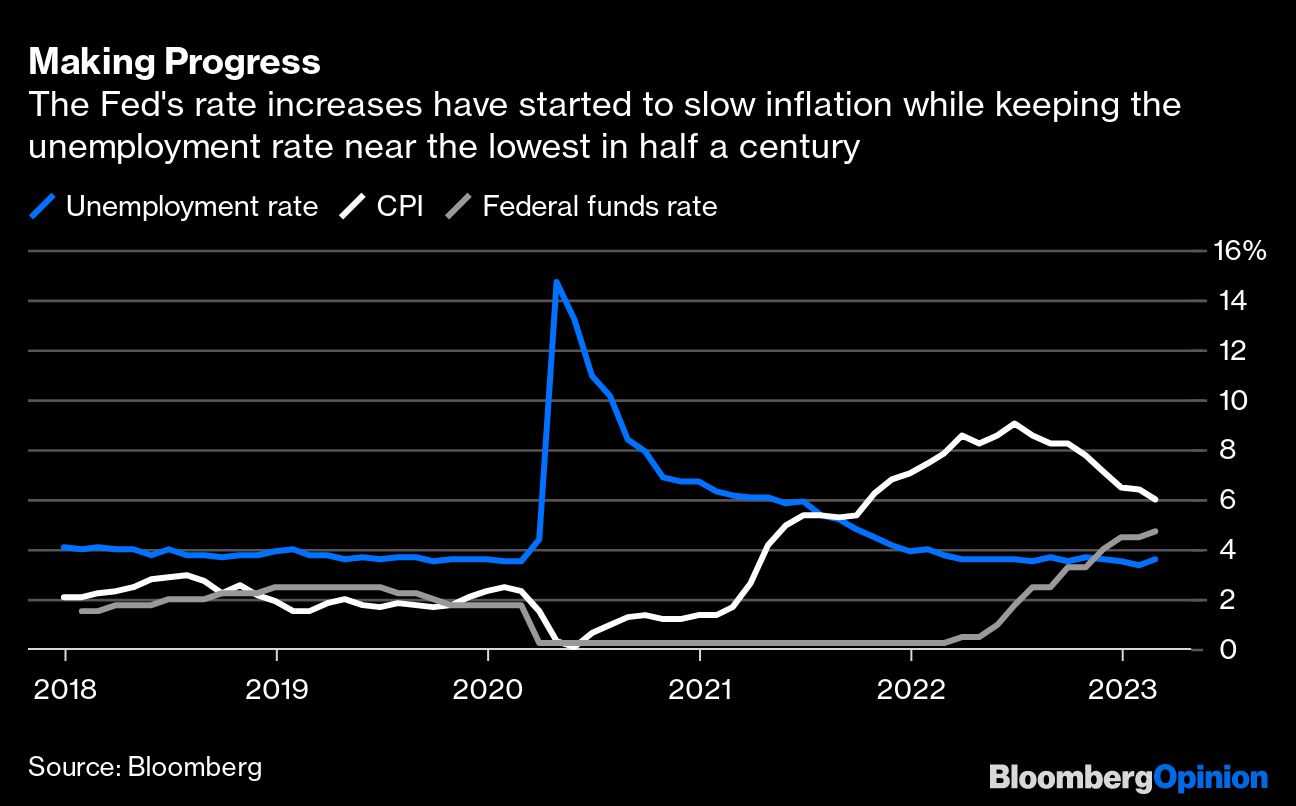
Media narratives miss the context that the Fed is fulfilling its obligation to restrain wage and price pressures while so far avoiding a recession. Unemployment fell to a 54-year-low of 3.4% in January even after the Fed had raised its target interest rate for overnight loans between banks – the federal funds rate – seven times over the prior 10 months, from 0.25% to 4.50%. (The Fed has since lifted the target twice more, to 5%.)
The consequence of this unprecedented tightening of credit in the Fed's 110-year history prompted similarly anomalous anxiety among market participants. Investors suffered the highest implied volatility in the market for Treasuries since the financial crisis of 2008, according to data compiled by Bloomberg. But unlike previous cycles of extreme bond market fluctuations, Americans are benefiting from the lowest average unemployment since 1969 and an economy that expanded 3.6% during the last half of 2022 as measured by gross domestic product.
How the economy came through the pandemic with a stronger labor market and an inflation rate that has started to trend lower after an initial spike can be attributed to the Fed's data-dependent policies, matter-of-factly explained by Paul Samuelson, the Nobel laureate and author of the best-selling textbook, “Economics.” Asked in 1970 why his preferred rate of inflation differed in the book's various editions, Samuelson replied: “When events change, I change my mind. what do you do?” Samuelson later credited the comment to John Maynard Keynes, who said decades earlier that a successful investor must be willing to adjust an opinion when facts and circumstances change. Keynes, the British-born mathematician before he become an economist and philosopher who changed the theory and practice of macroeconomics and policies of governments, also said, “Anything we can do, we can afford.”
When Covid-19 abruptly shuttered the economy in March 2020, the Fed slashed the fed funds target rate to 0.25% from 1.75%. That was precisely when unemployment jumped to 4.4% from 3.5%, in what was then the largest monthly increase in 67 years, according to data compiled by Bloomberg. (The next month, the unemployment rate rocketed to 14.7%.) Inflation, meanwhile, accelerated at the fastest rate since 1981 on global supply-chain disruptions, spending by the government to support individuals and businesses through the pandemic, and the subsequent energy crisis caused by Russia’s invasion of Ukraine.
So when unemployment dropped to the pre-pandemic level of 3.6% in March 2022, the Fed began raising rates. Critics were ubiquitous in decrying the Fed for being “behind the curve” even as the bond market showed no lack of confidence in the central bank with inflation expectations consistently anchored. The Consumer Price Index peaked at 9.1% in June on a year-over-year basis and was last at 6% for February.
The relatively benign current outcome of Americans fully employed without uncontrollable inflation is the opposite of what happened between 1970 and 1980 when the Fed raised its key rate to 13% from 5.5%. Back then, the CPI surged to 12% from 3% and unemployment climbed to 9% from 5%. By 1980, the Fed was still raising rates, to 20%, with a CPI of 15%. Unemployment rose to a post-World War II high of 10.8% at the end of 1982. Consumers and companies alike were roiled by such extreme volatility, ushering in decades of widening wealth and income inequality.
Now, corporate America is as healthy as it’s ever been and unemployment has returned to its lows. The ratio of company debt to earnings before interest, taxes, depreciation and amortization (Ebitda), which measures a company's total debt obligations divided by its yearly earnings power, fell to a record 0.95 among members of the benchmark S&P 500 Index last year. Earnings rose to a record $224 a share.
Homeowners’ equity in real estate increased to as much as $31 trillion, the highest since data was compiled in 1946. The strength of consumers and households allowed them to cope relatively well despite the incessant media focus on gasoline prices, which peaked at an average of $5 for a gallon of regular grade petrol after West Texas Intermediate crude oil fetched a decade-high of $122 a barrel in June. Oil has since dropped 38% to around $74, a level consistent with its 20-year average, and gasoline tumbled 31% to $3.40.
Even though the average household debt service ratio has increased the past two years, at 9.7% it is on par with where it was heading into the pandemic and still far below the peak of 13.2% in 2007, according to Fed data compiled by Bloomberg. And although the 30-year fixed mortgage rate rose to 7.08% late last year from around 2.65% at the start of 2021, the current rate of 6.39% is still below the 52-year average of 7.76%, data compiled by Bloomberg show. What about rising apartment rents? They are quickly moderating, slowing from a 17% annual gain a year ago to a recent 6.3%, according to Zillow Group, the tech real-estate marketplace.
Unlike in the 1970s when the expectation of faster inflation was widespread, Americans anticipate consumer prices rising just 2.8% during the next five to 10 years, according to the University of Michigan’s monthly sentiment survey. The same measure was as high as 9.7% in 1980. The consumer survey by Federal Reserve Bank of New York has inflation slowing over the next three years to 2.7%, the least since June 2020.
The $24.3 trillion US government bond market, for all its recent price fluctuations, similarly shows no wavering from its expectation that inflation will diminish substantially. Zero-coupon inflation swaps, which are payments calculated on future inflation exchanged for payments based on the actual inflation rate, reveal the year-over-year CPI will be 5% next month, 3.3% in six months and 2.6% in 12 months, according to data compiled by Bloomberg.
To be sure, with yields on short-term notes higher than those on long-term securities, a phenomenon commonly known as an inverted curve, are reliable predictors of recession that typically arrive a year or two after the Fed raises rates. But even when the inevitable recession comes, it may not be as severe as the 1981-1982 downturn because of the Fed's so far successful attainment of the dual mandate.
Bloomberg News provided this article. For more articles like this please visit
bloomberg.com.