Emerging Markets Decline Amid China Deflation, US Growth Worries
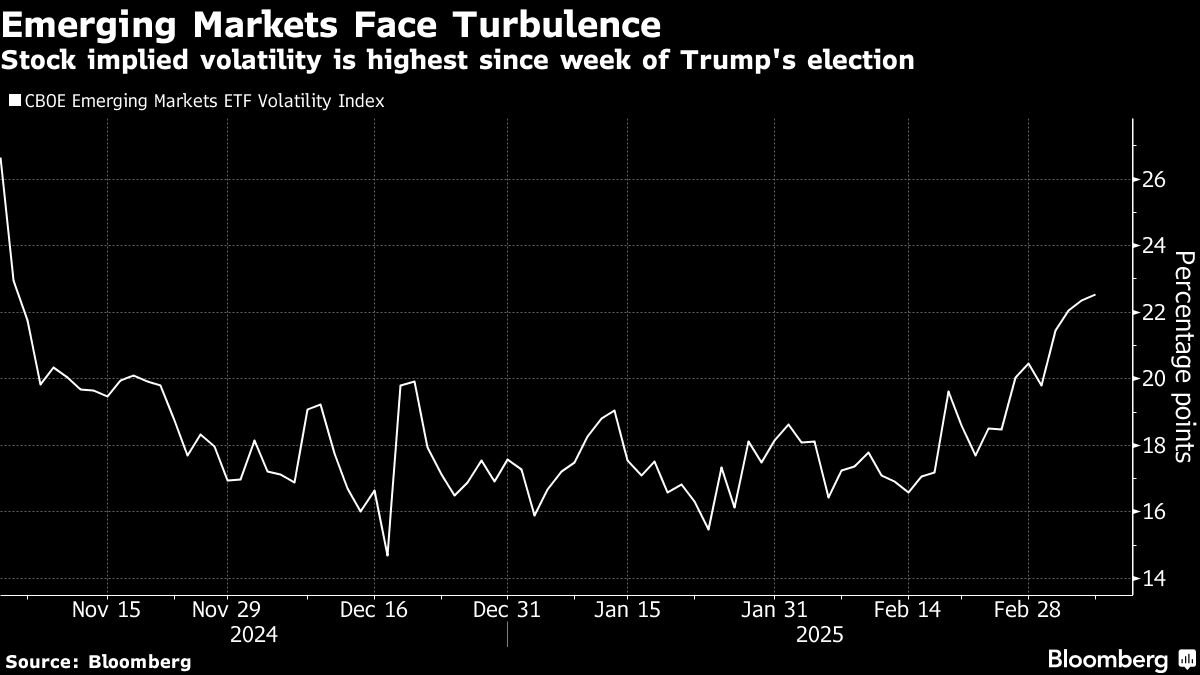
Emerging-market stocks declined for a second day and currencies halted a four-day rally as concerns grew that China’s deflation is spreading to its consumer economy and Donald Trump’s tariffs threaten US growth.
MSCI Inc.’s equity benchmark for developing nations fell 1.2% as of 10:17 a.m. London time, dragged by Hong Kong-listed Chinese stocks. All the industry subgroups on the gauge posted losses, with shares of consumer-discretionary companies underperforming. In the currency market, the yuan dropped for a third day, the while the Indian rupee and Thai baht trailed their peers.
China’s consumer inflation turned negative through January-February for the first time since 2021, widening the country’s factory-gate deflation that’s already sending the country toward the longest stretch of price contraction since the 1960s. Investors also had to contend with signs the US economy is set to slow from Trump’s tariff wars, a higher unemployment rate and federal workforce job cuts.
“Unease about the effect of Trump’s tariffs hangs over financial markets at the start of the week,” Susannah Streeter, head of money and markets at Hargreaves Lansdown Plc, wrote in a note. “The prospect of a recession in the US is lurking, with consumer confidence falling, companies facing increasing trade complexity. China’s deflation problem is also weighing on sentiment, and geopolitical concerns are staying in focus.”
The Hang Seng China Enterprises Index and the Hang Seng Tech Index both retreated more than 2% after weaker-than-expected inflation figures. While economists had expected consumer prices to turn negative on account of earlier-than-usual Lunar New Year holiday, the published figures showed the weakness had extended beyond that seasonal factor.












