President Donald Trump has pledged to hit countries on Wednesday with “reciprocal tariffs,” whatever that means. In the president’s characterization, the US will raise tariffs to a level that’s suitably high to match the tariff and non-tariff barriers that our exporters face in international markets. It sounds deceivingly straightforward; in practice, it’s a hornet’s nest of potential conflict and retaliation.
While the much-hyped announcement could take US stocks in either direction this week, the tit-for-tat and negotiations to follow are likely to generate bouts of volatility that could play out over years to come.
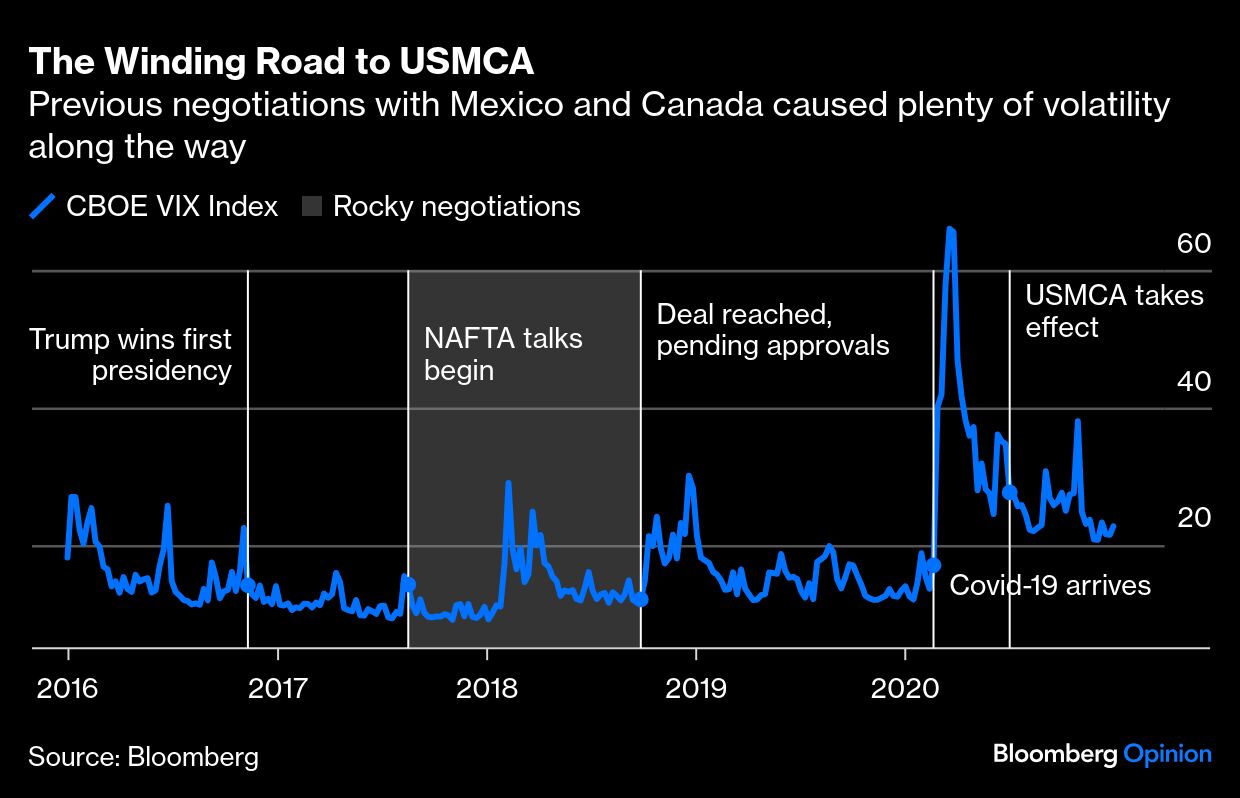
Consider the precedent of the US-Mexico-Canada trade talks. A bit over eight years ago, Trump won his first presidential election in part by promising to tear up or renegotiate the North American Free Trade Agreement that had supported commerce among the countries since 1994. Similar to “reciprocal tariffs” today, the market agita about NAFTA reached its initial peak sometime between Election Day and early 2017. By August 2017, when the parties ultimately sat down to formally renegotiate NAFTA, the warm and fuzzy opening remarks by members of the three delegations led many market participants to assume that they could stop worrying about North American trade. But negotiations are never straightforward, even when they involve just three sets of political actors.
In 2018, just when NAFTA talks seemed to be making some real progress, President Trump made the surprising decision to tariff Mexican and Canadian steel and aluminum imports, reversing course on a decision to exempt the two neighbors. The situation got even more tense when the Trump administration announced a so-called Section 232 investigation on auto imports — a potential precursor to tariffs that could’ve hammered the Mexican auto sector. Then, in June 2018, Trump further tested the uneasy negotiations by lashing out at then Canadian Prime Minister Justin Trudeau on Twitter. In his book No Trade Is Free, even Robert Lighthizer, Trump’s US trade representative at the time, says that NAFTA “was hanging on by a thread.”
It was that second year of the NAFTA negotiations which coincided with surging volatility in US markets. Although tax reform had buoyed investor sentiment in 2017, the renewed NAFTA drama in 2018 collided with other Trump tariffs on the likes of China. The S&P 500 Index experienced a correction in February, went sideways for months and came within a whisker of a bear market by December. The year was bookended by jumps in the CBOE VIX Index, a measure of implied volatility dubbed the fear gauge.
Ultimately, the United State-Mexico-Canada Agreement was reached, and it went into effect in 2020, after a winding road that passed through three legislatures. (Trump has effectively reopened the trade war with both countries, showing no deal is safe.)
Now imagine running that gauntlet but with several times as many counterparties. In an interview on Fox Business, White House National Economic Council Director Kevin Hassett referred to 10-15 target countries that “account for the entire trillion-dollar trade deficit, and they have both non-tariff barriers and big tariffs.”
If the goal of April 2 is really to start negotiations, those talks are all but guaranteed to start from a place of fundamental disagreement. Reciprocity in trade means completely different things to different people. In some cases, the US really can sit down in a boardroom and hash out bilateral deals in which “you cut your tariffs and we’ll cut ours.” But President Trump and his deputies have also said that their reciprocal tariff proposals could take into account value-added taxes and an assortment of other “non-tariff barriers,” including food-safety standards that make it harder for US producers to sell abroad. In many instances, these are policies put in place by the legislatures of sovereign nations, not bargaining chips in a Trumpian deal.
Likewise, VATs are fundamental to government revenue models. In Europe, Trump’s own stated goal is to force countries to spend more on defense, and that’s wholly inconsistent with asking them to abandon one of their bread-and-butter cash streams. It would be fiscally perilous for most European governments to lower their VATs (and they shouldn’t have to because VATs are wholly consistent with fair international trade). If the US wants to take the flimsy position that VATs create an uneven playing field, it should just institute a VAT of its own (read this).
Negotiations on any one of these issues involve countless layers of complexity: foreign interest groups, foreign legislatures and foreign electoral calendars, among other things. That’s not to mention the wobbly US economy and the looming 2026 midterm elections.
So where does all this leave us?
According to economists with Goldman Sachs Group Inc., a semi-straightforward adjustment to account for global tariff differentials could bump up overall import-weighted tariff rates by around 1-2 percentage points. All things considered, that would be an outcome that markets and global economies could happily learn to live with at this point.
But anything more than that should set us up for potentially wild and enduring conflict and negotiations. Goldman’s best bet is that non-tariff barriers could add another 6 percentage points to the effective tariff rate. VATs could layer on a further 15 percentage points and currency-related factors could add 15 percentage points on top of that. Here, you can see that we’re venturing into frightening new realms.
In comments from the Oval Office on Wednesday, Trump characterized his looming reciprocal tariff announcement as “very lenient” and said his government was “trying to keep it somewhat conservative,” briefly tempering earlier messaging around the announcement. Knowing Trump, the story could still change again.
Goldman’s baseline tariff scenario estimates that the entire Trump agenda will lead to a cumulative 15 percentage point hike, including tariffs that have been announced already. But let’s be honest: Who knows?
If Trump’s reciprocal tariff announcement is really meant to open negotiations around the world, we should expect an extended period of gamesmanship with investors left guessing at every turn. Whatever happens on Wednesday, it would be an error to let our guards down.
A message from Advisor Perspectives and VettaFi: To learn more about this and other topics, check out some of our webcasts.
Bloomberg News provided this article. For more articles like this please visit
bloomberg.com.