Silence and restraint.
That would be my advice for the Brazilian government on how to approach US President Donald Trump’s tariff-palooza.
Brazil only got a 10% ticket in Trump’s already infamous scorecard of tariff retaliations, which won’t significantly dent Latin America’s largest economy. In fact, quite the opposite: It’s possible that this relatively lower barrier ends up benefiting Brazil, a top supplier of grains, meat, oil and metals. China’s decision to retaliate against Trump, imposing a 34% tariff on all US imports starting April 10, means the South American nation is now poised to gain market share at the expense of American farmers and producers — as it has been doing since US-China tensions started. The country’s mammoth grains harvest this year, expected to grow 10% compared with the 2023/2024 season to a record 328 million tons, makes this trend even more timely amid solid domestic soybean prices.
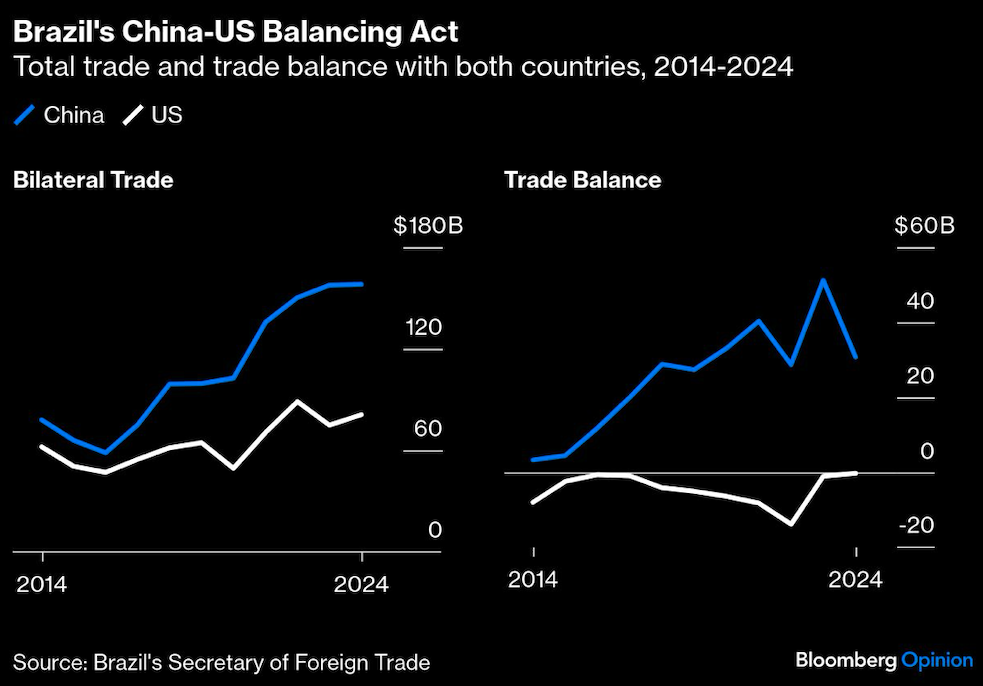
If Trump’s tariffs remain in place for long, Brazil could also increase its shipments to the US by triangulating products from countries with higher levies — or having American companies expand capacity locally. (The US is still its largest investor.) Remember the Brazil-led Mercosur trade bloc just signed a free-trade agreement with the European Union, which received a higher 20% tariff from Trump. Brazil would even be a natural supplier of rare earths to the US, given China’s new restrictions on exports to its rival. On the flipside, it may also face a flood of cheap Chinese products, a threat always feared by Brazilian industries. In any case, the relationship with its Asian geopolitical ally and main trading partner, worth more than $150 billion in annual bilateral trade, is set to deepen.

Economists at JPMorgan Chase & Co. estimate that a 10% US tariff will directly reduce Brazil’s gross domestic product by 0.3%. At the same time, in an expanded trade war the country’s agricultural sector could enjoy “significant indirect benefits” through trade diversion, they said.
“With direct and diversion effects likely canceling each other out, Brazil is in the passenger seat of the consequences of the trade war,” the JPMorgan experts led by Cassiana Fernandez wrote in a note last week.
In this new volatile world, not making too much noise pays off. Quiet diplomacy and direct engagement should be the default mode for Brasilia to deal with this White House, highlighting Brazil’s persistent trade deficit with the US over the years.
Now, it won’t be easy for President Luiz Inácio Lula da Silva, who has a complicated relationship with Washington, to pass up the opportunity to get into rhetorical battles with Trump — particularly as the 2026 presidential election approaches and the US leader backs Lula’s nemesis, Jair Bolsonaro. Lula may want to bolster his credentials as leader of the Global South at the expense of the Americans, as he has done for most of his career. It’s almost comical to see Lula, a staunch protectionist who heads one of the world’s most closed big economies, become a free-trade crusader just because that’s the convenient thing to say to mark a contrast with Trump: “We defend multilateralism and free trade,” he said last week, adding that Brazil “will respond to any attempt to impose protectionism that no longer fits in today’s world.” If he really wants to achieve that goal, he could start cutting tariffs in his own country.
I guess these quips are unavoidable for an old hand like Lula — but he should resist the temptation to make Trump pay attention to South America or become a focus of the White House’s attention for his fond relationship with China. Lula needs only to ask his friend Gustavo Petro, Colombia’s president, about the consequences of facing Trump without filters.
Of course, if a global recession is coming, the Brazilian economy won’t be able to dodge it. In that scenario, we are likely to see less inflationary pressures and a suddenly dovish Brazilian central bank that may cut interest rates earlier than expected. There is also the risk that Lula pushes for more fiscal stimulus, his favorite tool for sunny and rainy days, even if the country’s debt burden is already reaching worrying levels.
But overall, Brazil has been dealt a relatively positive hand. Now Brasilia has to play it smartly.
A message from Advisor Perspectives and VettaFi: To learn more about this and other topics, check out some of our webcasts.
Bloomberg News provided this article. For more articles like this please visit
bloomberg.com.
Read more articles by Juan Pablo Spinetto