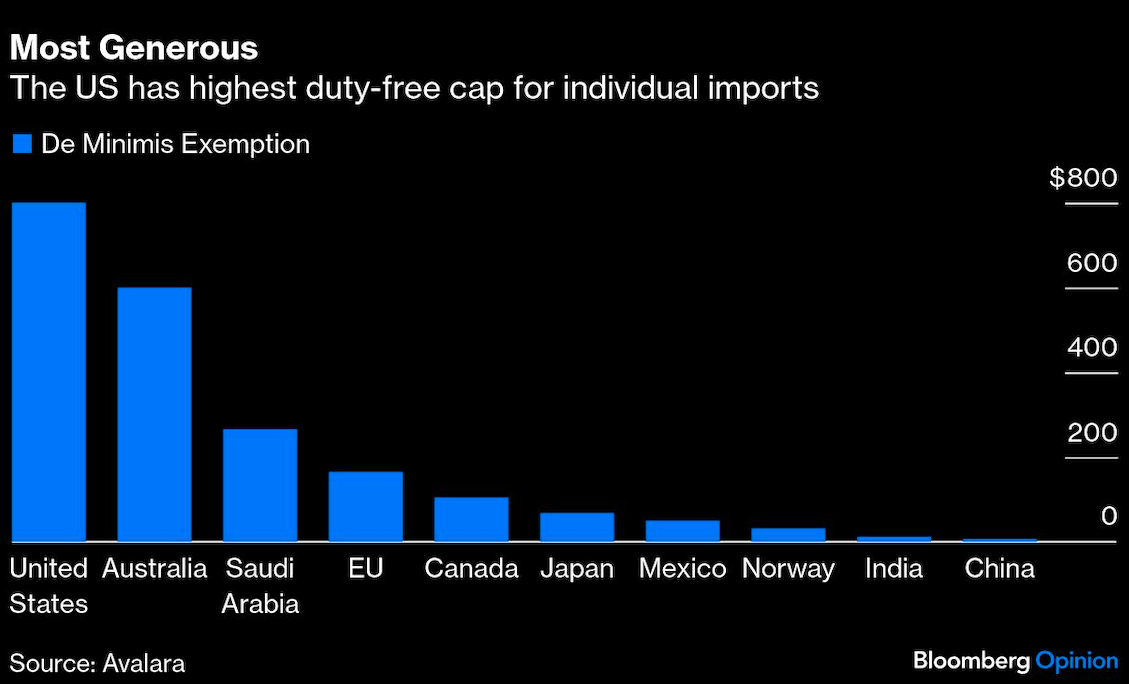
To understand the origin of the free-trade excesses that created record trade deficits and set in motion President Donald Trump’s tariff storm, consider the so-called de minimis exemption.
This law — often erroneously referred to as a loophole — allows for duty-free entrance of items with a value of less than $800, which is a much more lenient threshold than that of any of the other major countries with similar rules. Amid the flurry of tariffs that Trump announced last week, he also canceled these duty-free entries for China and Hong Kong by applying either a fee or tariff on the imports. He also left open the door for expanding this treatment to other countries.
The only thing holding Trump back on ending de minimis — which he first tried in February — is the capacity at US Customs and Border Protection to process the packages, which have been coming in mostly unchecked. Under de minimis, more than 1 billion packages flowed into the US in 2023, compared with 153 million in 2015, according to the Congressional Research Service. The surge was fueled by low-cost Chinese sellers, including Shein and Temu, shipping directly to US consumers.
The de minimis rule needs to be fixed. A light touch would reduce the duty-free limit to $200, where it was before 2016 — or perhaps to the level of Europe, which is about $165 (150 euro). In fact, de minimis could be a true reciprocal tariff; in that scenario, the US would match its rate to that of each importing country. Under a reciprocal rate, the exemption for Chinese goods would be $7 and about $68 for Japanese products. Australia has one of the highest de minimis exemptions at $600.

The reason the de minimis rule was created back in 1938 is still valid. For some inexpensive, imported goods, the formal customs process costs more than the item itself. The exemption for mailed items started at $1 and was increased to $5 in 1978. In 1993, it was unshackled from its original purpose and raised to $200. Then it jumped to $800 under the Trade Facilitation and Trade Enforcement Act of 2015.
That’s why the de minimis law can’t be called a loophole. Congress cranked up the threshold beyond any customs processing cost by design. The rule isn’t a workaround — it’s an incentive to entice other countries to follow suit.
The text of the bill makes that purpose crystal clear: “It is the sense of Congress that the United States Trade Representative should encourage other countries, through bilateral, regional, and multilateral fora, to establish commercially meaningful de minimis values for express and postal shipments that are exempt from customs duties and taxes and from certain entry documentation requirements.” It didn’t work.
As this language shows, the free-trade fever still lingered in 2016, when the bill was signed into law. But even then, cracks were starting to emerge. It was already clear that China’s 2001 entry into the World Trade Organization on generous developing-nation terms had not, as the West had hoped, resulted in it loosening its authoritarian grip. Instead, it had targeted industries to dominate, from steel to ships to electronics to auto parts. That’s since evolved to include solar panels and EVs — all enabled by massive trade surpluses. Now, China is financing a military build-up that’s underpinned by its massive manufacturing base and is gaining technological prowess in robotics, autonomous flight, quantum computing and space exploration.
When the US set global trade rules in the late 1940s, the world was still struggling to emerge from the ashes of World War II. These rules unleashed unprecedented prosperity and at first, benefitted the US, then a manufacturing giant. But as European and Asian nations rebuilt their economies and manufacturing bases, the US’s domination eroded away.
In the final stages of this catch-up process, large US companies, spurred by the North American Free Trade Agreement and the lure of China, sought to remain competitive by tapping the low-cost labor that was undercutting them. Now, as the pandemic made painfully clear, the US finds itself exposed, without sufficient domestic manufacturing and supply chain capacity to take care of some of its most essential needs.
China’s entrance to the WTO, which seemed like a golden opportunity for US companies to tap a market of more than 1 billion consumers, has tipped the global trade system so far out of balance that it’s now vulnerable to Trump’s attacks. The expanded de minimis exemption is a perfect example — the US kept opening its market, but this action wasn’t mutual. American consumers got the short-term benefit, but it ultimately made the country less competitive.
The current trade imbalances have built up over decades. An attempt to reverse that overnight — or even over the course of a four-year presidential term — is risky at best. But fixing the de minimis exemption is a good place to start. Rather than abruptly eliminating it, the president should lower the exemption, perhaps to the same level of other countries. The inexpensive Chinese goods will continue to flow in, but they will cost a bit more, be shipped by ocean containers instead of aircraft and hopefully be checked properly by customs.
The same argument can be made for global trade. The underlying reasons for free trade make sense and should continue, but the system must be more balanced.
In the fog of this trade war, the market is saying Trump’s tariffs went too far and too fast. Sounds familiar: On a much smaller scale and in the opposite direction, Congress did the same when it approved the big increase in the de minimis exemption almost a decade ago.
A message from Advisor Perspectives and VettaFi: To learn more about this and other topics, check out some of our webcasts.
Bloomberg News provided this article. For more articles like this please visit
bloomberg.com.
Read more articles by Thomas Black