The chain-smoking protagonist of Landman, the American television drama series about the Texas oil industry, puts it better than anyone else: “You want oil to live above 60, but below 90,” says the fictional Tommy Norris. “Seventy-eight dollars a barrel, that’s about perfect.”
In real life, prices are far below that “perfect” level. Earlier this month, West Texas Intermediate, the industry benchmark, changed hands below $60 a barrel, touching a four-year low of $55. Although prices have recovered in recent days, the impact is starting to be felt in Texas and beyond: Shale companies are trimming spending, announcing they will reduce the number of drilling rigs and fracking crews they employ.
The US accounts for two in 10 barrels of oil pumped worldwide, so what happens there has an outsize impact.
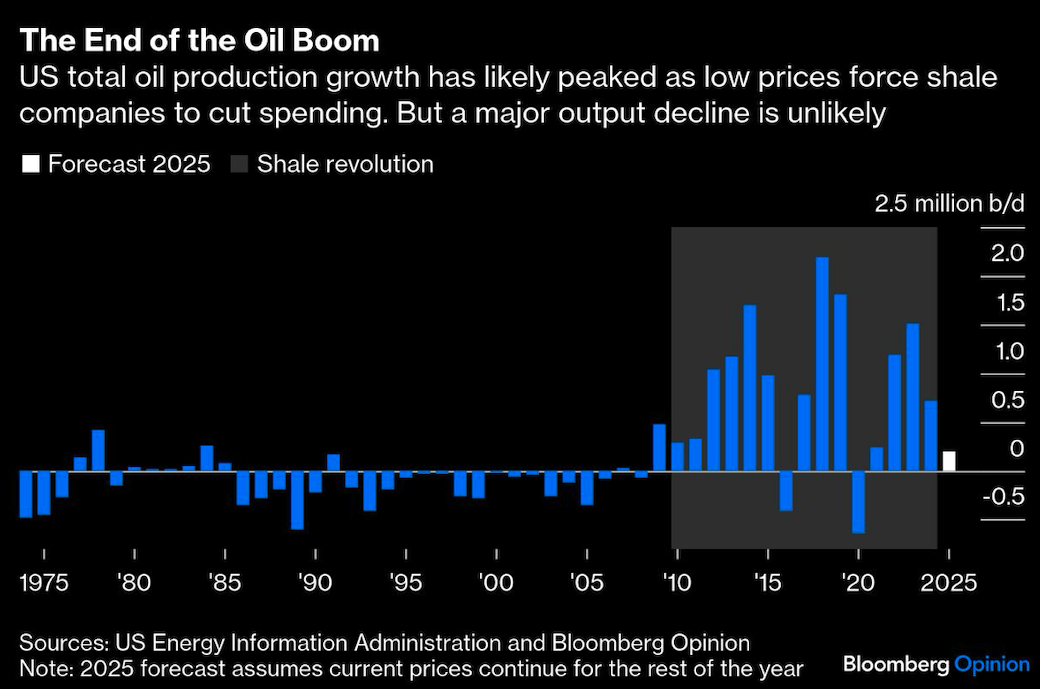
At current prices, US shale oil output has probably peaked. Just don’t expect a rapid decline like the downturns of 2015 and 2020; the most likely trajectory is an undulating plateau. Whatever the shape, it will be crucial for the global market. The OPEC+ cartel is boosting output faster than expected, and demand growth is slowing due to the trade war. That leaves shale as a key adjusting lever.

“We had expected that US production overall would peak between 2027 and 2030,” Vicki Hollub, chief executive officer of top shale producer Occidental Petroleum Corp., told investors last week. “It’s looking like that peak could come sooner.” Others echoed her words.
The “current prices” caveat is crucial. With shale, small price shifts matter a lot: The difference between booming production and declining output is measured in a fistful of dollars, perhaps as little as $10 to $20 a barrel. At $50, many companies are staring at financial calamity and production is in free-fall; $55 is survivable; $60 isn’t great, but money still flows and output holds; at $65, everyone is back to more drilling; and at $70, the industry is printing money and output is soaring.
Oil prices translate into production. The link is the reinvestment ratio: how much money shale companies devote to drilling new wells versus paying their shareholders and creditors. That percentage changes constantly. In the past, shale companies reacted to low oil prices by raising the reinvesting ratio, devoting significantly more cash to drilling. But right now, these businesses are under pressure from investors to pay them.
As such, the current price weakness may translate into output weakness quicker than what was the case during previous downturns, in 2020-2021 and 2014-2016.
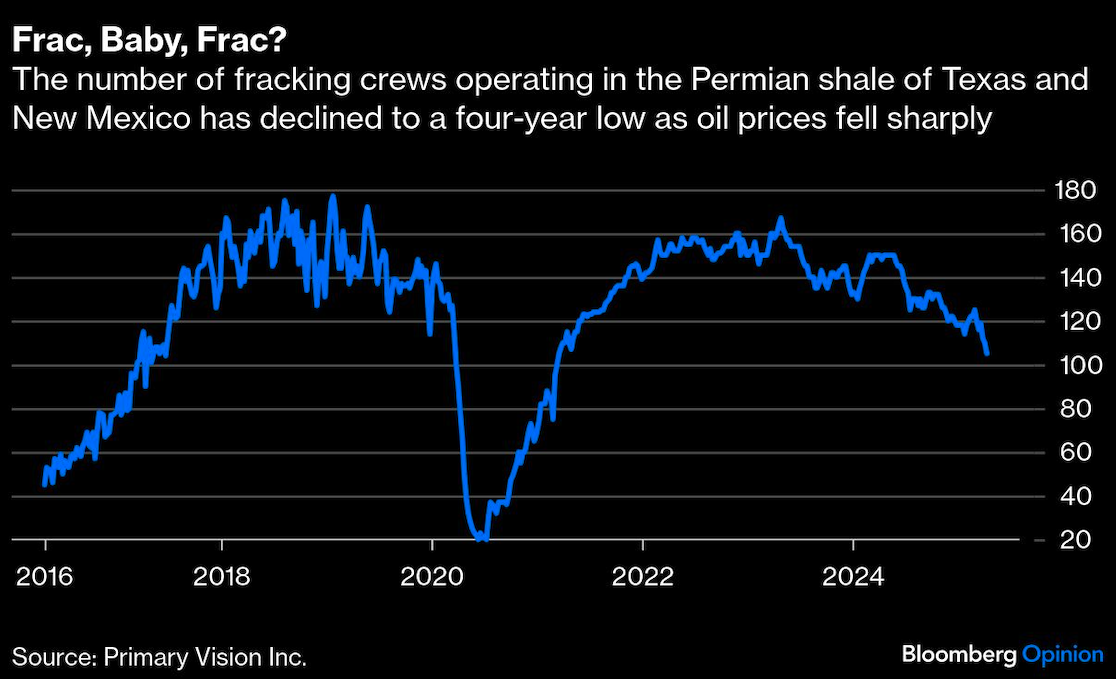
For now, signs of the slowdown are everywhere: The number of active oil drilling rigs now stands at 474, the second lowest since late 2021, according to data from Baker Hughes Co., a top energy services business. But in shale, drilling isn’t the most important barometer. Far more important is the proportion of so-called frac crews, the specialized teams that perform hydraulic fracturing, or fracking, on the wells: injecting water, sand and chemicals underground to free oil from the hard-to-crack shale rock. In the Permian, the key shale region straddling Texas and New Mexico, the number of frac crews dropped to a four-year low of 105, according to Primary Vision Inc., a firm that tracks industry trends. Back in 2023, when oil was close to $100 a barrel, more than 160 crews were working in the Permian.
Top shale companies, from Diamondback Energy Inc. to ConocoPhillips, used the first-quarter earnings releases to announce lower spending. Still, most of them have cautioned that the curbs won’t translate into large drops in production. That’s due to three reasons: Most companies pumped more than they had anticipated between January and March, offsetting future weakness; all of them are drilling far more efficiently; and although output of crude may drop, production of other petroleum streams, such as condensates and natural gas liquids, is likely to perform better.
Total US oil output set its most recent peak in October at 20.68 million barrels a day, according to the government data. The most recent weekly data, which is typically less reliable, put total production at around 20.4 million barrels a day.
If the weekly data proves accurate and production holds at that level for the rest of the year, the US would still pump in 2025 an average of about 20.3 million barrels a day, up from an annual average of 20.1 million barrels in 2024. Only if total US output declines to 20 million barrels a day by June or July would the annual average in 2025 drop below that of last year. An annual average drop is more likely in 2026, but for that the shale industry needs to face low prices for many more months.
Shale isn’t the only game in the American oil industry. The US Gulf of Mexico accounts for nearly 20% of total US petroleum production, and output there is likely to increase this year as several projects come onstream, helping to offset the drop in onshore output.
For now, everything suggests the US won’t see a rapid decline in annual average oil production. A peak seems very likely; and even a slight drop could materialize if prices remain depressed. But nothing suggests that the US is about to see a repetition of the large decline in 2020, when average annual output fell almost 650,000 barrels a day from 2019.
A message from Advisor Perspectives and VettaFi: To learn more about this and other topics, check out some of our webcasts.
Bloomberg News provided this article. For more articles like this please visit
bloomberg.com.
Read more articles by Javier Blas