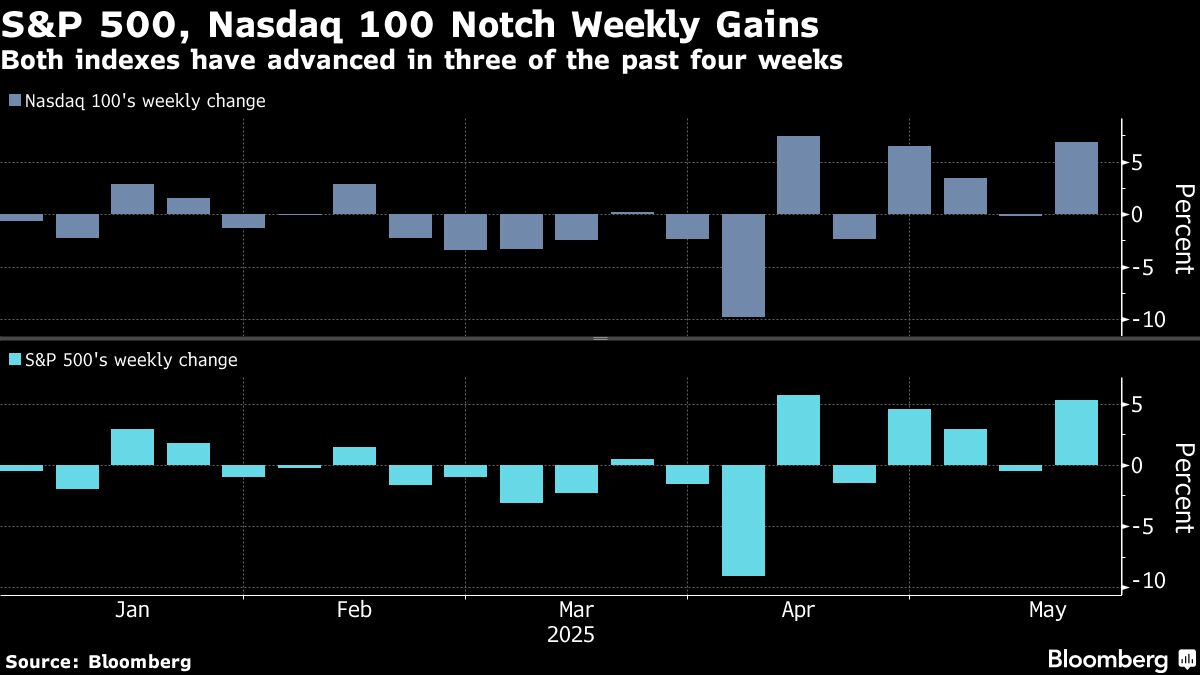
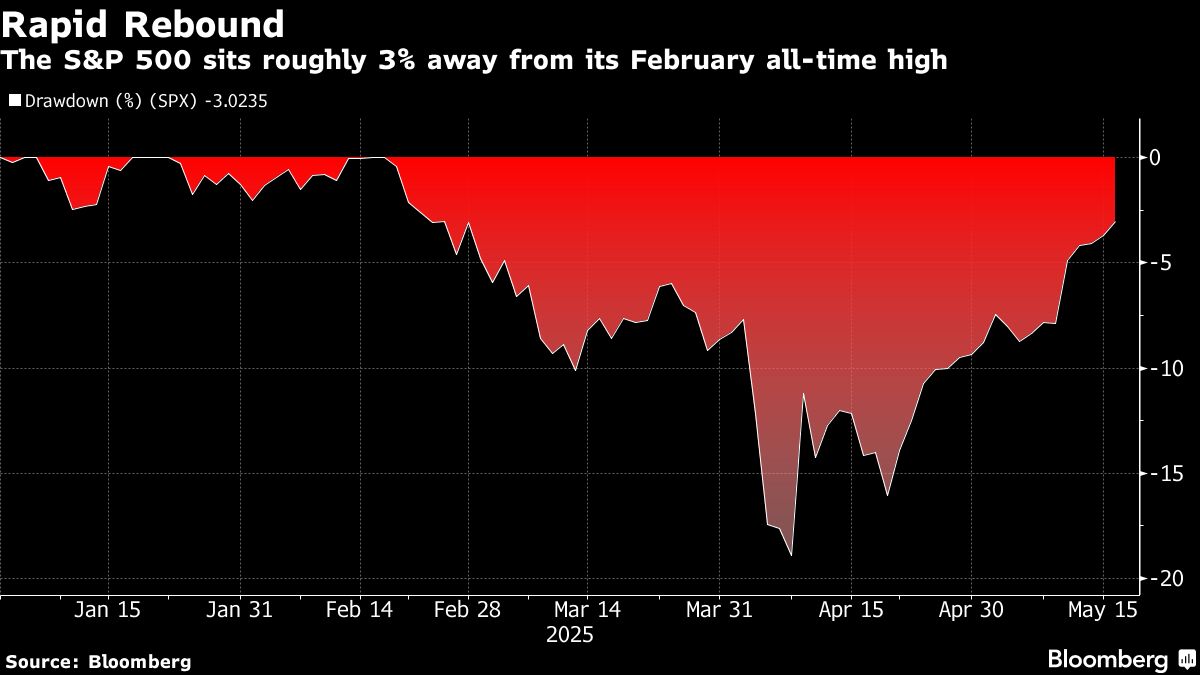
US stocks delivered their second-best weekly gain of the year on Friday, as Big Tech fueled a rally that brought the S&P 500 Index closer to an all-time high set nearly three months ago.
The benchmark equities gauge advanced 0.7% on the day, as investors shrugged off a soft consumer sentiment report. That continued a multi-week rise that has brought the index to within about 3% of its Feb. 19 peak. The tech heavy Nasdaq 100 Index rose 0.4%.
A basket tracking the so-called Magnificent Seven stocks including Nvidia Corp., Tesla Inc. and Alphabet Inc. soared more than 9% this week — its best since late January. For the week, the S&P 500 and Nasdaq 100 have climbed 5.3% and 6.8%, respectively.
Markets have calmed after months of turmoil as hopes grow that a tariff blitz unleashed by President Donald Trump will be less severe than expected and a solid season of corporate earnings draws to a close. Still, investors have little clarity on how global trade ructions might impact the US economy and companies’ profits down the road.
Target Corp. and The Home Depot Inc. are among the retailers set to report earnings next week as tariff-fueled economic anxiety fans a consumer pullback.
“This week’s advance is all about tariff optimism alleviating recession fears,” Ivan Feinseth, chief investment officer at Tigress Financial Partners. “The risks is anything unpredictable can still happen in the global trade war, so hearing from more retailers next week on their earnings and consumer outlook is crucial.”
Shares of Applied Materials Inc., the largest American maker of chip-manufacturing equipment, fell more than 5% on Friday after the company gave a lackluster forecast for the current period. Video game publisher Take-Two Interactive Software Inc. fell 2.4% following a full-year forecast for revenue that came up short.
Meantime, Charter Communications Inc., which operates the Spectrum pay TV and internet services, saw its shares rise 1.8% after it agreed to combine with privately held Cox Communications in a cash-and-stock deal that would unite two of the biggest US cable providers. The takeover values Cox at about $34.5 billion including debt, the companies said in a statement Friday, confirming an earlier Bloomberg News report.
Watching the Charts
Investors are scouring charts for clues on whether the advance can persist. The S&P 500’s 14-day relative strength index is at the highest point since early December, nearing the 70 level that some market technicians view as a sign of overheating.
Friday marks the half-way point in the second quarter following a tumultuous stretch sparked by global trade war fears, which sent the S&P 500 teetering on the brink of a bear market. April started with a massive shock in the form of aggressive tariffs from Trump, quickly followed by a reprieve. Then came budding optimism that the economy will avert a recession after the US and China reached a temporary trade truce.
But even though Washington and Beijing recently agreed on a 90-day stand-down for many of their tariffs, frictions remain and it will take time for tariffs to fully show up in economic data.
In the first three months of the year, hedge funds boosted positions in healthcare stocks while reducing exposure in the technology sector, as they navigated a period marred by tariff uncertainty and threat of economic recession, according to Bloomberg’s preliminary analysis of data from 13F filings.
Meantime, UnitedHealth Group Inc. rose 6.4% after shares of the insurance and healthcare company tumbled 11% on Thursday after The Wall Street Journal reported the Justice Department was investigating it for possible criminal Medicare fraud. On Tuesday, shares fell 18% after the company’s CEO stepped down and UnitedHealth suspended its 2025 outlook.
A message from Advisor Perspectives and VettaFi: To learn more about this and other topics, check out some of our webcasts.
Bloomberg News provided this article. For more articles like this please visit
bloomberg.com.