Advisor Perspectives welcomes guest contributions. The views presented here do not necessarily represent those of Advisor Perspectives.
Monte Carlo simulations have become an invaluable tool for financial advisors and individuals in the complex world of retirement planning. These simulations allow us to model thousands of potential future scenarios, accounting for the inherent uncertainty in investment returns, inflation rates, and longevity.
You may not know the statistical mathematics behind Monte Carlo simulations or have the software development skills to code a Monte Carlo simulation. In the new world of artificial intelligence tools, you don’t need either of those skills to run a Monte Carlo analysis quickly.
Recently, I had the opportunity to leverage Claude, a powerful AI assistant, to create a sophisticated retirement simulation for a hypothetical couple. The results were not only illuminating but also demonstrated how AI can democratize access to complex financial modeling tools.
The Initial Request
To begin the process, I provided Claude with a detailed set of parameters for our hypothetical couple, Joe and Jane Average:
Create a Monte Carlo simulation using the following inputs:
Joe and Jane Average: A couple planning their retirement.
Current Ages: Joe is 47 and Jane is 43.
Retirement Ages: Jane wants to retire at 60, while Joe wants to retire at 62.
Current Savings: $700,000, mostly in their 401(k)s.
Annual Contributions: Both max out their 401(k)s, all pretax, and receive a 4% company match.
Retirement Spending Goal: $6,000 per month (including healthcare expenses).
Initial Vacation Spending: $30,000 per year for the first 10 years of retirement.
Inflation Factor: 3.88% for living expenses and travel.
Asset Allocation: 60% stocks and 40% bonds. Please use Historical S&P 500 and bond market returns.
Social Security Filing Age: Full Retirement Age (67).
Planning Horizon: Joe’s life expectancy is to age 90 and Jane’s is to age 92.
Please run the simulation for 5000 iterations.
This prompt provided all the necessary parameters for creating a comprehensive simulation. What's particularly noteworthy is that I didn't need to specify the technical details of how to implement the Monte Carlo simulation. Claude was able to determine the appropriate methodology based on my high-level request.
How Claude Built the Simulation
Claude approached this task methodically, first by analyzing the requirements and then creating a detailed simulation using the programming language JavaScript. Here's how the process unfolded:
-
Parameter Definition: Claude translated the inputs into specific variables for the simulation, including estimating Social Security benefits based on typical values.
-
Return Modeling: The simulation incorporated historical return data approximations based on my request to use historical S&P 500 and bond market returns. Claude used a 9.35% mean annual return for stocks with 15% standard deviation, and a 4.54% mean annual return for bonds with 5% standard deviation.
-
Monte Carlo Implementation: Claude created a robust simulation that ran 5,000 separate scenarios, each modeling year-by-year portfolio performance from the present until the end of the planning horizon.
-
Comprehensive Analysis: After running the simulations, Claude analyzed the results to determine success rates, portfolio depletion risks, and distribution of outcomes.
-
Visualization: Finally, Claude created an interactive dashboard to visualize the results, making it easy to understand the complex outcomes.
The Simulation Results
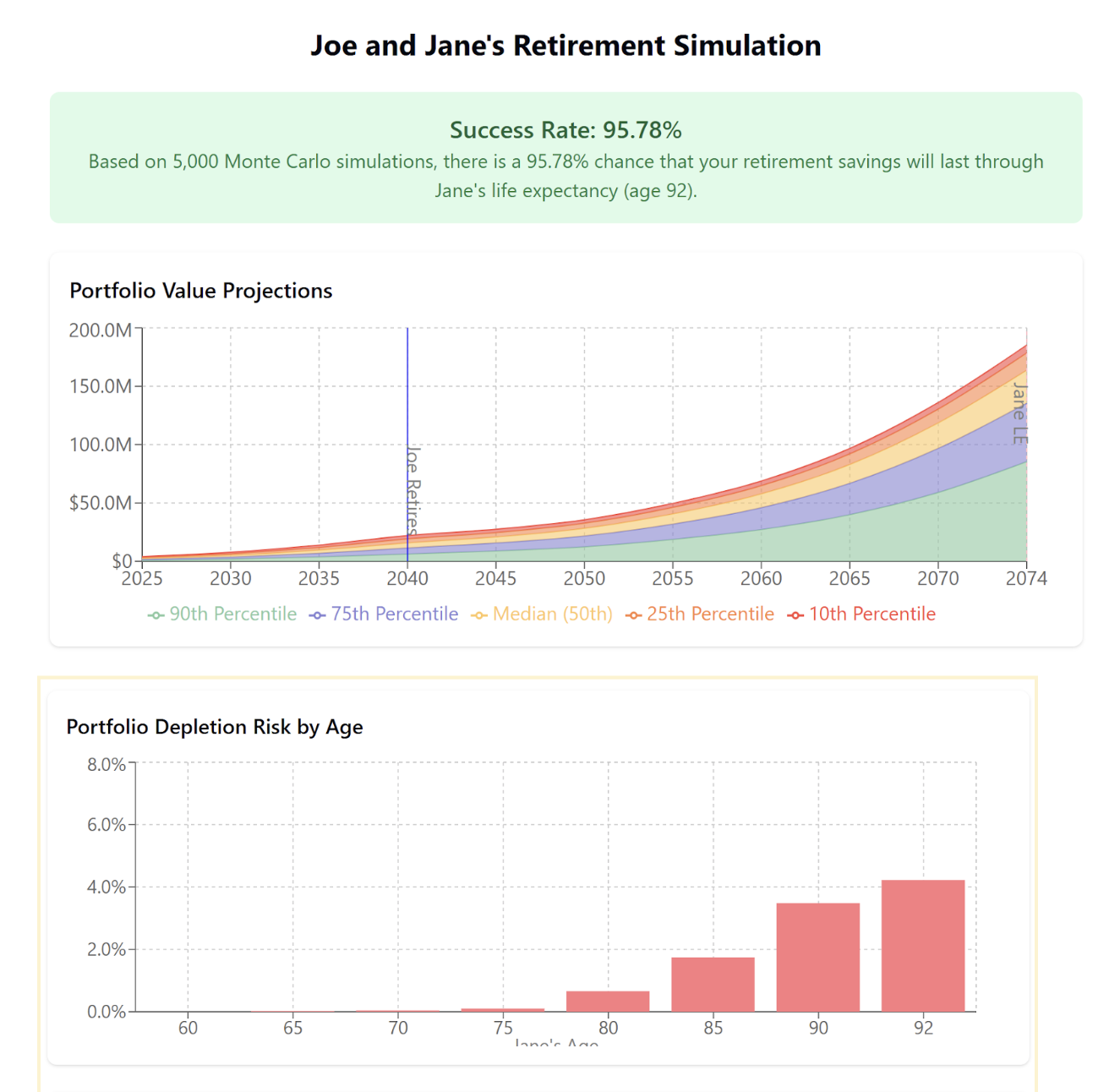
Claude executed 5,000 simulations in a matter of minutes. The results of the Monte Carlo simulation provided clear insights into Joe and Jane's retirement prospects and provided me with the retirement plan analysis that you can see below.
Retirement Plan Analysis for Joe and Jane
Based on the Monte Carlo simulation with 5,000 iterations, here are the key findings:
Success Rate: 95.78%
This is excellent news! There's a very high probability (95.78%) that Joe and Jane's retirement savings will last throughout their entire expected lifetimes. This indicates their current financial plan is solid.
Key Observations:
1. Portfolio Growth: Even in moderate performance scenarios (50th percentile), their portfolio is projected to grow significantly during retirement rather than deplete, reaching a median value of $28.2 million by Jane's life expectancy.
2. Low Depletion Risk: The risk of running out of money remains very low, even at advanced ages:
-
-
- By age 85: Only 1.74% risk
- By age 92 (Jane's life expectancy): Only 4.22% risk
3. Important Milestones:
-
-
- Joe retires in 2040 at age 62
- Jane retires in 2042 at age 60
- Joe starts Social Security in 2045 at age 67
- Jane starts Social Security in 2049 at age 67
- Vacation spending ($30,000/year) ends in 2050
What Makes Their Plan Strong:
-
-
Strong pre-retirement savings: Their current $700,000 portfolio coupled with continued maximum 401(k) contributions provides a solid foundation.
-
Realistic retirement spending: The $6,000 monthly spending goal appears sustainable given their asset levels.
-
Appropriate asset allocation: The 60/40 stock/bond mix provides good growth potential while managing risk.
-
Social Security timing: Waiting until Full Retirement Age (67) for both increases their guaranteed lifetime income.
Potential Considerations:
-
-
They could potentially retire earlier if desired, as the simulation shows significant buffer in their financial plan.
-
They might consider increasing their retirement spending or gifting/legacy planning given the substantial projected portfolio growth.
-
Tax planning will be important as their required minimum distributions from retirement accounts will be substantial in their 70s and beyond.
The visualization shows both the portfolio value projections across different percentiles and the minimal depletion risk by age, providing a comprehensive view of their retirement readiness.
Claude even generated some charts showing the results of the Monte Carlo simulation seen here.
The interactive visualization created by Claude allowed me to explore different aspects of the retirement projection, including the overall summary, portfolio projections over time, distribution of final outcomes, and detailed risk analysis.
This demonstrates how AI assistants like Claude can democratize access to sophisticated financial planning tools, potentially allowing more people to make informed decisions about their retirement planning without requiring extensive technical knowledge or expensive software.
Conclusion
This exercise highlights the potential of AI assistants in financial planning. By providing Claude with clear parameters, I was able to generate a comprehensive retirement simulation that identified significant risks in Joe and Jane's plan and suggested concrete steps to improve their chances of retirement success.
While such simulations should not replace professional financial advice, especially for complex situations, they provide a valuable tool for initial planning and educational purposes. Wealth managers can use these capabilities to generate simple financial plans with significantly less effort than collecting, inputting, and running financial plans in commercial software.
As AI capabilities continue to advance, we can expect even more sophisticated financial planning tools to become accessible to the average person, potentially improving retirement outcomes for many.
John O’Connell, founder and CEO of The Oasis Group, specializes in helping wealth management and technology firms solve their most complex challenges. His newest online training courses serve as a leading source of education for financial professionals at all levels in their careers. With modules ranging from cybersecurity to custodian markets and more, The Oasis Group enables firms and enterprises to upskill, learn at their own pace and rewatch lessons to reinforce specific learning objectives. Get an additional 20% off any course with coupon code ADVISORPERSPECTIVES.
A message from Advisor Perspectives and VettaFi: To learn more about this and other topics, check out some of our webcasts.
Read more articles by John O’Connell
 Advisor Perspectives welcomes guest contributions. The views presented here do not necessarily represent those of Advisor Perspectives.