The biggest story swirling around Tesla Inc. right now concerns Chief Executive Elon Musk’s sudden, if unsurprising, break with a leader who is as calm and unassuming as he is, President Donald Trump. The important story concerns what is happening far from these shores: China.
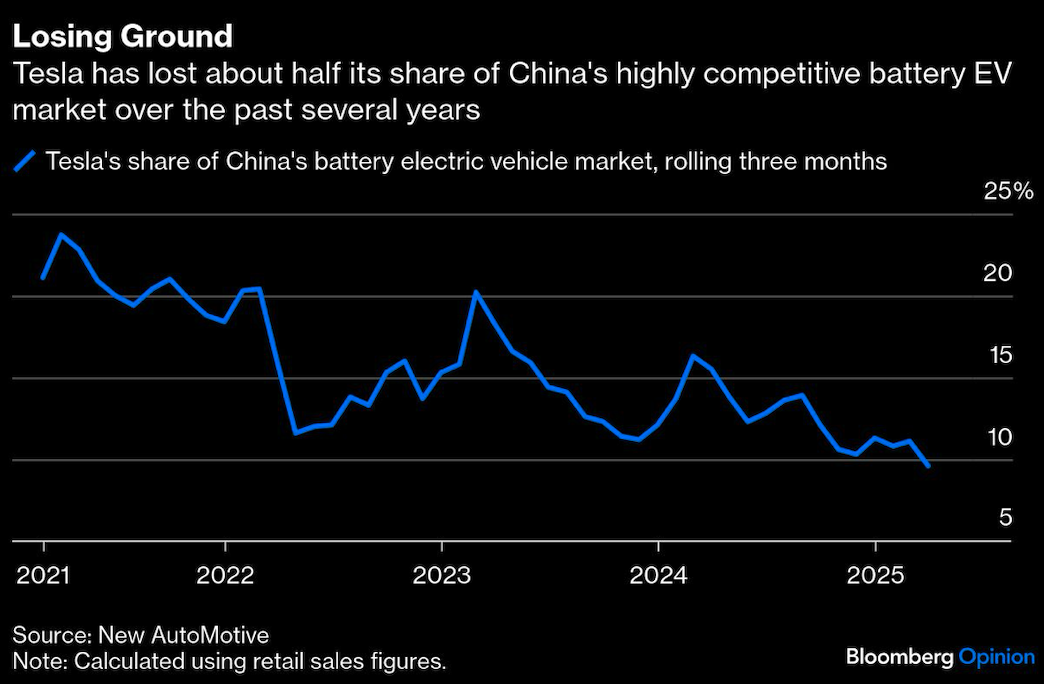
Shipments from Tesla’s Shanghai factory fell by 15% in May compared with a year before, according to preliminary data from China’s Passenger Car Association. That marks eight straight months of declining output from Tesla’s single biggest electric vehicle factory, accounting for around 40% of its global capacity. These figures don’t break out which of those EVs get sold in China or get exported from there, but this trend is not Tesla’s friend. Through April, its share of China’s battery EV market had fallen by more than half over the past four years, according to data compiled by New AutoMotive, a UK-based research firm.

The numbers also suggest deteriorating economics. On a simple, calendar-day basis, they imply Shanghai factory utilization of 76% in May. That isn’t terrible, but it’s down significantly from last May. So far this year, excluding the month of February when Tesla was retooling for the refreshed Model Y, implied utilization is running 10 points lower than the same period in 2024. Speaking of that updated Model Y, it isn’t a good sign that Tesla has already offered incentives like zero-percent financing in China. Taken together, lower capacity utilization, implying higher fixed costs per vehicle, and higher discounts, meaning less net revenue, point to a continuing problem with what was all too apparent in Tesla’s first quarter results: Crushed profit margins in its main business.
Unlike Tesla’s weaker EV sales in other important markets such as California and Europe, the slide in China has nothing to do with Musk’s politics. Tesla’s reputation within China remains high, viewed as an essential catalyst in revolutionizing the quality and scale of the country’s auto sector. Except that ‘catalyst’ isn’t quite the right word, because the beauty of catalysts is that they spark transformations but don’t get used up in the process. In this case, it would be more accurate to call Tesla a reactant, because the domestic Chinese EV industry spurred on by its example is now eating it alive.
While Tesla’s share of China’s battery EV sales is down to about 10% so far this year, that drops to 5.8% when you include other so-called “new energy vehicles” such as plug-in hybrids, according to figures compiled by Goldman Sachs Group Inc. Competitors including BYD Co. Ltd., which holds about 27% of China’s NEV market, are now delivering the sort of excitement that Tesla used to in terms of looks, range and driver assistance features — and at lower prices. Xiaomi Corp., the smartphone maker, is in the process of launching the YU7, a high-tech, fast-charging electric SUV that resembles a Porsche or Ferrari but is perhaps best pictured as a Model Y-seeking missile.
In an alternate dimension, China would serve as a hothouse laboratory for Tesla to hone world beating, profitable EVs that might even be exported to its home market. In the dimension we’ve got, Musk has seemingly lost his ambition to develop brand new, affordable EVs that can compete across the world. Tesla’s last genuinely new model, the Cybertruck, is certainly big but only about as “beautiful” as the Trump tax bill that Musk now openly derides as an “abomination.” While Tesla sits apart from the legacy automakers in the US, Germany and Japan in many respects — certainly in terms of valuation — it has, like them, seen its position in China eroded rapidly. And regardless of Musk’s latest posts on X, he worked hard to secure the election of a president and Congressional majority intent on crushing EV sales in the US.
With the end of the second quarter approaching, and the sales figures emanating from China and Europe portending another set of weak earnings, it is perhaps little wonder that this narrative is crowded out by all manner of other things. Musk, who ditched Tesla’s public relations team and routinely denounces the media as “propaganda” has nonetheless plunged into a media blitz of late, and has now whipped up a new political intrigue. Is the break with Trump real? My litmus test: watch out if @elonmusk posts a picture of a taco.
Plus, of course, we have the imminent launch of Tesla’s self-driving cars in Austin. Whatever they actually turn out to be, with the always dubious narrative of Musk’s White House job boosting Tesla’s fortunes now played out, those robotaxis constitute the main pillar supporting Tesla’s triple-digit earnings multiple. Certainly, that number has nothing to do with what’s happening in the biggest EV market on the planet.
A message from Advisor Perspectives and VettaFi: To learn more about this and other topics, check out some of our webcasts.
Bloomberg News provided this article. For more articles like this please visit
bloomberg.com.
Read more articles by Liam Denning