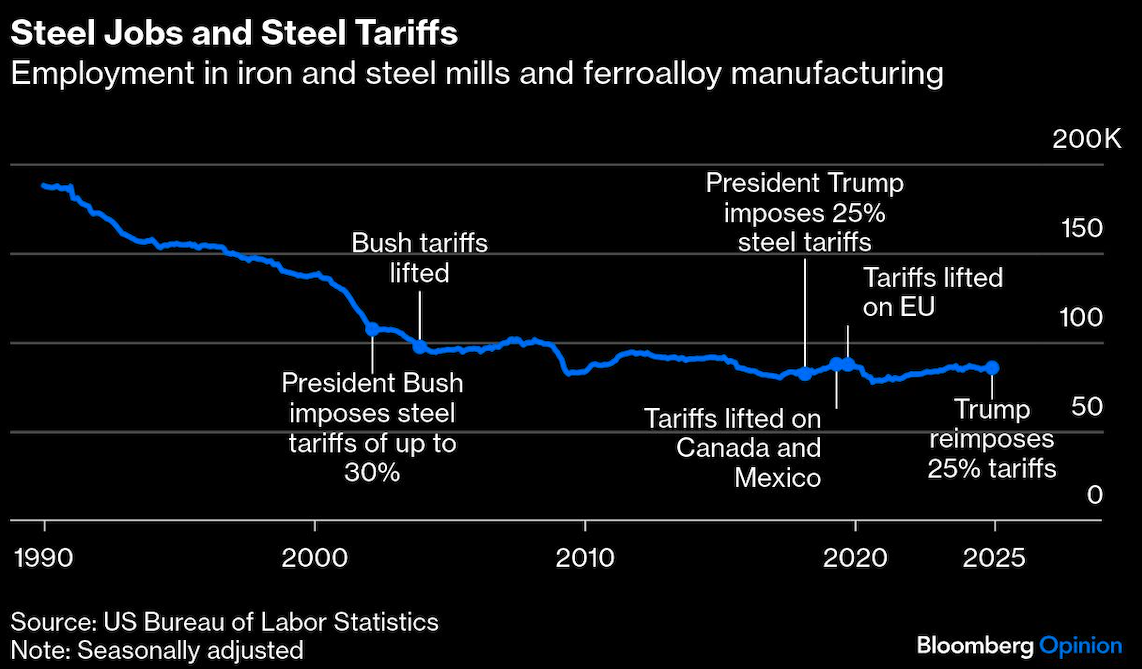
Iron and steel mills employ about 85,700 people in the US. That’s less than half as many as in 1990 but slightly more than in 2016 and 2017. Have the increased tariffs on steel imposed by Donald Trump starting in March 2018, partly continued by his successor Joe Biden and just this week ratcheted by Trump to 50%, played a role in this improvement? Yes, probably.

Employment in US iron and steel mills and ferroalloy manufacturing fell after George W. Bush increased steel tariffs in 2002, albeit more slowly than in the preceding two years, so there are clearly forces at work apart from tariffs. Still, the sector’s jobs gains after March 2018 were impressive. Employment was up a seasonally adjusted 6,300, or 7.7%, as of July 2019. It began falling after that, but in February 2020 — just before the Covid-19 pandemic sent steel demand and production plummeting — the gain was still 3,800. This March, employment was 3,400 higher than in March 2018.
All these numbers are higher than the frequently cited statistic of 1,000 steel jobs gained from the tariffs, which was based on data available as of late 2019 that has been revised a lot since. Add in jobs in (1) steel product manufacturing from purchased steel and (2) alumina and aluminum production and processing, which were also protected by Trump’s tariffs, and the employment increase since March 2018 is close to 8,000. One can understand why steel and aluminum industry executives and workers welcome the president’s help.
The US industries that have to buy steel and aluminum to make their products together account for many more jobs than the steel and aluminum producers do. About 12 million Americans work in industries that use steel, economists Katheryn Russ of the University of California at Davis and Lydia Cox, now of the University of Wisconsin, estimated in 2020. Two million of them work in industries where steel makes up more than 5% of inputs. Having to pay more for steel harms the competitive standing of these industries, and Russ and Cox estimated — based on a 2019 Federal Reserve Board study of how industries more and less affected by the tariffs on steel and aluminum were faring — that the tariffs had reduced employment in steel-and-aluminum-consuming manufacturing industries in the US by 75,000 jobs relative to what it would have been without the tariffs.
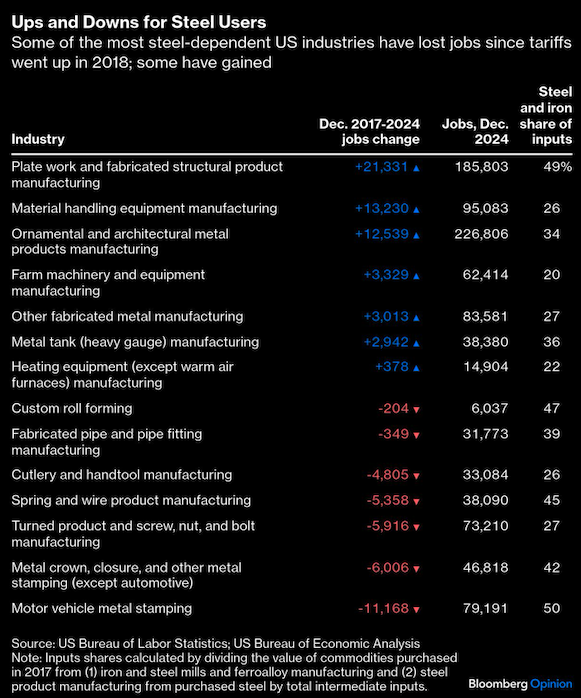
That’s not to say employment necessarily fell in those industries. Using the US Bureau of Economic Analysis’ most recent detailed industry input-output accounts, from 2017, I sorted out the 14 industries (other than steel product manufacturing from purchased steel) for which iron and steel accounted for more than 20% of intermediate inputs, and got their employment data from the US Bureau of Labor Statistics’ Quarterly Census of Employment and Wages, which offers a more detailed industry breakdown than the monthly BLS jobs data but is released with a longer lag and isn’t seasonally adjusted. Overall, these industries employed just more than a million people in December 2024, up 22,956 — 2.3%, compared with a 7.7% gain for total nonfarm payroll employment — from December 2017.
Seven of the 14 gained jobs and seven lost them. At the industries with the biggest gains, one can identify sources of new demand that outweighed any negative effects from steel tariffs. Plate work and fabricated structural product manufacturing and ornamental and architectural metal products manufacturing benefited from the construction industry’s recovery from its post-financial-crisis doldrums, with real US construction spending up 25% over the past seven years. Material handling equipment manufacturing benefited from a warehousing boom driven by online retailers.
Nothing here contradicts the economists’ conclusion that the harm to steel users from the tariffs outweighed the gains to steelmakers, but one can see why it might be easier to organize support for an increase in steel tariffs than opposition to it. Steel users don’t exactly form a united front, and many have done just fine since the tariff increases of 2018.
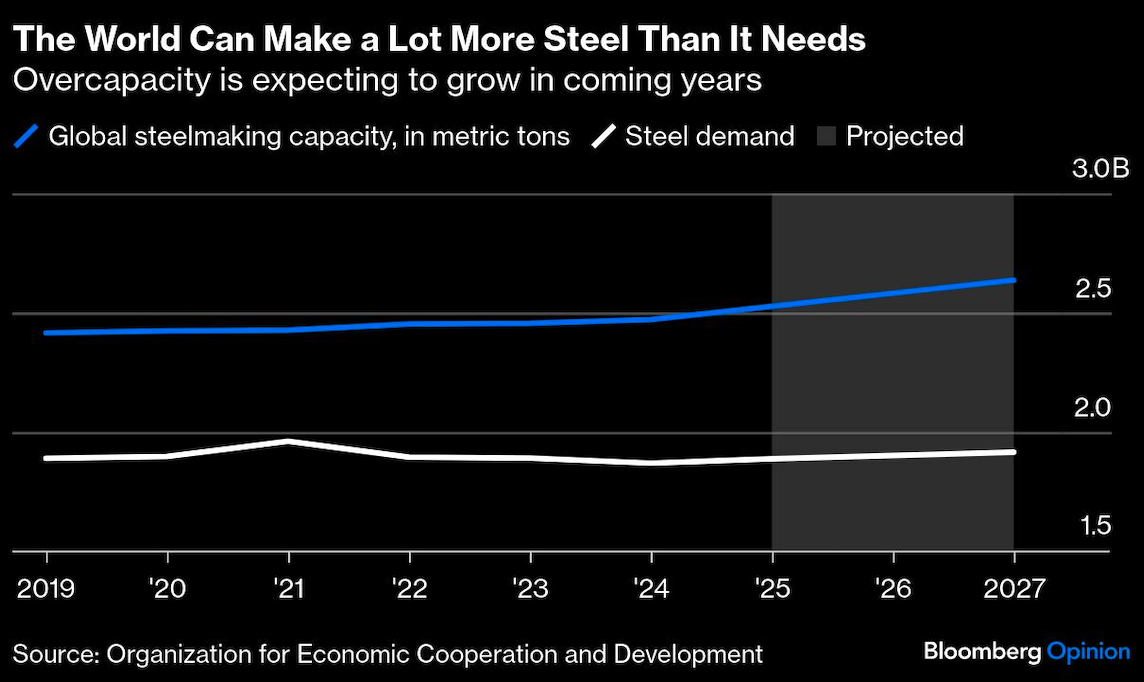
This time around, Trump is pushing for higher tariffs on pretty much everything, but steel remains a focus. It isn’t just Trump — promoting and protecting domestic steel production has been a priority for American politicians for more than a century. It’s a priority elsewhere in the world as well, with one result being that the world has much more steelmaking capacity than it knows what to do with. The G20 nations established a Global Forum on Steel Excess Capacity in 2016 and the problem does not seem to be going away.
The Organization for Economic Cooperation and Development, the club of the world’s affluent democracies, argues in its recent Steel Outlook 2025 report that the main culprit for the rise in excess capacity is China, which makes more than half the world’s steel. Subsidies for Chinese steelmakers — below-market loans and cheap energy, among other things — are 10 times higher as a share of steelmaker revenue than in the OECD countries. The US imports hardly any steel directly from China, but its steel industry competes in global markets being reshaped by Chinese surpluses. There’s an argument for simply accepting this low-cost bounty but also a case to be made for ensuring that otherwise viable steel industries aren’t swept away by it. Whatever is done to help steelmakers will come at a cost to industries that buy steel, but that cost isn’t always easy to see.
A message from Advisor Perspectives and VettaFi: To learn more about this and other topics, check out some of our webcasts.
Bloomberg News provided this article. For more articles like this please visit
bloomberg.com.
Read more articles by Justin Fox