Just when the International Monetary Fund sees slower growth around the globe, the economy the World Bank ranks 112 out of 196 based on gross domestic product is leading everyone – with the opposite outlook.
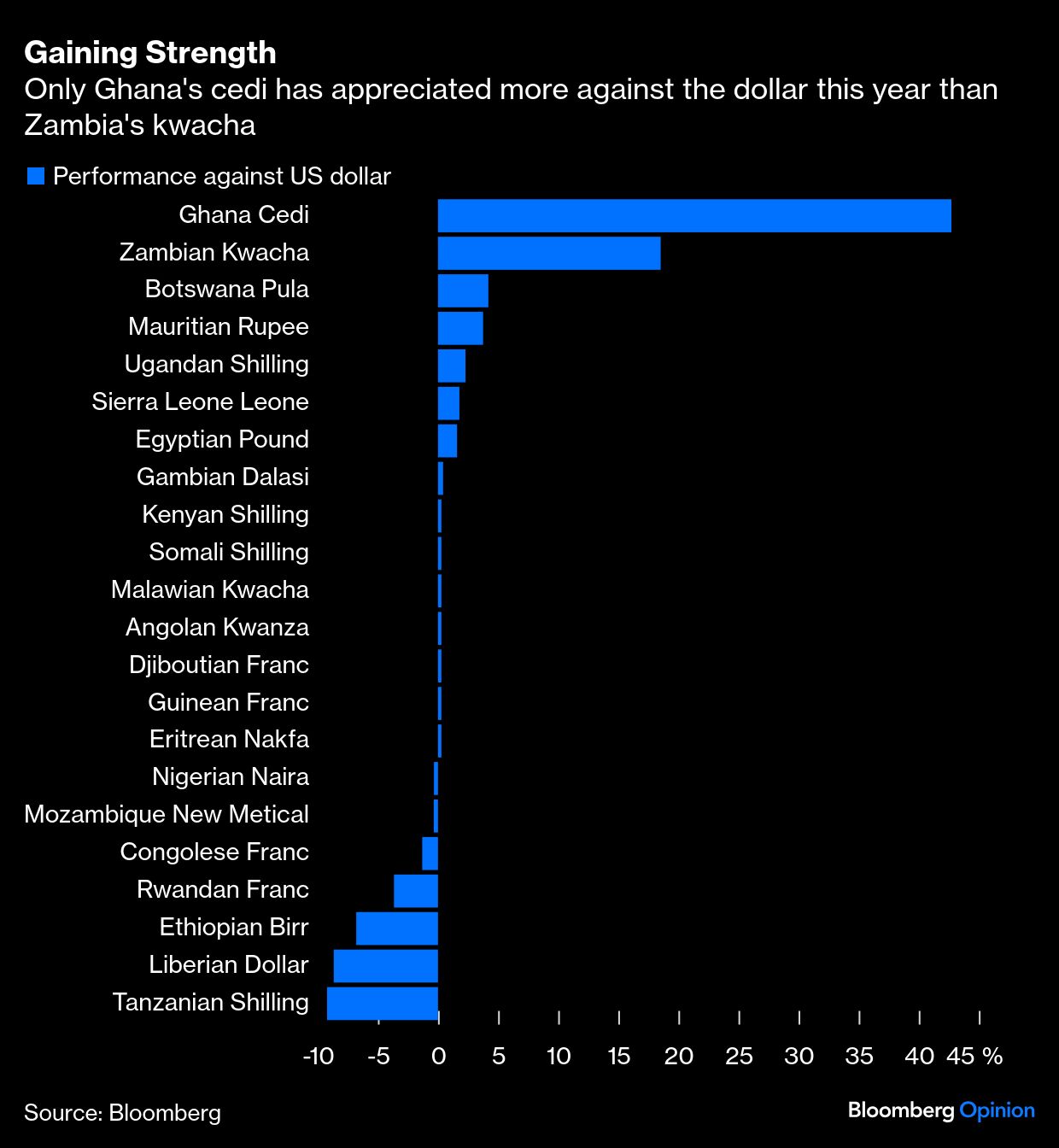
That would be Zambia, the Sub-Saharan African nation of 20 million people that defaulted in 2020. The “air-conditioned state,” so-called because of its elevation and climate, is poised to watch its economy expand at least 6% in 2025, buoyed by improving rainfall, increased copper production and a debt restructuring with interest rates as low as 1% until 2037. Zambia's dollar-denominated securities now have no peers in the international bond market, and the kwacha’s performance this year is second only to Ghana’s cedi among Africa's currencies, according to data compiled by Bloomberg.
Following the worst drought in two decades and the resolution of delinquent borrowings last year, Zambia Finance Minister Situmbeko Musokotwane said he is “confident that we will get to that 6%” growth rate, up from 4% in 2024, during an interview with Bloomberg News reporter Matthew Hill earlier this month in Livingstone, a resort destination five miles from Victoria Falls. His expectation is bolstered by recent rainfall ending a drought and the resurgence of Africa's second-largest producer of copper, which accounts for more than 60% of Zambia's exports. The red metal climbed 25% in the first three months of the year, its best quarter since 2009, and is up 22% for the year, the most among base metals, Bloomberg data show.
“We just need to maintain for 10, 15 years -- positive growth every year,” Musokotwane said, supported by a report from Harare, Zimbabwe-based ZB Financial Holdings projecting GDP growth of 6.6% in 2025. The World Bank predicts Zambia will expand 6.2% this year and 6.6% in 2026; the IMF forecasts 6.2% and 6.8%. “People will begin to see that it's not a certainty that you are born in poverty and you will end in poverty,” he said of Zambia, a country where the World Bank says 64.2% of the population lives on less than $2.15 a day. “Things change.”
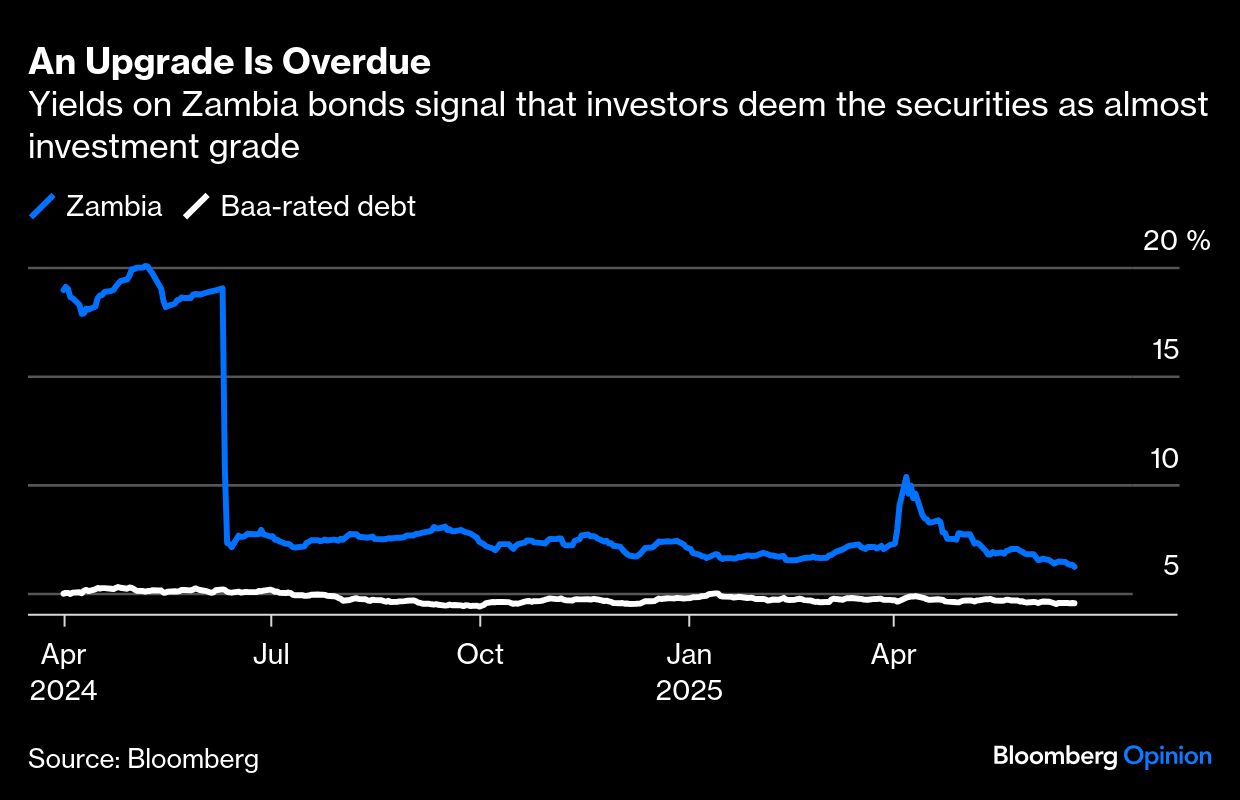
Global investors may be starting to agree. The $2.74 billion of dollar-denominated government securities that make up the Bloomberg Zambia Sovereign Debt Index gained 18% since July. That’s a month after the country completed the refinancing of its troubled debt, pushing out maturities on $6.3 billion in bilateral obligations to 2043, and double the total return (income plus appreciation) of the emerging-market benchmark. Bondholders are reaping a bonanza: A $100 million investment has swelled to $121 million in less than a year as lenders to emerging markets and high-yield borrowers in general turned the same amount into much less, or $109 million and $112 million, respectively.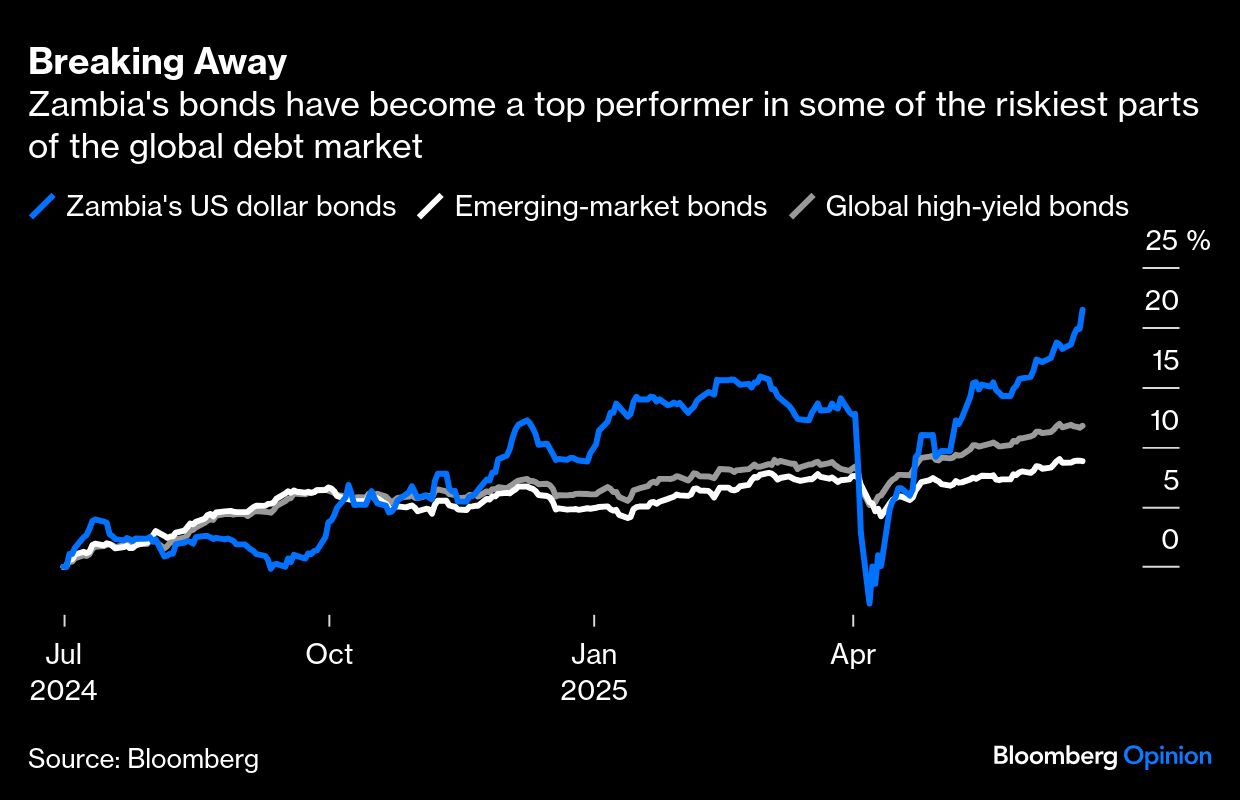
Zambia especially benefits from the restructuring. Creditors showed their confidence in the country, founded in 1964, by extending the average maturity of its dollar-denominated debt to 15 years, a superior outcome when compared with South Africa and Kenya, whose average debt maturity is 12 years, Ghana at 10 years and Nigeria at nine years, according to data compiled by Bloomberg. Zambia's public debt will decline to 100% of GDP this year from 126% in 2023, prompting Moody's Ratings tochange its outlook to “positive” from “stable.” Foreign-exchange reserves increased to a record $4.3 billion last year, according to ZB Financial. Inflation likely will slow to 8% by the end of the year from 15.3% in May, ZB Financial forecasts.