The United Arab Emirates has managed to thrive during global instability, drawing capital during the Arab Spring, opening up quickly during the pandemic and attracting Russian money after Moscow’s invasion of Ukraine.
But the Iran-Israel confrontation, which involved the US, poses one of the most stringent tests yet to the country’s neutral and open-for-business stance.
By Tuesday morning, just hours after Iran hit a US base in nearby Qatar and the UAE briefly closed its airspace, it was already business as usual in the financial centers of Dubai and Abu Dhabi.
An executive at one of Abu Dhabi’s wealth funds said it was proceeding as planned with deals and investments, even encouraging foreign executives to visit for meetings. In Dubai, bankers were quick to relay optimism that the UAE would sidestep any major fallout.
But while a ceasefire announced by US President Donald Trump appears to be holding, some executives acknowledge an undercurrent of nervousness because the geopolitical risks of the Middle East have come so sharply to the fore.
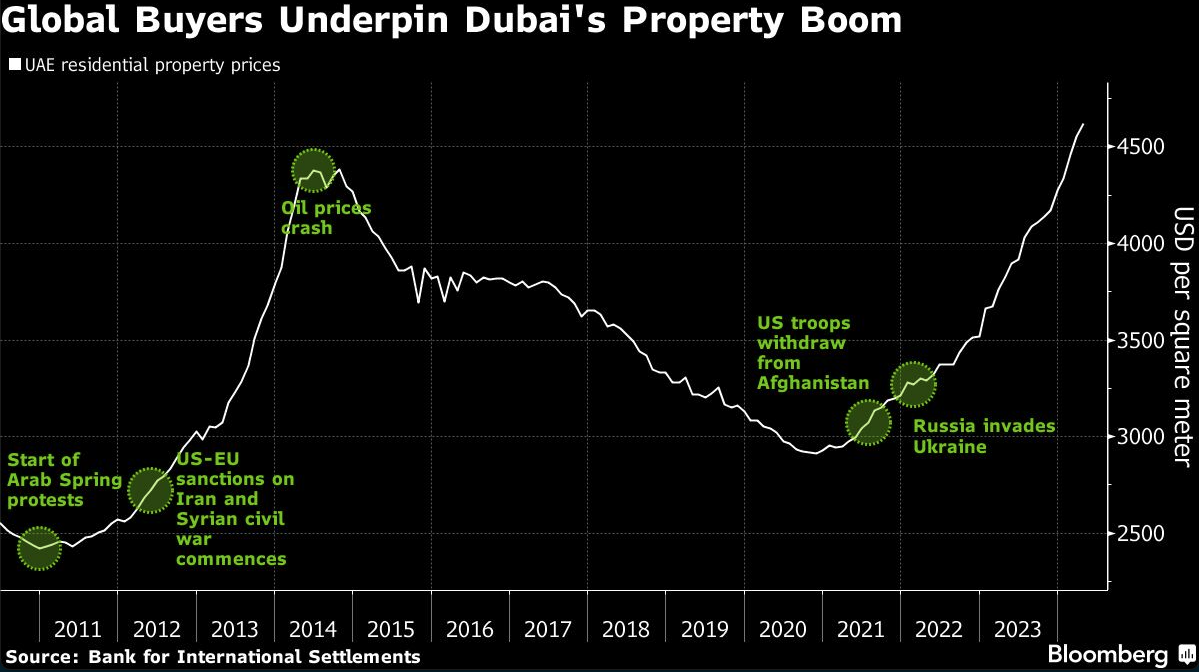
The stakes for the global financial community are particularly high in the UAE, which has attracted international billionaires looking to safeguard their wealth as well as Wall Street banks and hedge funds looking to expand. Abu Dhabi has been on a dealmaking spree with its $1.7 trillion sovereign wealth pile. Meanwhile, Dubai’s property prices have surged 70% over four years propelled by buyers from around the world.
“I think the current situation is contained. But what happened is significant — it’s a signal that no action is off-limits anymore,” said Hussein Nasser-Eddin, chief executive of Dubai-based security services provider Crownox, referring to the attack in Qatar, which like the UAE is a long-time ally of the US.
Nasser-Eddin said his firm — which provides travel security, protective and risk advisory services — has seen a rise in contingency planning requests in the Gulf in the last couple days. Companies have asked for details of Crownox’s cross-border capabilities, essentially wanting to know if it could “save the day” if things went wrong, he said.
Even such lingering concerns haven’t been enough to deter those investing or living in the UAE. More than a dozen bankers, hedge fund and sovereign wealth fund executives interviewed by Bloomberg News said they haven’t seen signs of capital flight or firms considering a pullback. They asked not be named because they weren’t authorized to speak to the media.
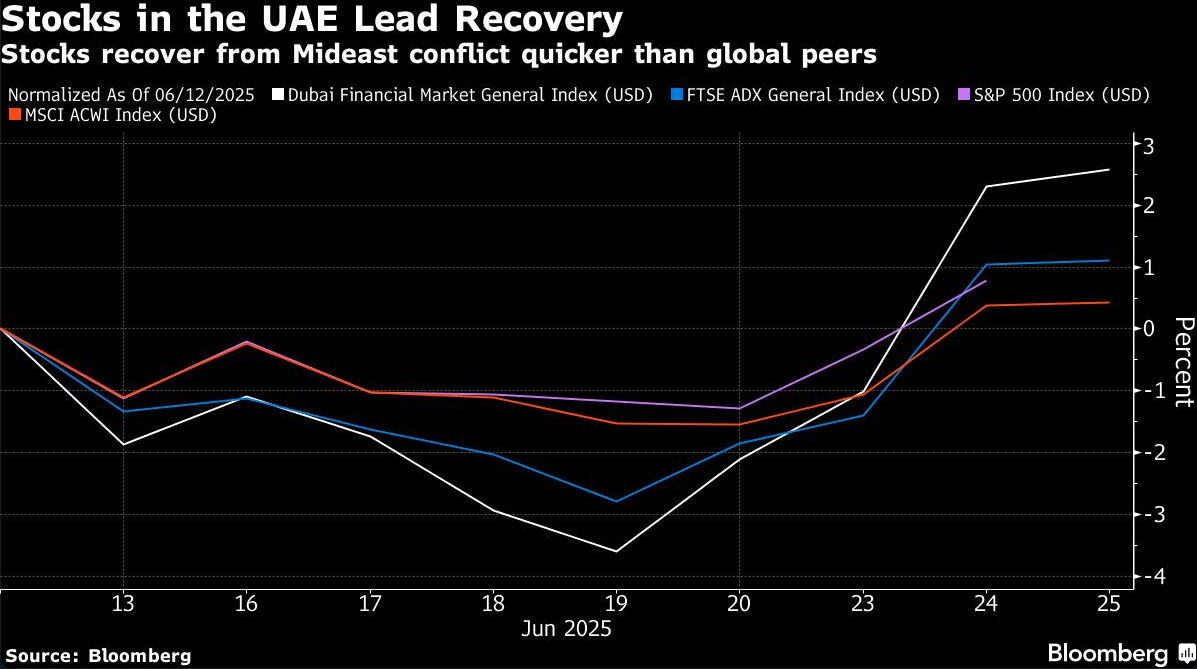
UAE stocks, which sank at the outbreak of the Israeli strikes on Iran, have not just recouped those losses but scaled new highs in tandem with US stocks. Dubai’s equity benchmark is trading almost 3% higher than before the conflict, reaching the highest level since the 2008 global financial crisis. Abu Dhabi’s index has added more than 1% and is at the highest since January. Both indexes are rising faster than the global benchmark MSCI ACWI.
“I believe that the safe-haven status will continue, the macro story remains robust and the reform program compelling. We continue to expect capital and population inflows in the medium-term,” Monica Malik, chief economist at Abu Dhabi Commercial Bank PJSC, said about the UAE. “The fact that there were no economic disruptions and the ceasefire are positive.”
Historically, Dubai has benefitted from periods of unrest not just regionally but elsewhere too. Most recently, after the invasion of Ukraine in 2022, some Russians bought Dubai real estate. Property prices have been shooting up since the pandemic. Still, the emirate’s population is largely made of expatriates and any pullback from them would also dent the housing market, which makes up more than a third of the city’s gross domestic product.
“We had a period of 48 hours where buyers were reluctant to pull the trigger,” said Myles Bush, chairman of brokerage Phoenix Homes. “However, now it’s business as usual and buyer confidence has bounced back.”
While market sentiment hasn’t been affected so far, a resumption of hostilities may shake confidence, said Anna Kirichenko, a property broker who has worked in Dubai since 2007.
There is also the potential for other economic fallout. Despite airspace closures ending and the ceasefire, several global airlines are still avoiding Dubai to ensure the safety of crew and passengers amid geopolitical tensions. Among them are Singapore Airlines, Air India Ltd. and United Airlines Holdings Inc. The aviation sector supported 27% of Dubai’s GDP in 2023, according to a report by Emirates, contributing nearly $40 billion to the city’s economy.
Dubai and Abu Dhabi have in recent years attracted expatriates and financial firms partly because of the UAE’s easy visa policies, low taxes and convenient time zone between East and West. The regulator for Dubai’s financial center said it had contacted a number of firms, who reported normal business activity.
A management consultant said it would take a far more devastating strike — such as one on a population center — to derail the UAE’s haven status and its internationalization drive. IPO bankers in the UAE have said that their post-summer pipeline hasn’t been affected by the geopolitical turmoil. Even in nearby Doha, the capital of Qatar, one banker said work had resumed as if the attack on the US base had never taken place.
To be sure, plenty of risks remain. Even after the truce was announced, there appeared to be early breaches by both sides that caused Trump to issue angry warnings. US intelligence findings have also shown that American air strikes had only a limited impact on Iran’s nuclear program, while Trump has maintained the sites were completely destroyed.
Still, executives were reassured because Iran appeared to have provided warnings before the attack and the UAE — which also houses US military personnel — wasn’t targeted. The chain of events suggests that officials in the Gulf had been able to manage the crisis from behind the scenes, one Dubai-based portfolio manager said.
Ken Moelis, the veteran Wall Street dealmaker with close ties to the Middle East, characterized turbulence in the region as an opportunity for one of the most optimistic changes in the Gulf for a long time. He highlighted opportunities such as the potential impact of unlocking Iranian oil reserves and opening up the country’s labor market, assuming sanctions are lifted.
“All I hear about is what if the peace doesn’t hold,” Moelis said in an interview on Bloomberg Television Wednesday. “I haven’t heard one person say, ‘What if the 90 million population of highly educated motivated Iranians come into the market?’”
A message from Advisor Perspectives and VettaFi: To learn more about this and other topics, check out some of our webcasts.
Bloomberg News provided this article. For more articles like this please visit
bloomberg.com.