Is There an Energy Transition? Yes, But It’s Not What You Think
Membership required
Membership is now required to use this feature. To learn more:
View Membership BenefitsAdvisor Perspectives welcomes guest contributions. The views presented here do not necessarily represent those of Advisor Perspectives.
Are we experiencing an energy transition? According to geologist and fund manager Jane Woodward, we are — and it’s proceeding more quickly than almost anyone expected. In a dazzling speech she gave at the semiannual conference of Foundation Financial Officers Group (FFOG) in April in Oceanside, California, Woodward set forth a blizzard of facts supporting the idea that renewable energy sources are replacing fossil fuels at a very encouraging pace.
But not everyone agrees. Mark Mills, a physicist and venture capitalist about whom I’ve written extensively (and collaborated with) in earlier essays, has said that “there is no energy transition.”1 And Alex Epstein, author of “Fossil Future,” whose speech preceded Jane’s at the conference, doesn’t want an energy transition. He argued that the benefits of fossil fuels are so extraordinary that eliminating them from our energy mix would be tragic.
Who’s right? What are these critics talking about? How should we understand the progress that’s being made toward a post-Oil Age world?
Woodward is right if you define an energy transition in relative terms (what are the changing shares of renewables versus fossil fuels) and if you care mostly about electric power generation and if you’re looking only at the economically developed world.
But, if you compare the absolute amounts of fossil fuels and renewables being used for energy generation globally for all uses, the transition is something of an illusion.
First, I summarize Woodward’s speech. Then, I compare her views to those of the previous speaker, Epstein, and to the work of Mills. the. Finally, I suggest that placing a discussion like this in the frame of macro- and microeconomics would better clarify some of the mysteries surrounding these very different-sounding — but not all that contradictory —perspectives on energy.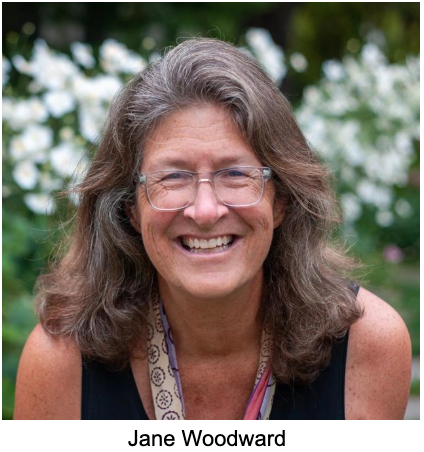
Source
In addition to her service to Stanford University as an adjunct professor of civil and environmental engineering, Woodward is a founder and managing partner of WovenEarth Ventures, a clean tech venture fund of funds (with a lot of exposure to energy). She’s also a founding partner at MAP Energy, a private energy firm currently invested in oil and gas royalties. (Woodward was focused on this business from 1986 to 2000, and after its wind, solar, and storage assets and team were sold to Global Infrastructure Partners, she co-founded WovenEarth Ventures.)
Woodward’s take on the energy transition
Woodward’s case for a powerful, effective energy transition (from fossil fuels to renewables) rests on the skyrocketing share — albeit from a low base — of solar and wind in the generation of electricity in the developed world. (She also argued that fusion and enhanced geothermal energy are experiencing a stealth “super launch” with big technology breakthroughs, policy support, and hyperscaler demand enabling future growth.) Exhibit 1 shows the growth of global (not U.S.) renewables as a share of total electric power generation so far in this century. The part not shown, above the wind and solar share, consists of fossil fuels and nuclear power. If you consider nuclear to belong to the renewable category, which I do, the renewable share is even larger than shown in Exhibit 1 (although the nuclear share is growing very slowly, if at all).2
The expansion of the renewable share has, of course, displaced fossil fuels to some extent. From a peak of 68% in 2007-2012, the fossil fuel share of global electricity generation has fallen to 59% in 2024.3 That’s progress, although “net zero” is still far away. If you consider fossil fuel emissions to be an emergency, we’re not responding to it well. If it’s not an emergency (but the likely global warming will be an immense headache and expense), which is what I believe, the picture is better, but not great.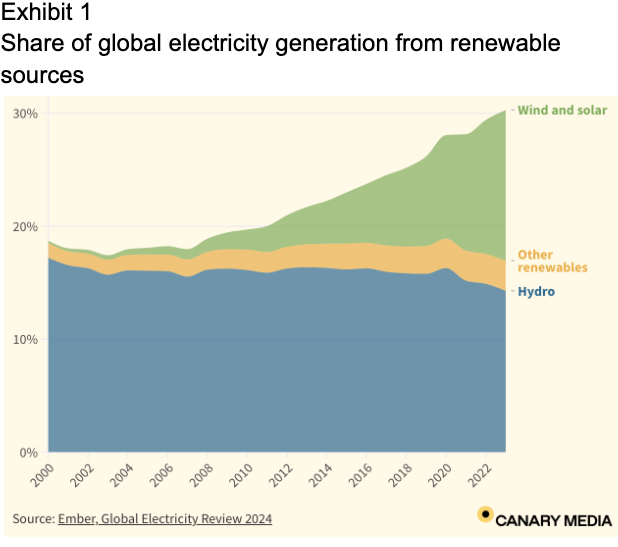
The big picture: Energy is not just electricity
But let’s look at the bigger picture: total global energy production, not just electricity. Transportation, heating, and high-temperature industrial processes are tough nuts to crack. Oil is such a dense, portable, and cheap fuel for land transport that replacing it with electricity involves a massive investment in batteries and the electric grid, and adoption has largely required subsidies and mandates.
Air travel is even worse: Electric airplanes are still mostly on the drawing board, existing ones have a short range and can’t carry many people, and nobody really knows how safe they are because of the short amount of time they’ve flown. Aviation is all about
limiting the weight that has to be lifted and, as Mills has written, “maximum theoretical energy in a pound of oil is 1,500% greater than [maximum] theoretical energy in the best pound of battery chemicals.”4
And let’s not forget agriculture. The world’s 8 billion people are mostly eating well because of fertilizer produced using the century-old Haber-Bosch process, which extracts nitrogen from air. This process uses fossil fuels. Without Haber-Bosch, the Earth’s farms and ranches would support about 4 billion people. Attempts to replace Haber-Bosch with cleaner technologies have been halting and expensive. Don’t expect a quick solution.
All these factors combine to produce an overall energy production picture that is less favorable than that for electricity alone. Exhibit 2 shows the energy sources used globally to produce the world’s entire energy budget.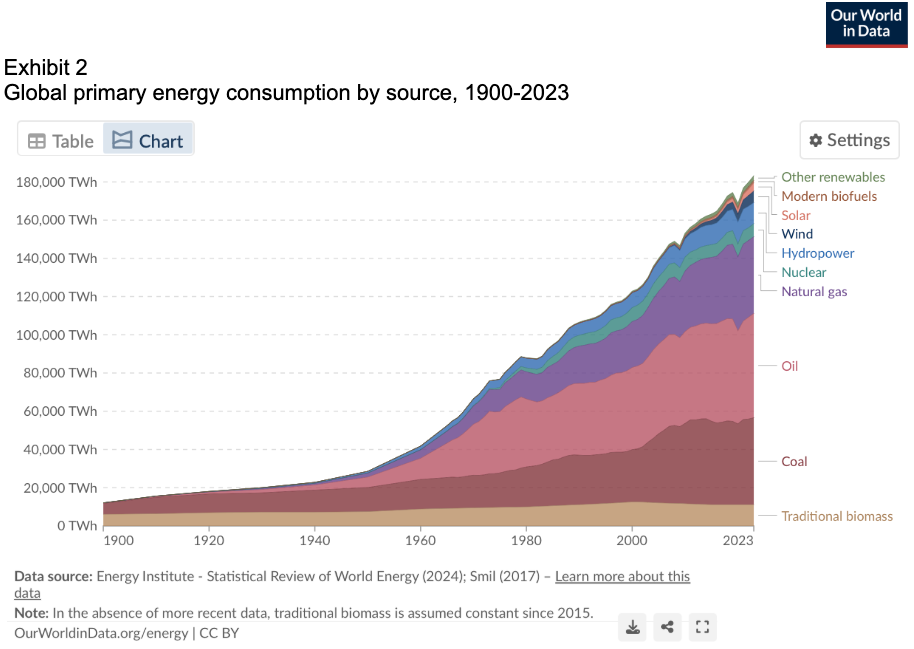
Source
Fossil fuel use (coal, oil, natural gas) reaches a new high every year, except during economic depressions. If Exhibit 2 were drawn on a log scale, you’d see that the growth rate has slowed, but is still positive.
The energy triptych: How to think about energy
Enough about the energy transition in raw numbers. Let’s turn to the most helpful part of Woodward’s speech: a conceptual framework for thinking about how energy is produced, transformed, and used. This framework helps us discuss energy issues in a more rational and better-informed way.
Woodward encourages us to think about energy as a system (as opposed to, I guess, a “thing”). It’s produced, transmitted, and used in three phases as depicted in Exhibit 3, which is a triptych, or three-panel display. The first panel is primary sources of energy; the second, what Woodward calls energy “currencies” (explanation to come); the third, uses to which energy is put.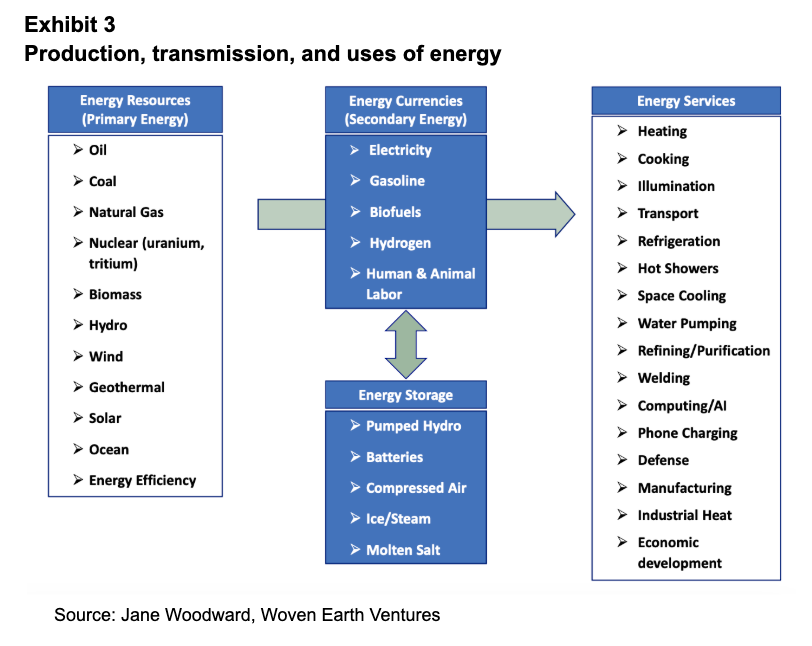
The primary energy sources in the first panel of Exhibit 3 are raw “materials” (not all of them are materials in the strict physical sense, for example, solar radiation). They have the potential to be transformed so as to be useful to humans but have not yet been transformed.
In the second panel, we see energy in various ready-to-use forms, which Woodward calls currencies in the sense that cash is currency; it needs no further processing before you can exchange it for a good or service you want.
The third panel shows the various uses to which energy is put — the goods and services you can “buy” with your energy “currency.”
This three-part diagram is an effective way of focusing one’s attention on the components — rather than the whole — of the energy economy, and should be carried in one’s memory through any discussion of energy technology or policy. But how do you mentally put the pieces together to arrive at a coherent story?
Through a pathway diagram such as Woodward’s Exhibit 4, of course. It gives two examples: 1) the conversion of crude oil (primary energy), through various intermediate steps, to miles traveled in a car (the service rendered, ultimately, by the oil); and 2) the conversion of coal to lighting, following a similar route.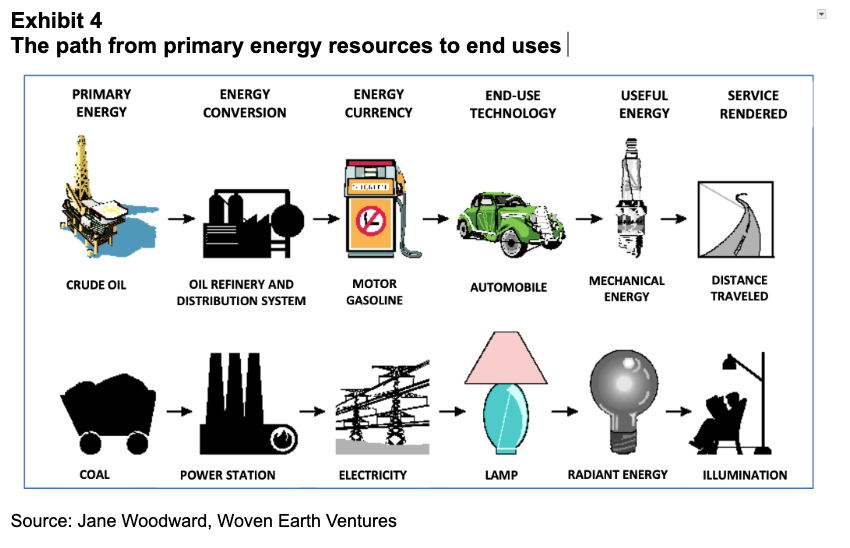
Here comes the sun
Each conversion (represented by an arrow in Exhibit 4) involves a lot of energy loss — what engineers call inefficiency; Woodward notes, “the fewer conversions the better.” This idea is intuitively obvious, but it’s reassuring that it works in practice. For example, photovoltaic (PV) solar panels convert solar radiation directly to electricity, skipping several steps used by other electricity sources, almost all of which use boiling water to operate a turbine that spins a generator. PV efficiency is around 22% for typical panels and up to 47% in the lab with advanced technology.
That is one reason solar is soaring ahead of other renewables in terms of change on the margin — in 2024, 60% of new U.S. power additions were solar.5 Other reasons include low costs and generous subsidies. That new sources of energy will be substituted for old ones when the former become cheap enough is a standard prediction of growth theory and price theory. But in looking at totals instead of change on the margin, solar is still far behind fossil fuels: In 2023, it was a skinny 4% of U.S. total electricity-generation capacity, and 5% worldwide.
PV solar power, while extremely promising, is not all sunshine and rainbows. Solar farms cover huge amounts of land, use a lot of raw materials, are not trivial to install or hook to the grid, and will produce a mountain of waste when the cells wear out. And there is the intermittency problem (shared with wind). Every technology that has an upside also has a downside.
Inequality
According to Woodward, the U.S. alone will need to triple its already-high electricity output to accommodate electric cars, electric heating, and computing (AI and data centers). But there’s a more profound and pressing reason why the world needs to increase its energy output by more than triple: Most people don’t have enough energy — not even close.
A story I like to tell (but wish I didn’t have to) is that of Mercy Njima, a Kenyan doctoral student, who reports:
Women and children...spend hours every day searching for…energy resources. Once they start burning biomass, the acrid smoke causes serious lung disease. More people die from smoke inhalation than from malaria. Because children have to help collect fuel during school hours, time spent on their education is severely reduced.
We in the developed world are exercised about inequality — why some have so much when others have little. But what little the poor of the developed world have is unimaginable luxury compared to many of the children of Kenya (not a particularly poor country by African standards) who have to collect sticks and dung to use as fuel. They are living at an energy standard not very different from that of their ancestors a thousand years ago.
Superficially, looking at Exhibit 5, the world — other than sub-Saharan Africa, seems to be in pretty good shape regarding electricity access. Globally, about 90% of the population has electric access. That’s a big change from only a few decades ago.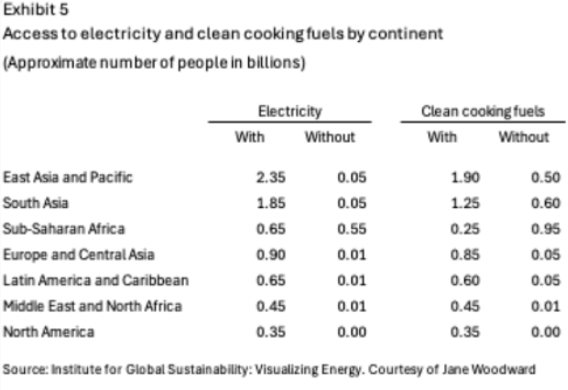
But “access to electricity” is defined by aid and development agencies as “having an electricity source that can provide very basic lighting, and charge a phone or power a radio for 4 hours per day.”6 That’s a very low bar, and almost 1 billion people worldwide don’t clear it. To address this kind of extreme energy poverty, we’re going to need a lot more electricity.
The situation with clean cooking fuels is worse. In total, 55% of the world’s people have them; 45% do not. East and South Asia, vigorous growth areas economically, still house 1 billion people without such fuels. Africa houses another billion — see Mercy Njima’s story above. Fossil fuels are one possible remedy, but they’ll add to atmospheric carbon. This may be a trade worth making while we wait for more widespread electrification. If I were an African schoolchild, I’d resent a bureaucrat or scientist in wealthy Brussels or Washington telling me I have to suffer because of their fear of a possible rise in sea levels.
Three musketeers of energy
Woodward, Epstein, and Mills — all of whom have spoken to the FFOG, of which I am a member — form a sort of triangle of energy expertise, enabling us to compare their views and approaches.
Alex Epstein
Epstein, whose book “Fossil Future” I reviewed here, comes across as a bit of an extremist, partly because he champions fossil fuels at a time when it is profoundly unpopular (some would say dangerous) to do so, but also because he is a little prickly. He adds to the heterodoxy by suggesting that global warming might be more good than bad. When you’re saying something that far removed from the mainstream, you’re going to annoy a lot of people, so you might as well make prickliness one of your selling points.
But it’s hard to argue with the observation, documented in Exhibit 6, that the curve of human progress over the last century (and longer) almost precisely matches the curve of fossil fuel use. We’ve undergone energy transitions, of a kind, during that time — from wood to coal to petroleum to natural gas to nuclear and renewables, but each of these has been additive. We didn’t stop using the old energy sources (not even coal, although use in the United States and Europe has declined); we just became more energy-rich each time. Since most of the energy in modern times has come from fossil fuels, the benefits of a “fossil past,” described in loving detail by Epstein, are undeniable.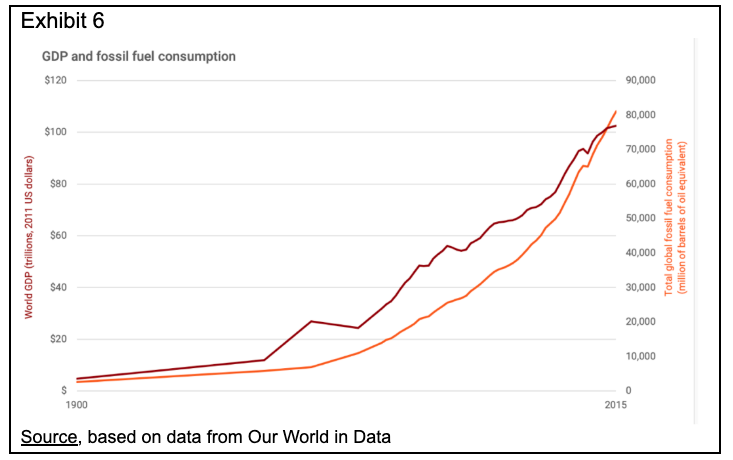
Whether our future is “fossil” depends on the balance between the need for cheap, portable, abundant energy and the hazards of adding CO2 to the atmosphere. Far from being a climate denier, Epstein writes:
I totally acknowledge that [fossil fuels] have contributed to the 1°C warming we’ve experienced over the last one-hundred-plus years, and they will contribute to further warming going forward. But I will argue that the negative climate impacts of fossil fuels will be far, far outweighed by the unique benefits of fossil fuels.
If there were no concern about climate, he would be exactly right — but not forever. There are only so many cubic meters of fossil fuel in the Earth, and they’re not making any more of it (at least not quickly). So, the day will come when they become scarce enough to be expensive relative to other energy sources. At that far-off time, the Oil Age will come to a gradual end, and oil will only be used where it is least replaceable, such as in airplanes.
But concerns about the effect of CO2 on climate are legitimate, and policies worldwide reflect that fact, or will do so increasingly. We will not have a fossil-only future.
Mark Mills
We met Mills earlier in connection with the surprising quote, “there is no energy transition.” (I summarized and commented on his 2024 FFOG talk here.) While Mills, Epstein, and Woodward all agree that fossil fuel use has continued to rise even as we try to force it downward, Mills is the clearest of the three in forecasting what will happen in the long run. We will transition from fossil fuels to other energy sources, but we’ll use a lot of fossil fuels in getting from here to there. “To reduce the world’s use of hydrocarbons,” he wrote, “we need to use...more hydrocarbons.”7
How will this work? Mills notes that
Fabricating wind, solar and battery hardware entails a radical increase in the use of a range of minerals from copper and nickel to aluminum and graphite, and rare earths such as neodymium. The increases range from 700% to 4,000% more minerals per unit of energy production.
The spending to meet the wind, solar and EVs mandates will require an astonishing, unprecedented increase in output from the old-school industries of mining and mineral refining. The transition will require hundreds of billions of dollars invested in hundreds of massive new mines, somewhere.8
All this mining, refining, and fabricating will involve a lot of fossil fuel use. That, along with limitations of renewables for certain applications, is the reason why he and I say that it will take a lot of fossil fuels to reduce our use of them.
Meanwhile, Mills recommends that we build lots and lots of nuclear power plants. It’s hard to see how we avoid doing so if we’re ever going to achieve a legitimate energy transition without sacrificing our prosperity and the hopes of billions who are not yet prosperous.
Jane Woodward
Into this melee steps Woodward, who at first glance appears to be a renewable energy junkie. A more careful look, however, shows that she has a sophisticated and balanced view; the “unstoppable wave” to which she referred toward the end of her presentation is a wave of investment in renewables, not necessarily a wave of renewable energy taking over the world. The investment wave is already taking place, is very large ($1.8 trillion in 2023), and is to be expected whenever a new technology challenges an old one.
It’s worth noting that Woodward is a partner in an investment management firm “currently focused on oil and gas royalty interests.” This is not to say that she is a hypocrite — just the opposite. What she is doing is exactly right: When you don’t know what is going to happen, you diversify. And Woodward indicated in several different contexts that fossil fuels will be part of our future for a long time to come. It’s to her credit that she never even mentioned “degrowth,” that poisonous philosophy of environmental purity-through-poverty that is currently making the rounds.
Conclusion
Woodward’s presentation of the facts surrounding the energy riddle was densely packed and quite entertaining. She is just as enthusiastic about humans flourishing as Epstein, or Mills, or me — and as convinced of the need for much more energy. Woodward just hopes to achieve it through a slightly different (not radically different) pathway. And given the reality that we don’t know how bad climate change will be in the long run, or how much we can do about it, the pathway she advocates is the one that’s most likely to occur — and probably should occur.
I would love to see Woodward enrich her explanation of our energy future by including more economics, both macro and micro. As she points out, energy is not a single “thing”; it’s a system of services and technologies to support basic human needs such as heating, cooking, illumination, and transportation, as well as many more functions comprising essentially all economic life. We would all benefit by deepening our understanding of the economics of our energy production and use along with the associated externalities, especially from someone as capable as Woodward.
Laurence B. Siegel is the Gary P. Brinson director of research at the CFA Institute Research Foundation, economist and futurist at Vintage Quants LLC, and an independent consultant, writer, and speaker. His books, which include Fewer, Richer, Greener and On Progress and Prosperity, explore ideas in economics, investing, the environment, and human progress. His website is http://www.larrysiegel.org. He may be reached at [email protected].
The author thanks Stephen Sexauer, CIO of the San Diego County Employees Retirement Association, for his contribution to this article in outlining the macro- and microeconomic aspects of the energy topics discussed herein.
A message from Advisor Perspectives and VettaFi: To learn more about this and other topics, check out some of our webcasts.
1 https://www.youtube.com/watch?v=ZXkEgF1I2FA
2 Technically, nuclear power is not renewable, because once the uranium or other fissionable material has been used, it cannot be used again except at much lower efficiency levels. It is not “free” like sunshine or wind. But because it does not produce carbon emissions, it can be classified as renewable (not quite the right word, but it will have to do) for the purpose of determining whether there is an energy transition out of fossil fuels and into noncarbon-emission-producing energy sources.
3 https://ourworldindata.org/grapher/share-electricity-renewables
4 https://manhattan.institute/article/inconvenient-energy-realities
5 Source: Canary Media. 2025. “96 Percent of New US Power Capacity was Carbon-Free in 2024” (January 10).
6 https://ourworldindata.org/grapher/share-of-the-population-with-access-to-electricity, in the notes
7 In the Pittsburgh Post-Gazette on December 6, 2023 at https://www.post-gazette.com/opinion/Op-Ed/2023/12/06/mills-hydrocarbons-energy-transition-oil-gas-coal/stories/202312060007.
8 Ibid
Membership required
Membership is now required to use this feature. To learn more:
View Membership BenefitsSponsored Content
Upcoming Virtual Events View All












