Europe Should Stop Worrying and Learn to Love Nuclear
Membership required
Membership is now required to use this feature. To learn more:
View Membership BenefitsWhat if a single technology could help meet many of Europe’s challenges — accelerating decarbonization, enhancing international competitiveness and ensuring the security of energy supplies?
Nuclear power has the potential, if Europe’s leaders give it the chance.
Just a few decades ago, Europe led the world in adopting nuclear. It relied on the technology for more than 30% of its electricity and accounted for more than 40% of global production. But fear of accidents — stoked by the 1986 Chernobyl disaster and the 2011 Fukushima meltdown — drove a reversal, most notably in Germany. The European Union’s largest member shut down more than 26 gigawatts of capacity, which today would make up about a fifth of the EU total.
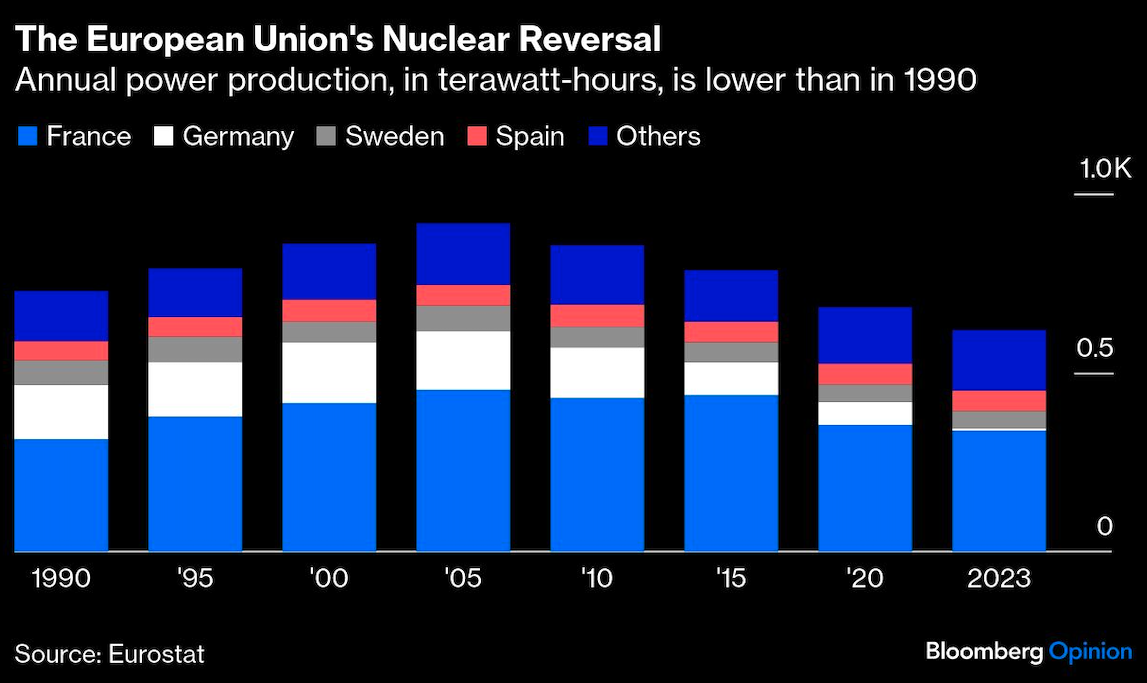
The about-face proved to be an epic mistake. Europe forfeited the kind of consistent, inexpensive, low-carbon generating capacity that it now desperately needs. Germany found itself more dependent on coal and imported natural gas than it otherwise would’ve been — and hence more vulnerable to Russian meddling and volatile gas prices. Insufficient baseload energy can destabilize electricity grids and make net zero emissions harder to achieve.
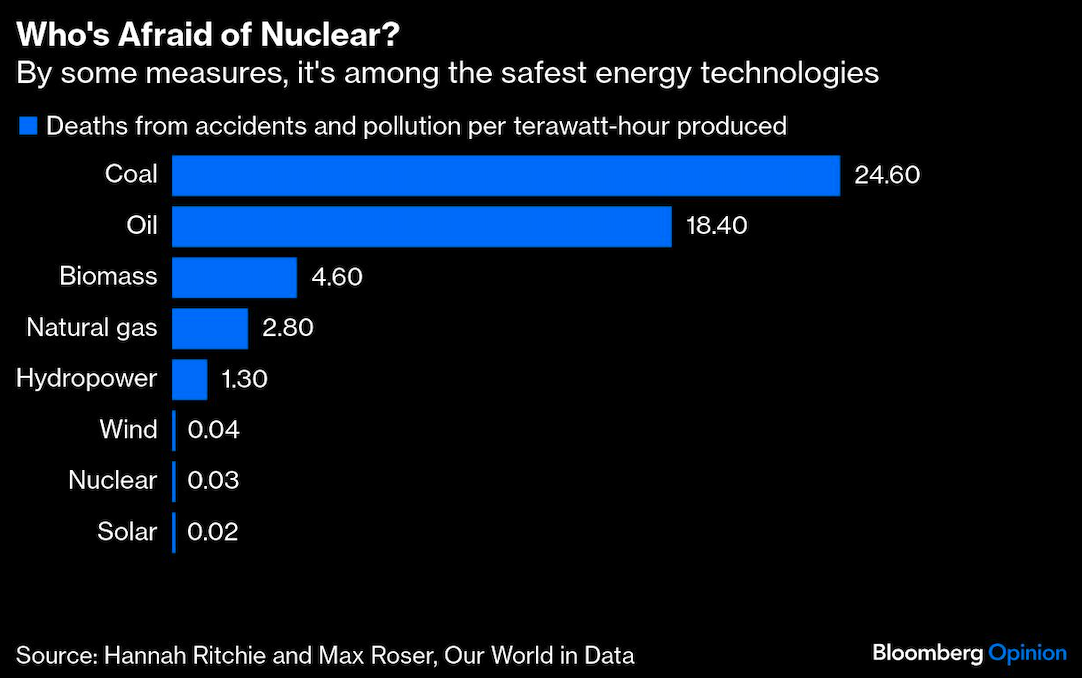
Although the public remains wary about safety, the risks shouldn’t be exaggerated. Even accounting for Chernobyl, nuclear energy’s risk to human lives per terawatt-hour produced is orders of magnitude lower than fossil fuels such as coal and oil. Newer technologies are safer still, often employing “passive” systems that — for instance — use gravity to head off accidents automatically.
European leaders are rightly coming around, reflecting a broader global recognition of nuclear as a necessary tool in the green transition. The EU is aiming to ramp up capacity again, while Germany has dropped its long-standing opposition. Italy, Poland and the UK are all turning to the technology to help meet decarbonization goals. Promising innovations include small modular reactors, which have simpler designs and can ease grid strains. Waste-free fusion may be on the horizon.
Yet rebuilding is easier said than done. To some extent, restarting or extending the life of existing plants can help: By one estimate, Germany could bring 12 gigawatts of capacity back online by 2032 at a cost of less than €20 billion. Beyond that, new reactors in the EU, US and UK have consistently been plagued by regulatory hurdles and cost overruns. Construction timelines have increased to well beyond a decade, compared with as little as five years in Russia and China — the opposite of the typical technological learning curve. This complicates financing and undermines nuclear’s price advantage.
Given the potential public benefits, authorities must remove what obstacles they can. Governments should harmonize licensing, such that a design approved in one country would also be allowed in others. Institutions such as the European Investment Bank — as well as the EU’s state-aid and sustainable-finance rules — should treat nuclear as favorably as they would any other low-carbon project, so that member states can provide similar guarantees to attract private investment and reduce financing costs. This should also encourage development of supply chains, particularly for nuclear fuel, much of which currently comes from Russia.
History is littered with examples of societies that, to their great disadvantage, lost valuable technologies or allowed capabilities to atrophy. Europe shouldn’t let that happen with nuclear energy.
A message from Advisor Perspectives and VettaFi: To learn more about this and other topics, check out some of our webcasts.
Bloomberg News provided this article. For more articles like this please visit bloomberg.com.
Membership required
Membership is now required to use this feature. To learn more:
View Membership BenefitsSponsored Content
Upcoming Virtual Events View All












