As leaders of the China-led group of emerging-market economies known as the BRICS descend on Rio de Janeiro for their summit starting Sunday, expect the usual coterie of talking heads offering prepared remarks to the media with the city’s iconic Sugarloaf mountain serving as a picturesque backdrop. And yet, behind the diplomatic niceties and pledges of cooperation lies an uncomfortable truth for Brazil, which is that the value of belonging to this incoherent club that also consists of Russia, India and South Africa is rapidly diminishing.
Since its founding in 2009, the bloc has presented itself as an alternative to the postwar global order shaped by the US and its developed-nation allies. Instead of a system based on liberal democratic values, the BRICS promote an alternative view that favors multipolar engagement and leveling the playing field for developing nations. The idea has caught on, with Egypt, Ethiopia, Indonesia, Iran, Saudi Arabia and the United Arab Emirates becoming members.
The problem is that all these years later, the BRICS remains mostly inconsequential on the world stage. Its biggest weakness is its composition, including both democracies and autocracies. Belligerent nuclear powers such as Russia overlap with peaceful nations like Brazil. India and China are aligned here, but India has no plans to cede leadership of the so-called Global South to China. The disparities are plenty and it seems the main thing that binds this bunch together is their shared antipathy toward Washington.
Sure, Brazil has extracted some benefits, namely gaining influence in a fractured world where emerging nations are demanding more say in global decisions. It also gave Latin America’s largest economy another platform to promote its positions to go along with the Group of 20 and the Mercosur trade bloc, which President Luiz Inácio Lula da Silva has used to push for a rebalancing of global power away from the US.
But the burden of being the “B” in BRICS is increasing, especially when Russia and Iran are part of the club. (It’s bad when the good news is that neither Russian President Vladimir Putin nor his Iranian counterpart Masoud Pezeshkian will show for the family photo in Rio.) The reality is that none of Brazil’s strategic goals — from being a regional leader to obtaining a coveted seat at the UN Security Council — are likely to be achieved through its association with the BRICS. To make things worse, Brazil lost a measure of influence within the block as it added new members, a process Brasilia resisted only to see China imposing its will, which has become a more frequent occurrence. With more voices at the table came more dissidence and infighting, paralyzing the bloc in ways similar to that of groups of developed-economy nations.
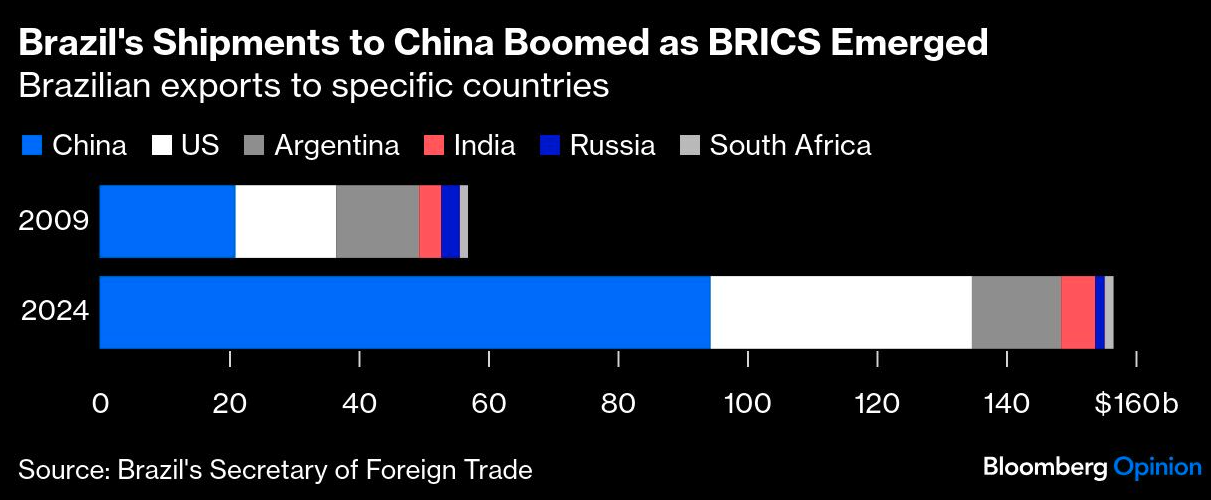
For Brazil, part of the reason to remain in the group is to cozy up to China, its largest trading partner and a strategic ally. That makes sense, especially if Brazil’s leaders believe it would come with financial or commercial benefits (although I suspect you don’t need to be a BRICS insider to build a close relation with Beijing). Nevertheless, Chinese President Xi Jinping is skipping the summit, partly because he met with Lula at other events in the past year.

If it isn’t evident, I don’t see the BRICS matching the hype. And I find the perception among many officials and academics of its influence puzzling. Yes, it represents roughly half the world’s population and almost 40% of its economy, but the bloc is neither an interlocutor of the old power nor a player with capacity to shape the global arena — and it may never be. For all its talk over the years, the liberal order is being dismantled by Washington itself at the moment, not by the BRICS.
Take the idea of reducing the dominance of the dollar in global trade. It wasn’t the notion of a BRICS currency that made investors start to doubt the primacy of the greenback — but Donald Trump. Also, Trump isn’t negotiating tariffs with the bloc as a whole but directly with its members on a bilateral basis. The BRICS don’t have the capacity to intermediate wars in Ukraine or Gaza, either. And in the unlikely case that Brazil ever needs military support, Russia and China aren’t likely to be reliable partners, as Iran can testify.
BRICS may be a useful alliance for Brazil to promote its interests and provide cover when it doesn’t want to clash directly with the US on matters of policy. But that’s no replacement for a grand plan that showcases its many strengths, from being a vibrant, peaceful democracy to a massive commodities producer. The best way for Brazil to become the global power it has long aspired to is through economic might and growing regional political and security influence.
In that sense, the country has a lot of work ahead, as evidenced by an economy that has expanded an average of just 1.6% per year since the launch of the bloc and failing on the promise of becoming an emerging economic superpower. Even after Lula’s more than 30 international trips since in 2023, Brazil’s capacity to help solve the biggest problems in its own neighborhood — whether in Venezuela, Nicaragua, Haiti or taming the continent’s security and migration crisis — is nonexistent. It’s by domestic strength that Brazil will project real influence on the global stage, not by getting tangled in a bloc that may soon resemble a new Group of 77.
A message from Advisor Perspectives and VettaFi: To learn more about this and other topics, check out some of our webcasts.
Bloomberg News provided this article. For more articles like this please visit
bloomberg.com.
Read more articles by Juan Pablo Spinetto