Huawei Technologies Co. is trying to export small quantities of AI chips to the Middle East and Southeast Asia, an effort to establish a foothold in markets dominated by Nvidia Corp. despite ongoing manufacturing challenges.
The hardware giant — China’s strongest competitor to leading US chipmakers — has reached out to potential customers in the United Arab Emirates, Saudi Arabia and Thailand about purchasing its older-generation Ascend 910B processors, according to people familiar with the matter. The two Gulf nations recently struck deals for well over a million Nvidia and Advanced Micro Devices Inc. chips over several years. Thailand’s artificial intelligence efforts similarly rely on Nvidia.
Huawei is offering 910B volumes in the low thousands, according to the people, though the exact number for any particular pitch remains unclear. The company is also trying to woo customers with remote access to CloudMatrix 384, the people said. That’s a China-based AI system built with more advanced Ascend 910C chips — which Huawei isn’t currently prepared to export due to limited supplies, according to a person familiar with the company’s thinking. Huawei is focused on selling 910Cs to Chinese firms that can’t access best-in-class American chips, the person said.
Huawei’s efforts haven’t produced any finalized deals, the people said — though they indicate the company, which Nvidia has called a formidable competitor, wants to give foreign AI markets a taste of its technology as it works to boost manufacturing output. The proposals also have garnered attention from policymakers in Washington, who want to ensure that the world builds AI systems using American, not Chinese, technology. US officials — and Huawei itself — estimate that the Ascend lineup trails Nvidia’s offerings by a generation or more.
Parties in the UAE — including the Mohamed bin Zayed University of Artificial Intelligence — haven’t shown interest, the people said, while the status of talks in Thailand is unclear. Representatives for the UAE government and the university didn’t respond to requests for comment, while Thai officials didn’t immediately respond on a public holiday.
Huawei has also pursued a deal for some 3,000 Ascend chips in Malaysia, Bloomberg News has reported, though the status of that project is unclear. Saudi Arabia, meanwhile, seems open to potential purchases — including by the Saudi Data & AI Authority or SDAIA, according to one person who described those conversations as advanced. The Saudi government didn’t immediately respond to a request for comment, while a SDAIA spokesperson said that “at this stage, we’re not in a position to provide a comment as the matter is outside our current scope.”
A senior Trump administration official has said Huawei can only make 200,000 AI chips this year, which are expected to be delivered mostly within China, where demand exceeds a million processors. (That number doesn’t include a stockpile of 2.9 million Ascend 910B dies Huawei managed to source from production powerhouse Taiwan Semiconductor Manufacturing Co.)
But Washington “shouldn’t take too much comfort in the fact that China’s production of these advanced chips is relatively small, because we know they have global ambitions,” Commerce Under Secretary Jeffrey Kessler told lawmakers last month.
Huawei declined to comment for this story, which is based on interviews with around a half-dozen people who requested anonymity to discuss sensitive information. The company said earlier this year it hasn’t shipped Ascend chips to Malaysia, and the Malaysian government has also distanced itself from that private project.
US officials are particularly focused on AI infrastructure projects in the Middle East and Southeast Asia, given those regions’ technological ambitions as well as their longtime ties to Beijing — and Huawei. While many governments have sought to avoid picking sides in the US-China AI race, Washington has applied increasing pressure for those decisions by warning companies against using Huawei AI processors — while offering access to advanced American chips, but only under certain conditions.
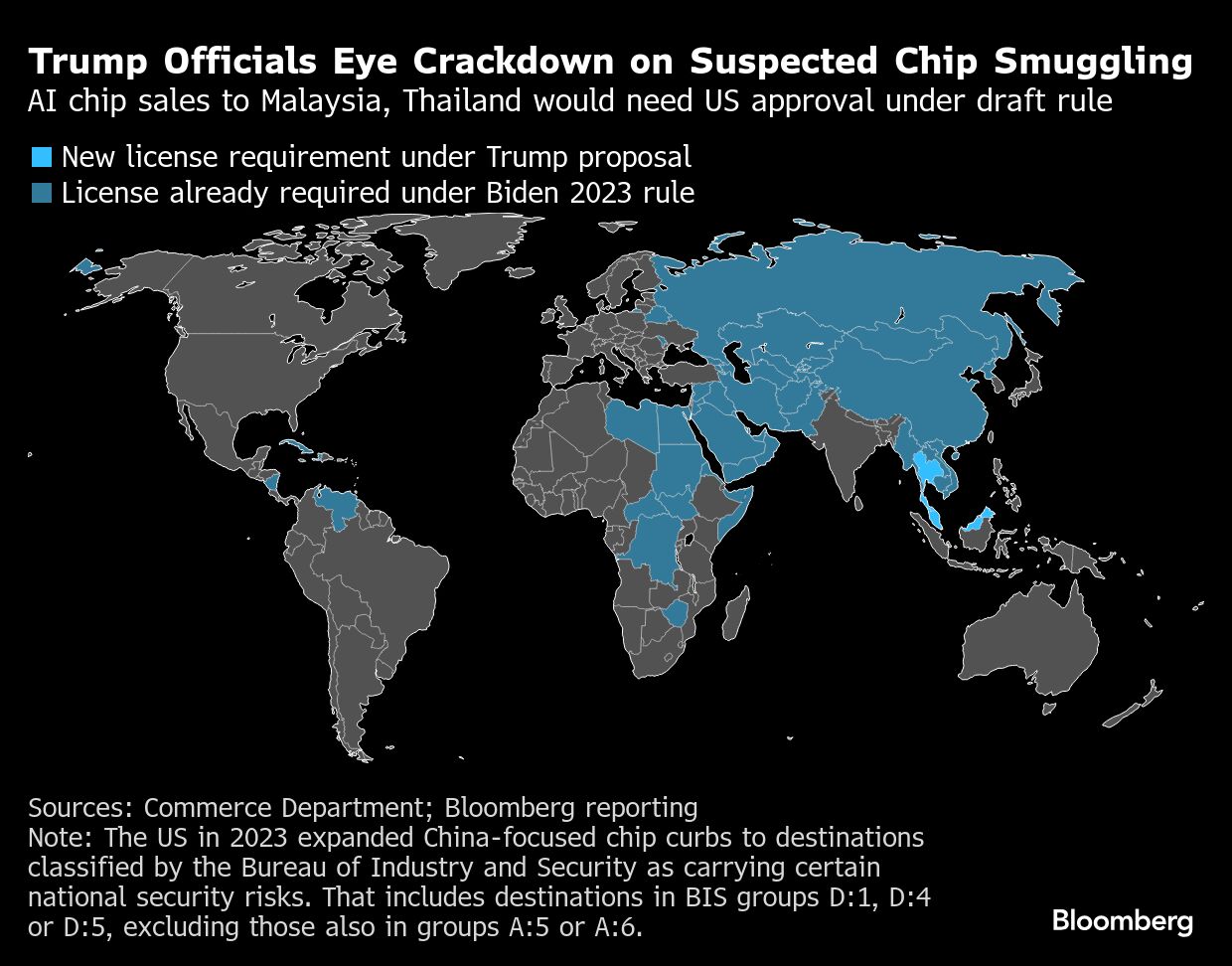
Those conditions, though, have yet to be determined. Nearly two months after the Trump administration said it would overhaul a Biden-era framework, officials remain divided on the national security implications of Nvidia and AMD sales to places like the UAE and Saudi Arabia. The Commerce Department has drafted but not finalized a rule that would formalize its May announcement and extend license requirements on AI chips to Malaysia and Thailand — but which doesn’t constitute a comprehensive replacement to Biden’s approach.
The agency also hasn’t approved chip shipments for billions of dollars in AI deals touted as part of President Donald Trump’s May trip to the Persian Gulf, people familiar with the matter said. AI chip exports to the UAE, Saudi Arabia and other Gulf nations have required US licenses since 2023. Nvidia declined to comment. AMD and the Commerce Department didn’t respond to requests for comment.
For Trump officials who’ve argued in favor of those projects, Huawei’s attempts to export Ascend chips are all the more reason to move quickly — so that the company doesn’t lock in customers now and then ship larger volumes in the future, people familiar with the matter said. But others remain worried that sizable exports of US chips could ultimately benefit Beijing, and argue that Nvidia’s dominance gives Washington leverage to impose stronger security conditions on overseas data centers.
In these officials’ view, people familiar with the matter said, the fact that Huawei is only offering foreign customers a few thousand Ascend chips — and not even its best ones — illustrates exactly why the US can afford to take its time.
In Saudi Arabia, where a state-backed AI fund has said it would divest from China if the US asked, the government has long collaborated with Huawei on AI initiatives. But it remains unclear whether SDAIA would move forward with an Ascend 910B deal — or how the US could respond.
The Commerce Department earlier this year said use of Huawei’s Ascend chips “anywhere in the world” could be a violation of US trade restrictions, which the agency says cover those processors because Huawei uses American technology in its production process.
Amid backlash from Beijing, the Commerce Department removed that global reference, though the guidance still says that unapproved use of the Ascend 910B, 910C or 910D — a future Huawei model — may result in penalties from Washington.
A message from Advisor Perspectives and VettaFi: To learn more about this and other topics, check out some of our webcasts.
Bloomberg News provided this article. For more articles like this please visit
bloomberg.com.