With the price of digital assets testing the boundaries of plausibility, and Congress promising legislation to boost the industry further, now might be a good time for bank regulators to take notice.
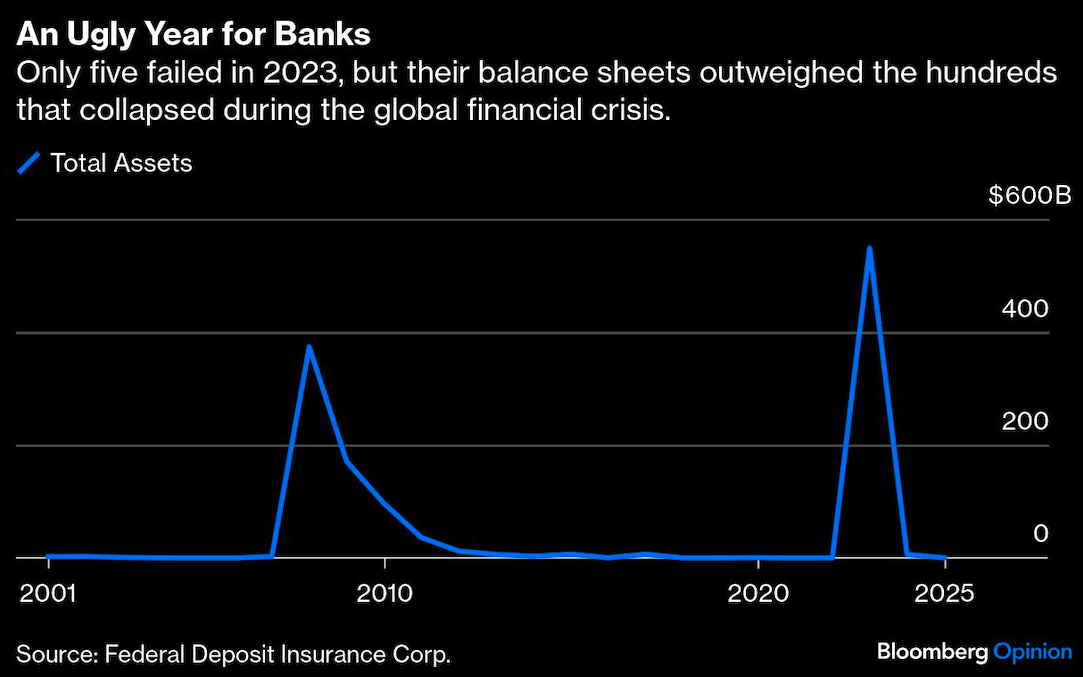
Why worry about banks? It wasn’t so long ago — less than three years — that banks catering to the cryptocurrency industry failed after prices tumbled and a raft of companies went bankrupt. Regulators had to take emergency steps to prevent a wider loss of confidence and promised reforms to make the industry more resilient.

That hasn’t happened. Instead — under pressure from the White House, the industry and lawmakers — regulators have rescinded guidance that sought to limit banks’ involvement in crypto or blockchain companies. A rally in digital tokens and related businesses has restored the financial industry’s fear of missing out. Meanwhile, crypto-connected companies are applying for their own bank charters.
Before the traditional banking system gets further intertwined with the blockchain-based economy, regulators should make some prudent adjustments. That means heeding two lessons of the 2023 meltdown.
The first is that banks are at risk when they have a lot of deposits from a single industry. Silvergate Capital Corp. relied on crypto companies for 98% of its deposits, only to learn how quickly they could evaporate in a downturn. It ended up liquidating its assets. Silicon Valley Bank’s emphasis on tech startups and venture capitalists ended with a run on the bank. Circle Internet Group Inc., which issues the USDC stablecoin, held $3.3 billion of its cash reserve at SVB, making it the largest uninsured depositor bailed out when regulators stepped in.
Such risks are almost certain to reemerge. Stablecoins are expected to grow to $2 trillion in value, up from about $260 billion today. Congress may soon require their issuers to park reserves in safe, liquid assets, which will almost inevitably mean some of their accounts will exceed the $250,000 insured limit. And one reason crypto companies are seeking bank charters is to create venues to bypass the sluggish interbank payments system. Regulators should remember that this was also the rationale behind Silvergate’s in-house electronic-exchange platform, which attracted so much deposit funding from blockchain-connected entities that the bank failed spectacularly when their finances soured.
To address this funding risk, banks should be required to post enough high-quality collateral (that is, not memecoins) at the Federal Reserve’s discount window to cover the withdrawal of all uninsured deposits. That would eliminate the chance of runs caused by a sudden exodus from stablecoins or a downturn in crypto prices — or the collapse of some other hot industry to which they’re exposed.
Another lesson from 2023 is that risk management and anti-money-laundering controls can be overwhelmed — or disregarded — when banks grow quickly. Silvergate’s customers included the high-flying exchange FTX, whose founder was later imprisoned for fraud. The company’s anti-money-laundering systems were also deficient; transactions over its exchange weren’t monitored for at least 15 months in 2021 and 2022. Short sellers punished the bank even before regulators did.
In addition to strictly monitoring such risks, finally, supervisors should try to make the rules easier to comply with. That means, for example, helping the banks test new technology to detect money laundering and reducing the burden of suspicious-activity reports for customers and activities that aren’t high risk. Raising the decades-old threshold at which banks must report transactions to the Treasury Department should reduce busywork without unduly hindering law enforcement.
Clearly, Congress and the White House both want to see crypto companies thrive. Banks, too, are eager to resume doing business with them. But when it comes to the risks posed by this chaotic industry, no one should assume that this time is different.
A message from Advisor Perspectives and VettaFi: To learn more about this and other topics, check out some of our webcasts.
Bloomberg News provided this article. For more articles like this please visit
bloomberg.com.
Read more articles by The Editors