Where are all of David Solomon’s critics now? Those who haven’t left Goldman Sachs Group Inc. for other firms are getting on with their jobs with gusto. The investment bank’s chief executive officer had a torrid time cleaning up his strategic misstep into consumer banking, but two years after ending that project, its core businesses are on fire.
Goldman reported record equity trading revenue in second-quarter earnings on Wednesday and trounced its peers with a rebound in investment banking revenue that was fueled by a 70% jump in deal-making fees versus the same period last year.
The big US banks have surpassed analyst forecasts in many areas in results this week. Bank of America Corp.’s trading desks turned in a thirteenth consecutive quarter of growth on Wednesday, while Morgan Stanley reported very strong stock trading versus last year. But Goldman outstripped the rest by some way in equities, where revenue was up 36% year-on-year. It also extracted the most out of the pickup in fund raisings and deals that came late in the second quarter, lifting its investment banking fees by 27%.
To be sure, these are markets that suit Goldman almost perfectly: Volatility has been high, big hedge funds have a voracious appetite for borrowing, and the bank has strong relationships with fast-growing proprietary electronic trading firms such as Jane Street.
But Goldman hasn’t only been riding a wave, it has also demanded more business from its largest clients and offered more financing to more of them. It is now a top three broker to 125 of the world’s 150 biggest stock-trading clients, Solomon told investors on Wednesday’s earnings call. It held that position at 77 of the top 150 in 2019, he said.
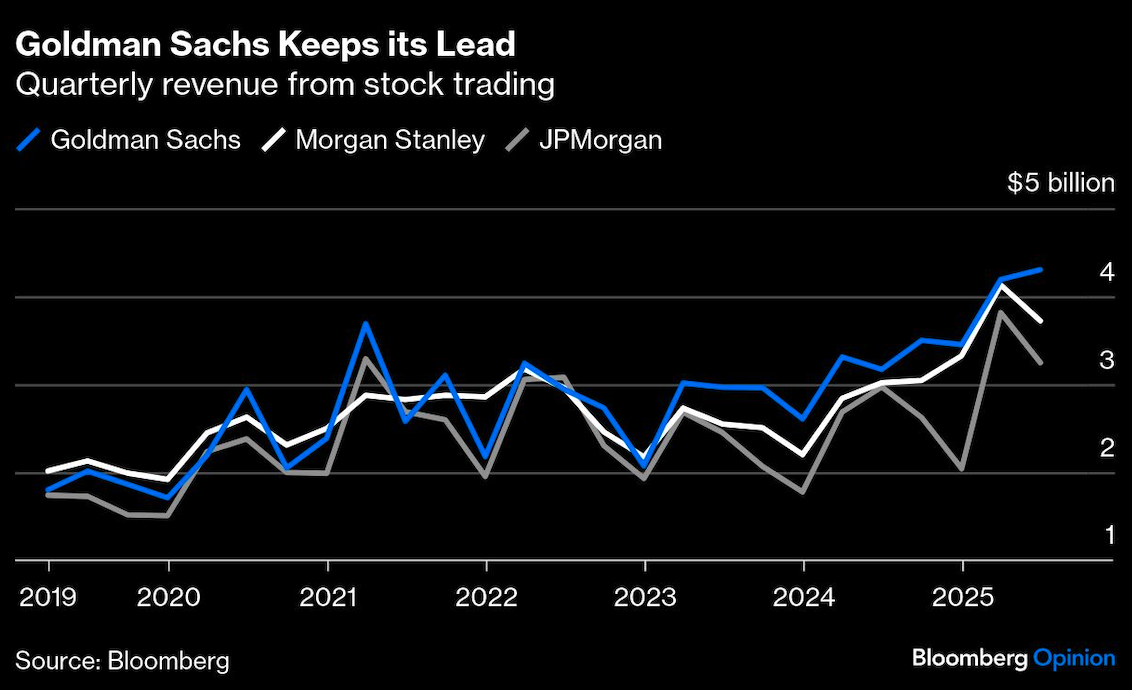
In equities, Goldman reported record revenue of $4.3 billion, which was made up of fees from cash and derivatives trading as clients kept adjusting portfolios to the ups and downs of White House policy, along with record lending to hedge funds, too. The result keeps it ahead of nearest rivals Morgan Stanley and JPMorgan Chase & Co.

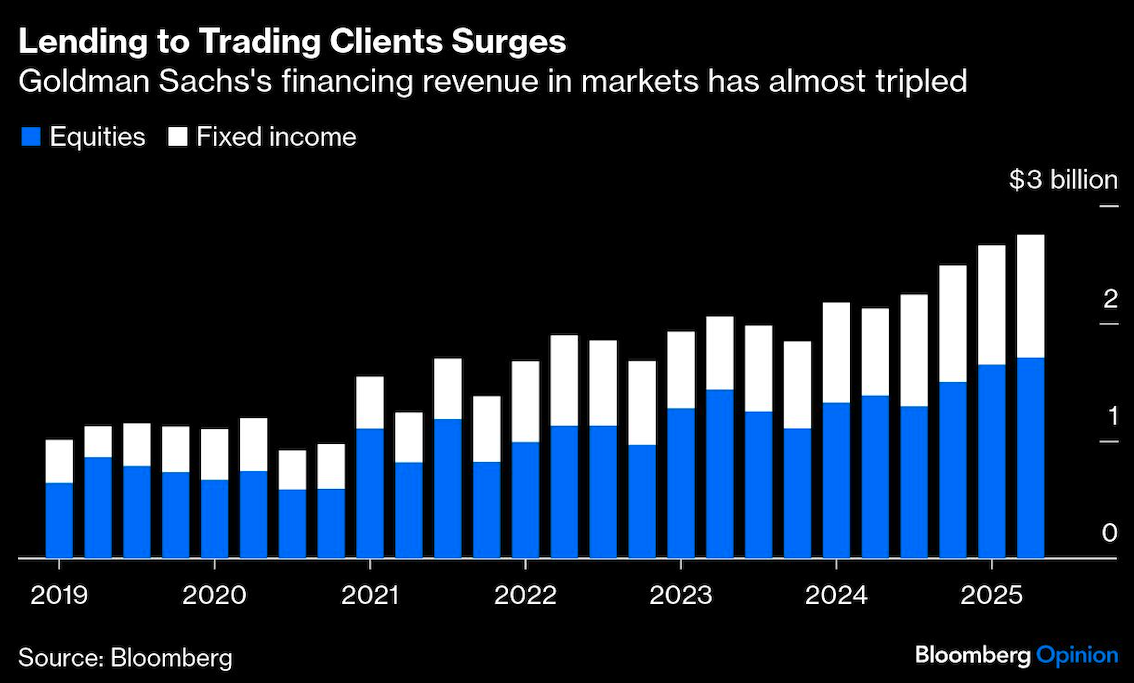
In bond, currencies and commodities trading, Goldman also produced decent growth, although its gains were less than peers in percentage terms versus last year. Fixed-income financing revenue from bond trading desks has been relatively flat at about $1 billion in each of the past four quarters even though the market has kept growing. That suggests Goldman might have hit a ceiling in risk appetite itself or among its clients.
However, the bank might soon have more capital to put into this area, allowing it to take more risk, after its much better stress test result this year and with the pending reforms to US leverage ratio rules.
Solomon has been pushing growth in lending to big investor clients since he took the CEO job because it is meant to be a more durable source of income than intermediating transactions alone. It was the same hunt for steady revenue that encouraged his move into consumer lending, too. But helping hedge funds and other money managers turbo charge their bets with debt is much more in the zone of Goldman’s expertise as the past quarter’s stellar results show.
Total quarterly financing revenue from stock and bond trading clients is now almost triple the levels the bank produced in 2019, Solomon’s first year in charge. That growth mimics the rise in US hedge fund leverage over the same period, which hit record levels of more than $5.5 trillion in the first quarter of this year, according to the Office of Financial Research. The boom in borrowing is making the Federal Reserve and other watchdogs nervous, especially as it is increasingly concentrated among fewer, larger funds. The practice will hit a downturn sometime and the durability of this business for Goldman will look more questionable at least, or potentially be a source of significant risk.
Goldman’s other ambition for steady income streams lies in its asset and wealth management arm, the one area that slightly missed the mark this quarter. Revenue of $3.8 billion was up slightly but came in just below forecasts. Still, cost control helped deliver a decent return on equity of 12.8%.
The bank’s shares dipped after the earnings call, possibly on a view that Goldman won’t keep beating its rivals in the same way over the rest of the year. But shareholders can be happy with Solomon’s work since ditching the consumer bet. Goldman’s stock has outperformed Morgan Stanley’s and JPMorgan’s for more than a year and is closing the gap in valuation terms as well.
Goldman is back to doing well at the things it does best. That will produce volatile earnings again in future, but, right now, Solomon’s doubters are way back in the rear-view mirror.
A message from Advisor Perspectives and VettaFi: To learn more about this and other topics, check out some of our webcasts.
Bloomberg News provided this article. For more articles like this please visit
bloomberg.com.
Read more articles by Paul J. Davies