In news of the future, Google is buying a boatload of fusion energy. The only problem is that its supplier lacks a power plant, has produced no energy to date, and may never do so on commercially viable terms. Even so, wish them well: Few technologies could have a more profound effect on the future of global energy.
Last month, Alphabet Inc.’s Google agreed to buy 200 megawatts of energy from Commonwealth Fusion Systems, a spinoff from a lab at the Massachusetts Institute of Technology that plans to build a fusion plant in Virginia. (Google is also an investor.) The goal is to start supplying power to the grid, and thus to Google’s data centers, by the early 2030s.
“If it works,” says Google, “it could change the world.”
Some skepticism is forgivable. Although Commonwealth plans to produce the plasma needed for fusion reactions by next year and to demonstrate “net gain” — that is, a process that yields more energy than it consumes — by 2027, many technical and financial hurdles remain. Moreover, few technologies have been quite so hyped for so long: Fusion, the old joke goes, is 30 years in the future and always will be.

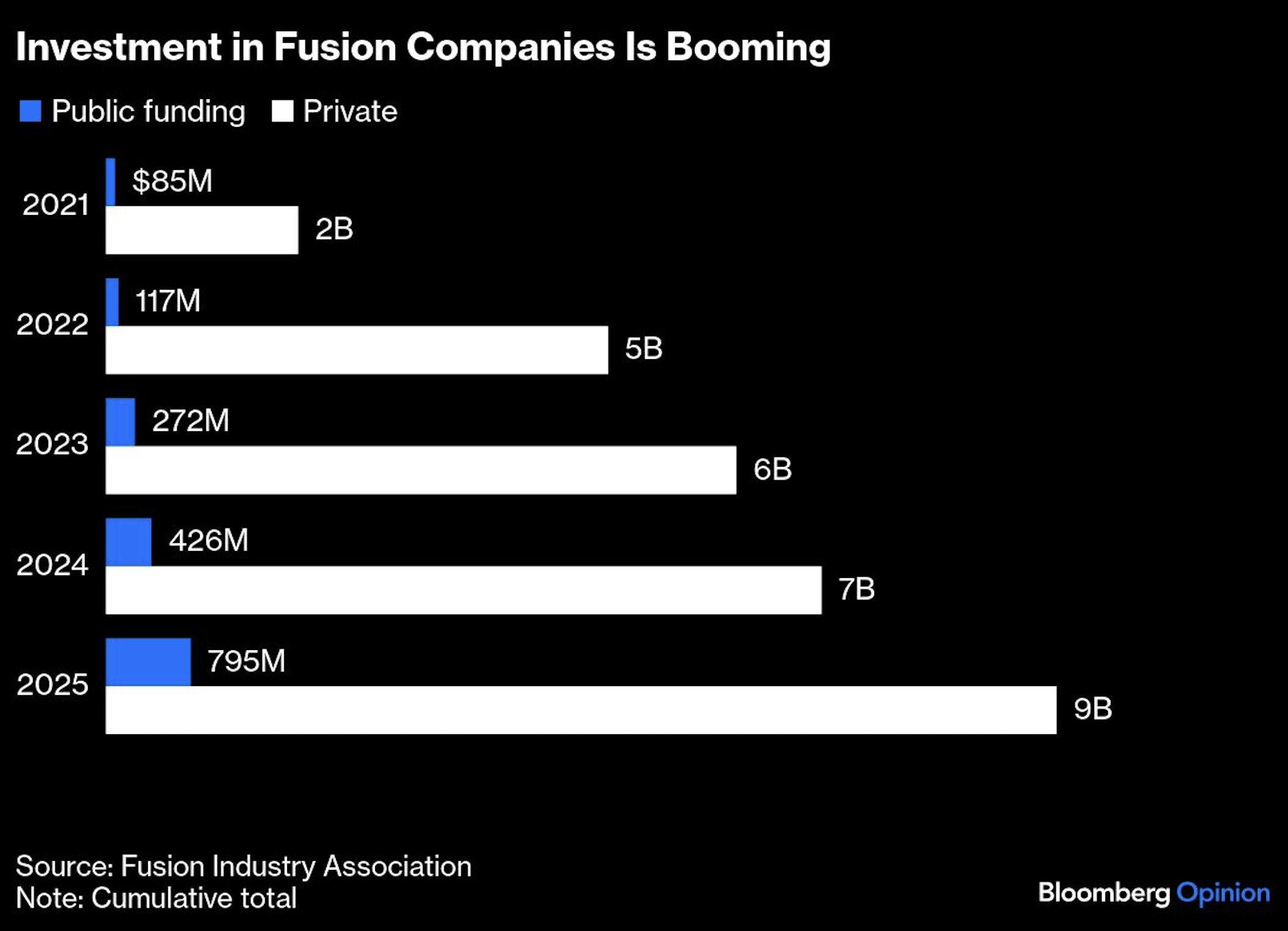
Yet Google’s agreement, like a similar deal that Microsoft Corp. signed with Helion Energy in 2023, is a hopeful sign. As an industry report released Tuesday found, dozens of companies are now at work in the field. They’ve attracted some $9.8 billion in investment, a fivefold increase since 2021. About two-thirds of those surveyed expect to have a commercially viable plant online within a decade. Research efforts, public and private, are advancing at an encouraging rate.
Crucially, Silicon Valley now has an incentive to help. With data-center electricity demand expected to double by 2030, and most big tech companies looking to honor net-zero commitments, fusion makes for a sensible goal. A litany of big-name tech investors are backing the technology, including Jeff Bezos, Bill Gates and Peter Thiel. As Sam Altman, of Helion and OpenAI, told Bloomberg News last year: “We need fusion.”
In that sense, the profit motive could well be aligning with the public good. Commercially viable fusion would have outsized benefits. It could provide an effectively limitless baseload power supply, for one. It would pose no risk of meltdowns or weaponization. It would also emit no greenhouse gases and could thus become an essential component of the clean-energy mix in the decades ahead.
Accelerating that progress should be a priority. Congress needs to build on recent efforts to streamline fusion regulation, expedite permitting, and invest in modernizing the grid and boosting transmission capacity. It should also offer more incentives for technical achievements, on the model of the Milestone-Based Fusion Development program, while the White House should work with global partners to coordinate supply chains and waste handling. More public funding for education and basic research in the field will be crucial.
Not so long ago, fusion energy was confined to fiction. Increasingly, it looks like a prosaic engineering problem: hard, expensive, time-consuming — but ultimately solvable. That’s a challenge Americans should embrace.
A message from Advisor Perspectives and VettaFi: To learn more about this and other topics, check out some of our webcasts.
Bloomberg News provided this article. For more articles like this please visit
bloomberg.com.
Read more articles by The Editors