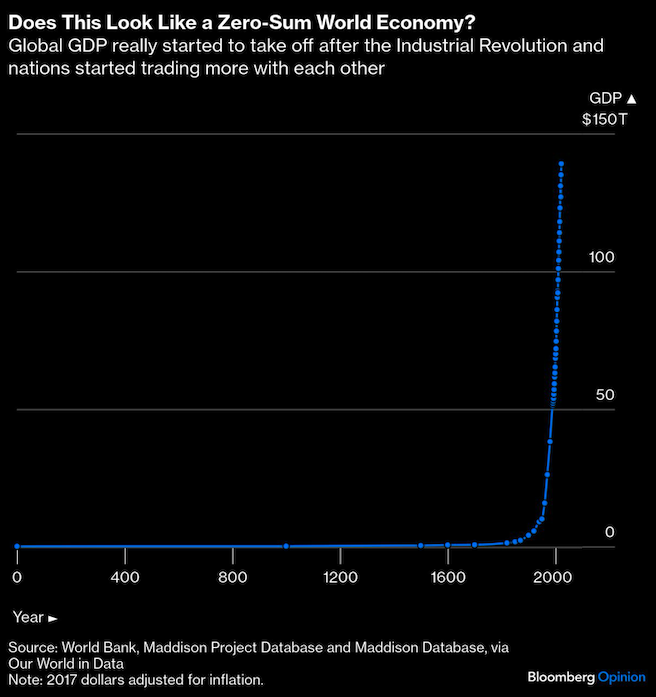
One idea unites the left and right lately: a zero-sum view of the world. Unfortunately, nice as it would be to hail a rare instance of ideological harmony, both sides are very much mistaken.
The zero-sum view manifests itself in both rhetoric and policy, with the left aiming to redistribute from the rich to the poor, and the right from foreigners to natives. This is a strange preoccupation, since today’s world economy is not zero sum. It is not without its problems — there are pockets of scarcity and widespread uncertainty — but real wages and wealth are increasing, as is our standard of living.
Perhaps the greatest achievement of modern civilization is that it allowed people to overcome the natural human bias that expects scarcity and competition. Now that instinct seems to be reasserting itself. But there is an irony here: Policies that aim to address the problems of a zero-sum world can actually make it more zero-sum.
There is a tendency to assume that if someone is getting more, someone else must be getting less. That’s because for most of human history, this assumption was basically true. When economic growth is near zero, resources are finite. Yes, there were always benefits to trade and specialization, but for hundreds of years the world had a zero-sum economy.
That changed once growth took off. One of the more counterintuitive aspects of the economic thinking that emerged during the Enlightenment is that the economy is not zero-sum. If we cooperate, create and innovate, we become more productive and can do more with existing resources.
It is not a coincidence that this new way of seeing the world emerged during the Industrial Revolution, when GDP started to grow faster than ever before. Innovations were feeding economic growth and sustaining a rising standard of living.
Since the industrial era, for the most part the developed world has known only growth. This created a positive-sum view of the world, which was reflected in many economic policies. What has changed in recent decades is attitude: Around the world, people doubt their children will do better than they did and think the economic system needs to change. This is driving populism on the left and right, and the rejection of neoliberalism more broadly. The president’s economic plan is a lot of things, but its main feature may well be nostalgia.
It's not hard to understand why. The postwar 20th-century US economy was positive sum, and it felt that way. Almost every American earned more than their parents did. More people were going to college, especially in the last few decades of the century, and they were handsomely rewarded. And even those who didn’t could afford to raise a family on a single salary. There was also more fluidity then — it was easier to move, buy a home and change jobs.
It's important not to idealize this era. There was also social strife, and discrimination by gender and race that meant that many Americans did not experience a positive-sum economy. One economic study has found that historically marginalized populations, such Black American descendants of slaves, tend to have a more zero-sum view of the world.
The 21st-century economy is also positive-sum. Americans are now more wealthy than they’ve ever been. And while you are no longer guaranteed to earn more than your parents did, most people still do. Younger generations are less likely to own a home, but they also earn more and have more wealth.
And yet. There is a widespread sense that no one is fully thriving, and younger people are definitely taking fewer risks. For ambitious college graduates, the economy feels more cut-throat. Making lots of money requires getting a job at a handful of high productivity firms. Success in some fields requires living in a high-cost city where housing is scarce. There is a widening divide in wealth and income between the economic and cultural elite.
For this segment of the economy, the economy is zero-sum — for you to gain money, status or a nice home, someone else misses out. This population also has outsized cultural and political influence.
Even if our lives are improving by many economic metrics, the pace of technological change is adding a level of uncertainty to everyone’s work and life. In the past uncertainty has increased zero-sum thinking: In Europe during the Renaissance, for example, changing weather patterns made crops yields less predictable, which resulted in more scapegoating and witch trials.
Of course there are many economic challenges facing the world — concrete ones such as the rising cost of housing, and more high-level ones such as the fact that growth is not fast enough to make everyone feel as if they are part of progress. It is natural to fall into an it’s-all-getting-worse doom loop. Populists the world over, whether from the right or left, prey on this anxiety with policies that will make us poorer: less immigration, or higher tariffs, or a renewed interest in socialism.
The danger of this kind of thinking, and of a zero-sum view of the world, is that it can become self-fulfilling. Better to think positive — not only because it’s healthier, but also because, for the last several centuries, it has been true.
A message from Advisor Perspectives and VettaFi: To learn more about this and other topics, check out some of our webcasts.
Bloomberg News provided this article. For more articles like this please visit
bloomberg.com.