With 2 billion monthly users in 200 countries, Google’s AI Overviews can claim to be the most popular generative artificial-intelligence product yet released to the public. The short summaries generated by the company’s Gemini AI model have turned Google from search engine to answer engine, settling the nerves of investors who were worried that ChatGPT was going to smash Google’s business model to pieces.
Then again, to describe those billions as “users,” as parent company Alphabet Inc. did when announcing its quarterly earnings last week, is perhaps disingenuous. No one consciously uses AI Overviews — it’s just there when users perform a regular search on Google, something billions of them have done several times a day for two decades. That’s one key advantage Google has over its competitors: People already associate the service with finding things out. The company has every right to capitalize on that reputation, one it built off the back of genuine innovation and quality (though, admittedly, it was later solidified with illegal multibillion-dollar deals to prevent competition).
Google’s second advantage with AI Overviews, however, warrants further scrutiny. Like other generative AI tools, the feature draws heavily from content that Google does not own but is available on the open web. Summarized answers are synthesized from one or more sources into a rewritten piece of information.
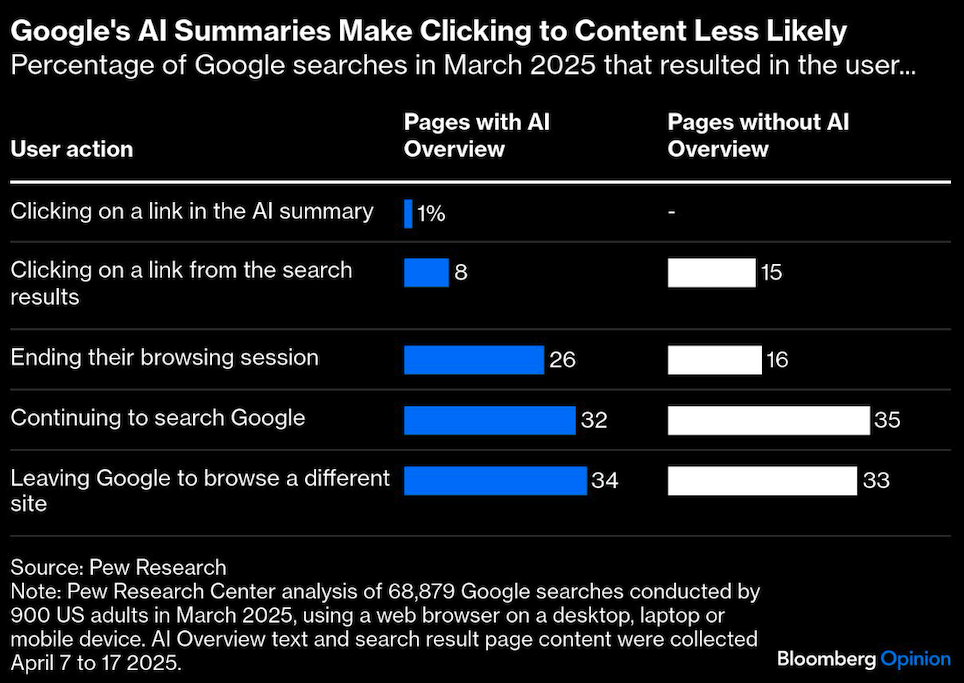
That’s useful for users; it saves them a click. But it’s devastating for content creators, who lose a would-be visitor and the revenues that follow. Startling Pew Research data released last week suggested users were considerably less likely to click through to websites if presented with an AI Overview, as is increasingly the case. One in five searches in a March 2025 sampling contained an AI Overview, a frequency that rises to as high as 60% if the queries are longer or contain the bread-and-butter words of journalism: who, what, where, when or why. (Google has pushed back against the methodology of the Pew study, saying its dataset — 68,879 searches by 900 US adults — was too small to be representative.)
Other AI chatbots offer the same kind of functionality, of course. But in those cases, content publishers can block these companies’ “crawlers” if they wish to do so by adding a line of code that acts as a digital bouncer at the door. That approach doesn’t work with Google, however, because blocking its AI crawler means also blocking a site from Google’s search results as well — a death sentence for any website.
Google is leveraging its dominant position in one industry to force success in another. It’s monopolistic behavior and something that should be addressed immediately as part of the remedies being devised as part of the antitrust trial it lost last year.
This is about taking away Google’s cheat code. “Google still thinks they’re special and that they don’t have to play by the same rules that the rest of the industry does,” Matthew Prince, chief executive officer of Cloudflare, told Bloomberg News in an interview last week. His company recently launched a tool that would allow publishers to set up a “pay-per-crawl” model for AI use. It works on crawlers from OpenAI, Anthropic, Perplexity and most others — but blocking Google AI would, again, mean blocking a site from Google’s search engine.
In Google’s defense, the launch of AI Overviews was a move spurred not by a desire to crush the economics of web — which has driven its entire business — but to stop its users from deserting the company in favor of AI chatbots. “The consumer is forcing them,” Wells Fargo analyst Ken Gawrelski said. Google was more than satisfied with the status quo, Gawrelski told me, which is partly why the company was beaten to market by smaller AI firms that didn’t need to worry about protecting an existing revenue stream.
Now the fight is on, Google is playing catch-up and doing rather well at it. It has protected its advertising revenue, which in the last quarter was up 12% to a record-high $54.2 billion compared with the period a year earlier. Its AI and cloud business faces supply constraints, warranting an additional $10 billion in capital expenditure, bringing it to $85 billion for the year. It recently added “AI Mode” to its search engine, which is like AI Overviews on steroids. The company has barely started to integrate AI across its varied products like Gmail and Maps — the Financial Times noted that 15 distinct Google products have more than 500 million users.
Executives say they will be able to monetize all of these innovations quickly. The company has less to say about what happens to the businesses that rely on Google traffic to stay alive, in turn providing the content that makes smart AI possible. The shift is profound: Google’s creation democratized the web, making it possible for an ecosystem of new sites and services to be found and supported. Now, the company’s strategy is to make it so users need to visit only Google. “We have to solve the business models for the varying players involved,” Sundar Pichai, Alphabet’s CEO, said in a call with analysts without elaborating.
Salvaging content creators from the coming AI wreckage begins by forcing Google to relinquish its unfair advantage. Only then will the company be compelled to enter into reasonable arrangements with content creators to utilize their content, as it has already done with the likes of Reddit. We can be mildly encouraged by the fact that Google is reportedly seeking out content deals for use within its other AI products. Perhaps this is in anticipation that the unfair advantage won’t last.
A message from Advisor Perspectives and VettaFi: To learn more about this and other topics, check out some of our webcasts.
Bloomberg News provided this article. For more articles like this please visit
bloomberg.com.