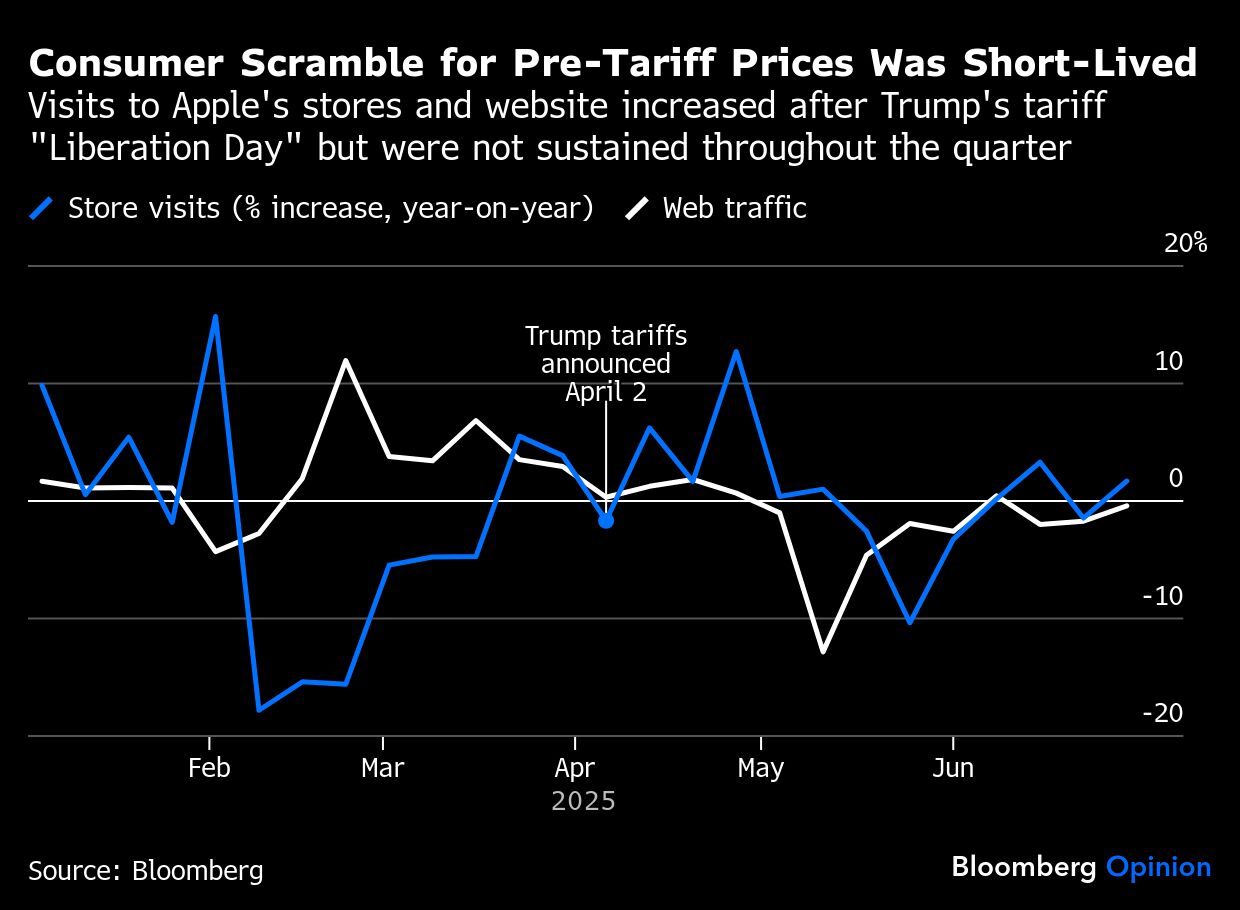
Did tariffs help Apple Inc. to a blowout quarter? That was one theory that emerged as the company disclosed a surprising surge in iPhone sales in the April-June quarter, up 14% compared with the period a year earlier, handily beating estimates. Consumers, it was said, were rushing out to stores in fear that Donald Trump’s “Liberation Day” trade levies would drastically increase the cost of an upgrade.
It certainly makes some logical sense; though the data shows consumers’ fears soon subsided. According to Placer.ai, which uses mobile location data to monitor foot traffic, elevated sales in the immediate days after Trump’s address rapidly petered out — visitors to US Apple stores were up just 0.93% for the entire fiscal quarter compared to a year earlier. Meanwhile, visits to Apple’s website from US consumers were down 3%, according to data from Similarweb.

On a call with investors to discuss the results, Chief Executive Officer Tim Cook acknowledged that tariff chatter did create unusual buying patterns in April, mostly around sales in the US of the iPhone and Mac computers. But overall, the boost was limited — Apple said just 1 percentage point of its 10% overall revenue growth came from these “pull forward” sales. If Apple’s analysis proves correct — and some analysts seemed skeptical, repeatedly asking for more detail — then that would be good news. It means investors would have to worry less that the better-than-expected sales won’t mean a significant dip for the rest of this year. That’s not to say tariffs won’t be a drag — Cook said the company would take a $1.1 billion tariff-related hit in the current quarter, up from $900 million in the last.
To emphasize the gusto of his most important product, Cook noted that somebody out there has the 3 billionth iPhone. That’s a staying power that will count for a lot as the company moves to this next era of uncertainty. The quarterly iPhone sales indicate that consumers don’t yet care that the bulk of the device’s artificial-intelligence features have yet to materialize — they’ll stick with Apple anyway. I found myself agreeing with Cook when he said he felt AI-specific devices — such as glasses from Meta Platforms Inc. or whatever it is OpenAI and Jony Ive create — are “likely to be complementary devices, not substitution” for the smartphone.
Still, AI is on the mind of investors, and the blockbuster quarter was not enough to distract from that. The company reiterated its intent to increase spending to fund its AI efforts and to reallocate talent to speed things up. Cook didn’t, however, address the fact that some of his top AI talent has reallocated itself to Meta. The Apple boss’ apparent disinterest in partaking in the unprecedented talent war — one that would have made his predecessor, Steve Jobs, sick to his stomach — is one facet in Apple’s obvious unwillingness to follow its peers and bet the entire house on AI. Its capital expenditures, while growing, are expected to be tens of billions of dollars lower than the other tech giants. The years to come will tell whether Apple was wise to separate itself from the pack.
Tellingly, when asked Thursday whether he felt AI innovations like large language models might become commoditized, he declined to answer. “That gives away some things on our strategy,” he said. That could be read as a sign Apple doesn’t feel it needs to directly compete in building AI. I think this speaks to a confidence that the iPhone will still be the de facto device of choice for AI whether or not Apple is successful in making a competent ChatGPT of its own. Another interpretation is that Cook doesn’t want to show his hand in any M&A negotiations, but I guess we’ll see. Cook said on the call that he was “very open” to dealmaking — we’ll see what exactly he feels he needs to buy rather than build.
Frankly, you didn’t need to see Apple’s numbers to know it had been a great quarter — you could just listen to the tone of Cook’s voice. Noticeably upbeat as he ran through his remarks, the tenor of the call was in stark contrast from last quarter when some (myself included) wondered whether the weight of Apple’s numerous challenges were starting to deplete the 64-year-old’s energy reserves. Talk of succession will surely now quiet down for the foreseeable future: It’s time to let Tim cook.
A message from Advisor Perspectives and VettaFi: To learn more about this and other topics, check out some of our webcasts.
Bloomberg News provided this article. For more articles like this please visit
bloomberg.com.
Read more articles by Dave Lee