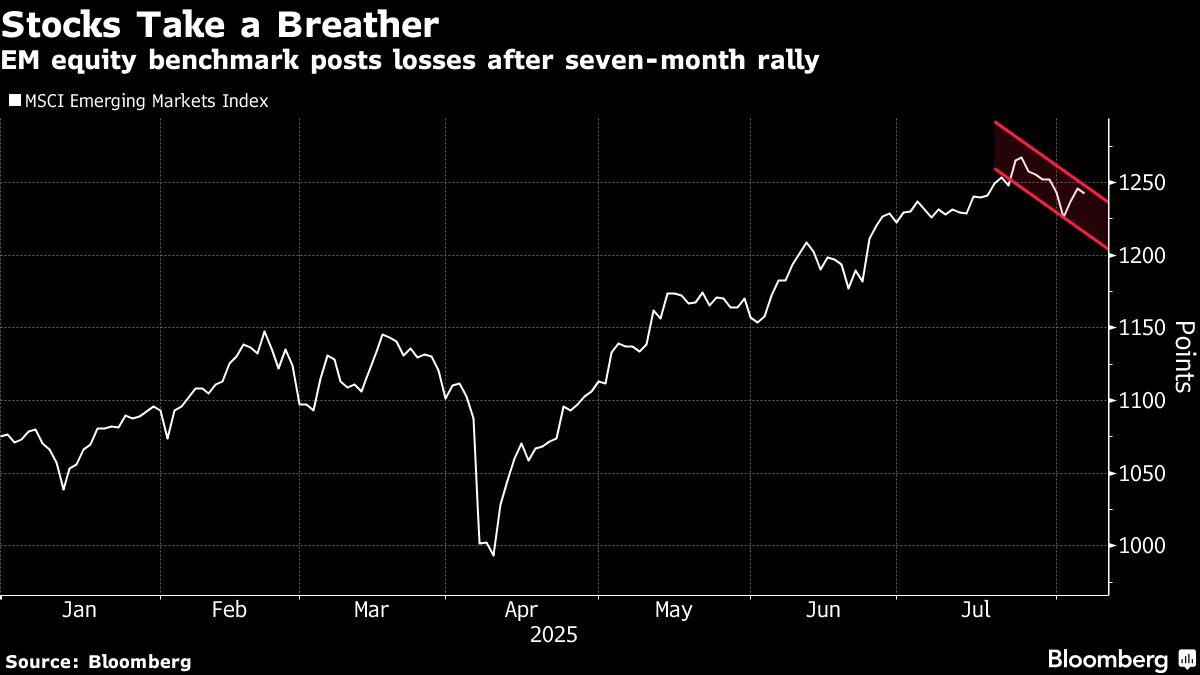
Semiconductor stocks sent the emerging-market equity benchmark lower as US President Donald Trump’s threat to raise tariffs on the sector and an investigation into a theft of trade secrets at Taiwan Semiconductor Manufacturing Co. spooked investors. Developing currencies fluctuated.
The MSCI Emerging Markets Index of stocks fell 0.2%, with TSMC’s move signaling a 100% contribution to the gauge’s losses based on its weight. In the currency market, the biggest underperformers were from Asia, while the South African rand and Mexican peso advanced.
Besides TSMC, the stocks index was balanced between gainers and losers. Chinese online-commerce stocks traded higher, led by Tencent Holding Ltd., while Korean chipmakers posted losses.
Investors are reassessing the outlook for EM equities after a seven-month rally, the longest winning streak since 2017. Trump’s tariff measures undermine economic growth in the developing world, with a vast number of countries left without a deal and some like India threatened with punitive levels of duties.
While China’s consumption economy remains weak and geopolitical tensions are dragging on, improved bets for Federal Reserve easing offer a slightly more positive backdrop.
Trading was thin due to the summer holidays across the northern hemisphere. As of 9:13 a.m. London time, trading in the MSCI index was 24% below its 30-day average.

TSMC’s shares fell 2.2% in Taipei, their biggest loss since June 23, after prosecutors arrested six people suspected of stealing trade secrets from the company. That opened an investigation into a potential breach of national security involving a global tech industry linchpin as well as the biggest contributor to EM equity gains this year. Samsung Electronics Co. and SK Hynix Inc. posted declines of at least 1.6% each in Seoul.
A stream of negative news is weighing down on the chip sector. Besides the Taiwan probe, investors also awaited Trump’s further measures after the president said US tariffs on semiconductor imports would be announced “within the next week or so.”
Global earnings news also weighed down sentiment. In the US, Super Micro Computer plunged after cutting its sales forecast, GlobalFoundries tumbled on a guidance miss and Advanced Micro Devices Inc. warned that its return to China is difficult to predict.
Oversold Territory
For those watching technical indicators, the declines in EM equities come after the MSCI Index touched a level of 68 on the monthly relative price index chart, near the so-called oversold level of 70 that has preceded past selloffs. The gauge has fallen about 2% from a July 24 peak.
Ukraine sovereign dollar bonds posted the biggest gains among peers on the Bloomberg EM Sovereign Total Return Index. Investors watched Russia’s next steps in its war against the country as Moscow considered concessions including a pause in air strikes. Meanwhile, the nation appointed a chief of the Economic Security Bureau of Ukraine, fulfilling a step required by the International Monetary Fund.
Indian local-currency bonds fell as the country has gone from being close to a trade deal with the US to becoming a target for some of Trump’s harshest measures, including an additional tariff for buying oil from Russia. The 10-year yield added 7 basis points to 6.40%. The rupee rose after the Reserve Bank of India left interest rates unchanged despite a benign inflation outlook.
South African rand was among outperformers in the currency market, along with the Mexican peso. The rand is being driven by increased bets for Fed rate cuts, according to Piotr Matys, a senior currency analyst at In Touch Capital Markets.
“The rand has been the main beneficiary of the markets fully pricing in a 25 basis-point rate cut by the Fed at its next meeting in September,” he said. The move follows “disappointing US nonfarm payrolls and rapidly escalating political pressure from President Trump on Chair Powell to slash interest rates.”
A message from Advisor Perspectives and VettaFi: To learn more about this and other topics, check out some of our webcasts.
Bloomberg News provided this article. For more articles like this please visit
bloomberg.com.
Read more articles by Srinivasan Sivabalan, Mpho Hlakudi