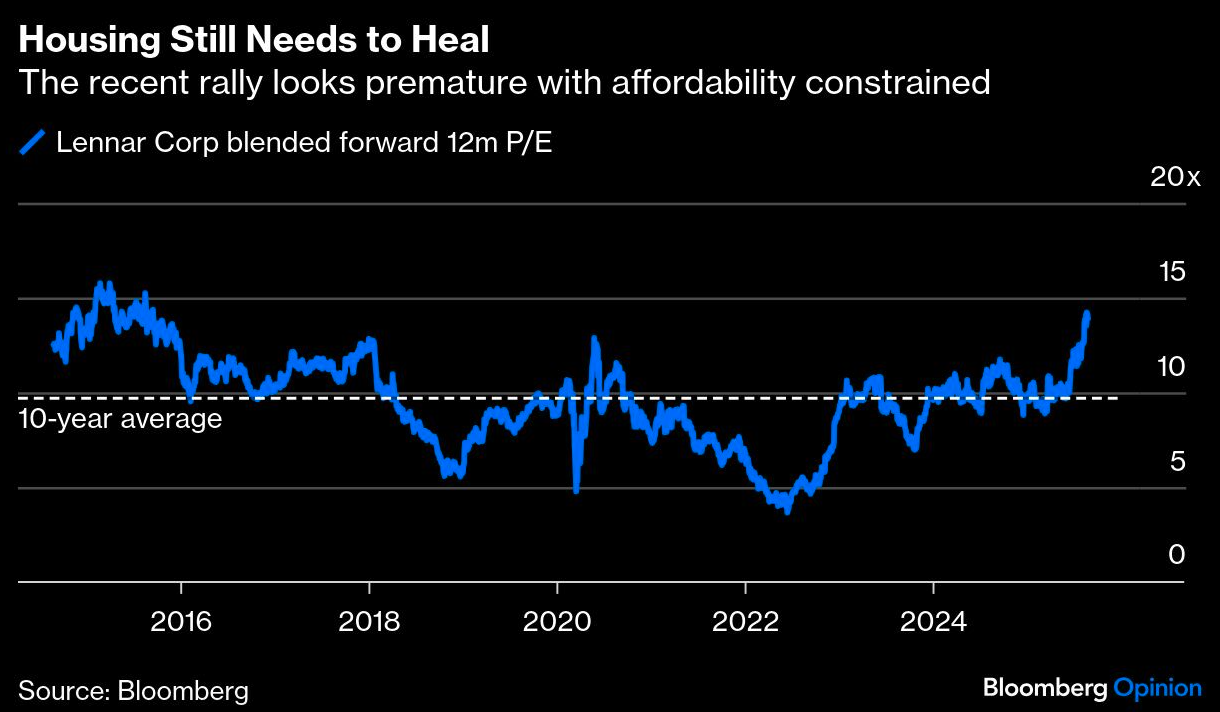
There’s been renewed optimism about housing in the stock market recently. Mortgage rates have fallen and home improvement giants Home Depot Inc. and Lowe’s Cos Inc. reported an uptick in activity in July. More significantly, Warren Buffett gave his blessing to the industry with Berkshire Hathaway Inc. revealing its holdings in homebuilders Lennar Corp. and DR Horton Inc.
Yet the market rally is premature. The two dynamics that have contributed to housing’s slump — poor affordability and rising levels of inventory — haven’t changed in a meaningful way. A more material improvement in the outlook for housing would require a much bigger move in mortgage rates or a slide in prices that’s unlikely to happen any time soon.
The half-a-percentage-point decline in mortgage rates since June — equivalent to a 4% increase in buying power for homebuyers — is modest when compared with how much affordability deteriorated during the pandemic-fueled housing boom that began in 2020. US home prices have increased by 51.6% since January of that year, according to the S&P CoreLogic Case-Shiller US National Home Price Index, and 30-year mortgage rates have climbed from around 3.5% to 6.5%. That means that the monthly outlay on a typical home with a 20% down payment has nearly doubled. Average hourly earnings for all private sector workers have only increased 28% over that same period. To put that 4% improvement in affordability into context, wages would have to increase by over 50% from here to match the early 2020 level of affordability — it’s a step in the right direction, but there’s still a long way to go.
And as we saw last fall, the Fed beginning to cut rates doesn’t guarantee mortgage rates will continue to decline. The low point for mortgage rates over the past year was September 11, 2024, the week before the Fed cut rates for the first time in this cycle. The current 6.5% mortgage rate takes into account market expectations for at least five 0.25% cuts by the end of 2026. Getting mortgage rates below 6% would take steeper cuts, which would probably mean a gloomy labor market and economic environment that might not be supportive of homebuying.
There’s also no indication that we’re beginning to see a stabilization in the balance between supply and demand when it comes to housing inventory. Real-time data suggest that the stock of existing homes for sale might be peaking for the season earlier than over the past couple of years, a signal that would be encouraging taken in isolation. However, data from online real estate platform Compass Inc. shows that withdrawn listings as a percentage of new listings have surged this summer, suggesting that discouraged sellers are behind the apparent stabilization, a potentially ominous signal for 2026 if those sellers return to the market next spring.
Buffett’s acquisition of homebuilder stocks should be seen more as a modest investment at a reasonable value than an all-clear sign for the industry. The second-quarter purchase of 5.3 million shares of Lennar was for $575 million, or an average price of $108.50 per share. Those shares could have been scooped up in April, when stocks were selling off due to tariff-related fears. Lennar stock is up 23% from that level while its earnings estimate for the next year has actually declined by 10% since the first quarter. Lennar is now trading at its highest valuation in a decade on a blended forward price-earnings-ratio basis. With affordability challenged, inventory levels continuing to rise and home prices falling, it’s unclear what would justify that kind of optimism.

As for Home Depot and Lowe’s, the worst does appear to be behind them after three challenging years. But a strong July was helped by better-than-expected weather and lapping the impact of Hurricane Beryl a year earlier. Home Depot is looking for a modest improvement in the second half of the year relative to the first half, and Lowe’s executives said that their expectations are for a “roughly flat home improvement market.”
Directionally, the housing market continues to heal. The increase in the inventory of homes for sale poses challenges for homebuilders and homeowners looking to sell, but we’re returning to healthier, more normal levels of inventory. Modestly falling home values and mortgage rates paired with rising incomes are leading to a slow and steady improvement in buyer affordability. But this recovery is likely to be gradual, and investors hoping for a huge inflection point like we saw in 2020 are probably going to end up disappointed.
A message from Advisor Perspectives and VettaFi: To learn more about this and other topics, check out some of our webcasts.
Bloomberg News provided this article. For more articles like this please visit
bloomberg.com.
Read more articles by Conor Sen