President Donald Trump’s efforts to stack the Federal Reserve with economists willing to cut interest rates is providing all the drama this week. But the longer-term future for monetary policy, the bond market and the US economy is even more ominous.
That’s because the US has an aging population, like many countries in Europe and Asia, and faces both growing debt and lower growth. And the ways out of this predicament come at a price American investors and retirees may not be willing to pay.
A new paper presented at last week’s Jackson Hole economic symposium lays out a more hopeful scenario: Aging countries can issue more debt, it says, because all those older people will buy up all those new bonds. Demand may even outstrip supply. If interest rates don’t go up, the paper estimates, the US can manage a 250% debt-to-GDP ratio. That’s close to Japan’s — and Japan is fine, kind of.
If the paper is correct, it’s not because old people are natural buyers of bonds. Demand for bonds, even in the retail market, is largely a function of government policy and regulation. And the US economy, like Japan’s, may have to rely on a regime of financial repression to keep interest rates low — to the detriment of returns and growth.
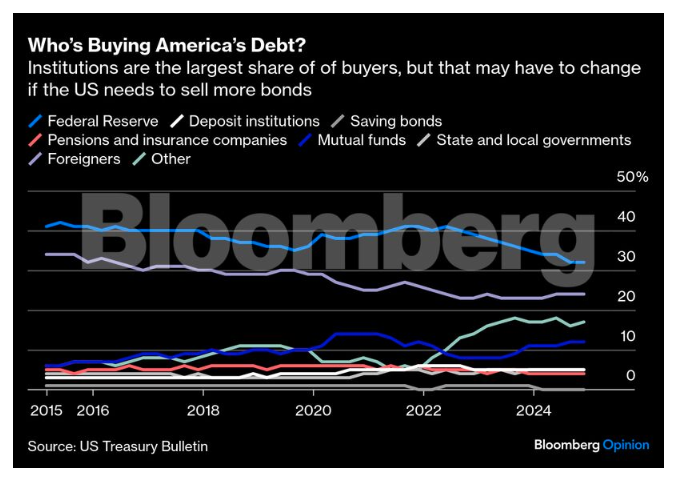
The paper speculates that rates became low despite higher debt in the last few decades because demand for bonds grew faster than supply — largely because there were so many foreign buyers. Their demand has softened lately, and with less international trade, will probably fall further.
The other big buyer of debt is the Fed. As the bank’s quantitative easing is phased out, the other big growing buyers are mutual funds, which is mainly retail investors; broker-dealers; and corporations, which fall under the “other” category.
As the paper predicts, domestic retail investors will almost certainly have to become a bigger market for bonds. Economists have long cited an aging population as an explanation for falling interest rates: Older people, the theory goes, have more wealth and prefer safer assets as they age.
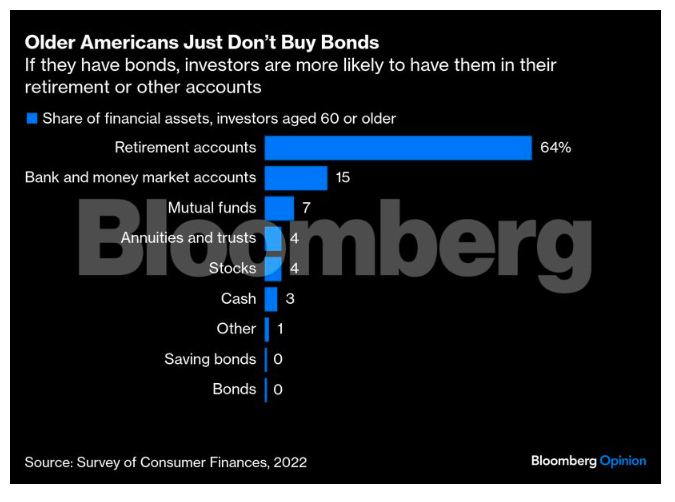
In fact, the correlation between an aging population and lower interest rates is not so clear; it may even be negative. Older people don’t necessarily increase their exposure bonds as they age. Outside of a retirement plan, most people don’t buy bonds. And retirement plans are where most Americans have their money.
When retirement accounts were first introduced, participants had to choose their investments, and people did not invest in more debt as they got older. This changed in 2006, when legislation required plans to automatically sign up participants for pension accounts and pick their investments for them. That led to the rise of target-date funds, which gradually move people into bonds to satisfy the regulation that default investments “de-risk” over time. Most people stick with this default investment, so older people do now in fact invest more in bonds.
Perhaps the glide path of a typical target-date fund will be sufficiently steep that there will be enough demand to buy up all of America’s debt. If so, it’s important to note: These purchases will not be made because older people prefer bonds. They will be made as the result of government regulation.
None of this is to say that such regulations wouldn’t be justified. Older people face a lot of income risk in retirement. They’d have more stable incomes if they bought annuities (and insurance companies would buy more bonds), or if they invested in longer-duration bonds themselves. But changing American’s investing patterns would require regulatory changes. And it is hard to separate financial repression that artificially boosts bond demand from rules designed to protect investors.
The economists who wrote the Jackson Hole paper offer Japan as a positive example. It shows that a country can run up big debts if there is enough demand for bonds from an aging population. But Japan also illustrates how addictive financial repression can be. For years, Japan maintained low rates because pension funds bought so many bonds, and more recently as the result of QE. This seemed to work when rates were falling (and bond prices increasing). But it can easily unravel when inflation increases, the government can’t keep buying up bonds, and bond prices start to fall. Japan’s years of getting away with carrying so much debt may be over, too. And even if they aren’t, its economic experience is nothing to emulate.
The lesson is that, yes, it’s possible for a country to have regulations that encourage more bond buying to keep rates low. But it’s a risky financial strategy, and if the US pursues it, it could lead to lower returns. That would leave the American economy smaller than it might have been, and American investors less well off.
A message from Advisor Perspectives and VettaFi: To learn more about this and other topics, check out some of our webcasts.
Bloomberg News provided this article. For more articles like this please visit
bloomberg.com.