For as long as I can remember, institutional investors have been hailed the “smart money” and retail investors derided as rubes. I’ve always been skeptical of those labels. I’m not saying ordinary investors don’t do foolish things with their money occasionally; I just doubt the average pension or endowment or hedge fund is any more disciplined.
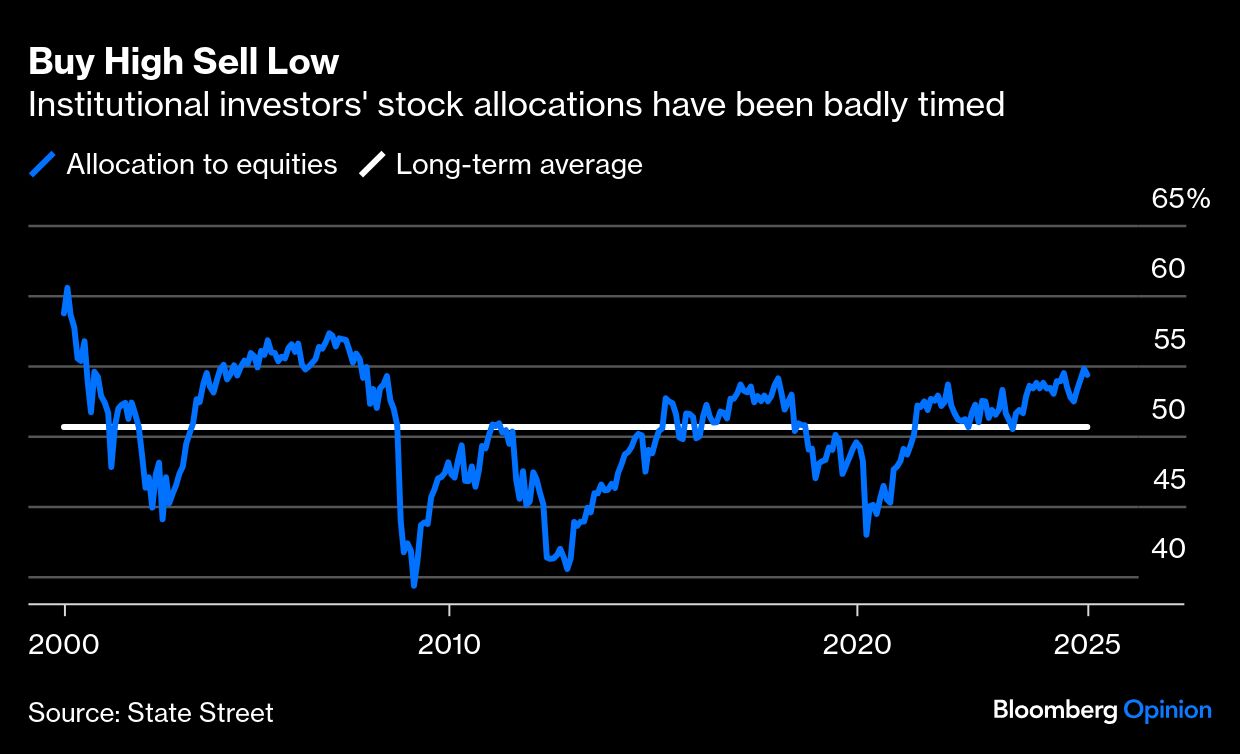
My suspicion was reinforced recently when I saw State Street Corp.’s latest institutional investor holdings report, which aggregates thousands of institutional portfolios from around the world collectively worth trillions of dollars. The chart that caught my attention shows changes in the aggregate allocation to equities back to 2000, mostly invested in US stocks. It’s a picture of ill-timed, buy-at-the-top-sell-at-the-bottom maneuvers — precisely the mistakes retail investors are constantly scolded about.
The chart’s highest stock allocation, at around 60%, was at the peak of the dot-com bubble in 2000. It dipped below 45% at the bottom of the crash in 2002, recovered to about 57% just before the 2008 financial crisis, then plunged again below 40% in the ensuing meltdown. Most astonishing, after nearly two decades and one of the longest, nearly uninterrupted bull markets on record, institutional investors’ stock allocation is just now approaching its pre-financial crisis level. That unfortunate record makes one wonder if they’re too late again.

Some of the allocation swings were driven by changes in stock prices, but I doubt they account for all of it given the size of the moves. More likely, some of these smarties sold in a panic when stocks nosedived and gradually bought back in as markets recovered. In any event, there is no indication that they bought opportunistically when stocks were on sale, as one would expect from supposedly shrewd investors.
If institutional investors have been sheepish about owning stocks in recent years, retail investors in the US certainly have not. They were net buyers of stocks during the pandemic, even during the vicious selloff in March 2020. They also bought aggressively during the tariff-induced panic in April. “Institutions were completely on the sidelines, very conservatively positioned, and the retail investor was aggressively buying dips,” Mark Hackett, chief market strategist at Nationwide’s Investment Management Group, told MarketWatch recently.
Retail investors showed increasing savvy even before then. Morningstar’s annual Mind the Gap report measures the difference between the return mutual funds and exchange-traded funds achieve and what investors in those funds manage to capture. The 2019 report, which looked at the period from 2005 to 2018, showed that investors captured roughly 92% of the return from US stock funds. In the latest report, which covers the 10 years through 2024, that number rose to 96%, presumably because investors were better able to hang on to their stocks through ups and downs. By the looks of it, the same can’t be said about institutional investors. Their equity allocations dropped significantly during the near-bear market in 2011 and the Covid pandemic in 2020, as they had in previous market declines.
Wall Street likes to joke that the stock market party ends when retail investors pile in, but institutional investors may be the better foil. Their peak equity allocations have coincided with the start of bear markets. They also tend to own the biggest companies because only those stocks have the capacity and liquidity to absorb large pools of capital. Perhaps it’s no coincidence that large companies are now the most expensive segment of the market.
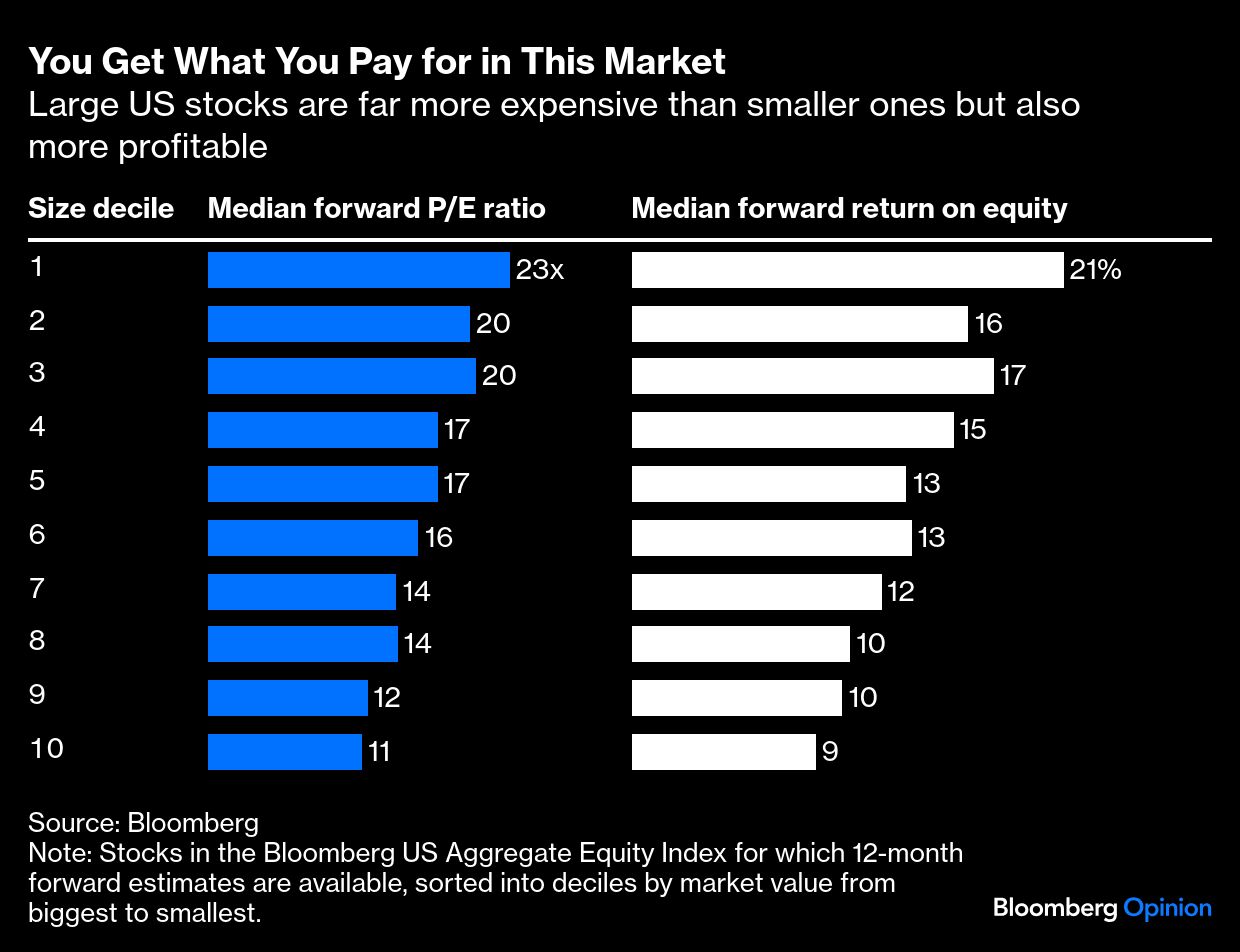
Of the companies in the Bloomberg US Aggregate Equity Index for which forward 12-month earnings and profitability estimates are available, some 2,000 of them, the largest 10% by market value have a median forward price-earnings ratio of 23, whereas the median ratio of the smallest 10% is closer to 11. And in between, the smaller companies generally trade at lower multiples. Larger companies tend to be more profitable now and, therefore, deserving of higher valuations. Still, the fact that the most expensive stocks are the same ones institutions tend to buy when they want equity exposure jibes with their penchant for chasing the market.
There’s another reason institutions favor large companies: Their stocks are less volatile than those of smaller companies. That volatility aversion explains why institutional investors allocate aggressively to private assets that, while generally riskier than stocks, rarely fluctuate in value. It may also explain why the historic market crash around the financial crisis scared off institutions for two decades.
Modern retail investors, by contrast, have evolved into entirely different animals. It’s not just that they’re better able to hang on to stocks and buy the dips. Their appetite for cryptocurrencies and disruptive startups and yes, absurd meme stocks, shows they are no longer the skittish investors of old. (The private asset industry may have more trouble pawning off its boring, illiquid investments on retail investors than it thinks.) That reputation better belongs to institutions.
There’s nothing new about retail investors’ enthusiasm for stocks; it’s institutions’ renewed bullishness that is noteworthy. It doesn’t mean a correction is imminent or even inevitable — no one can know that in advance. But if you want to gauge whether stock investors are too exuberant, have a look at the smart money.
A message from Advisor Perspectives and VettaFi: Discover something new! Click here to register for our upcoming webcasts.
Bloomberg News provided this article. For more articles like this please visit
bloomberg.com.
Read more articles by Nir Kaissar