Wall Street took profits in high flying technology stocks on Wednesday, rotating into cheaper corners of the market after the Federal Reserve delivered a widely expected interest rate cut under what Chair Jerome Powell described as an “unusual” situation of emerging labor-market weakness while inflation remains elevated.
A basket tracking the Magnificent Seven stocks including Nvidia Corp. and Alphabet Inc., slid 0.4% to snap a four-day winning streak. The group has surged nearly 60% since early April and is priced at 30 times projected profits up from nearly 22 times at the time, according to data compiled by Bloomberg.
The tech-heavy Nasdaq 100 Index fell 0.2%, with rate-sensitive technology shares like Nvidia, Amazon.com Inc. and Broadcom Inc., all in the red. Meanwhile Apple Inc. and Microsoft Corp., which traditionally serve as a flight-to-safety trade due to their strong business models and cash generation, rose.
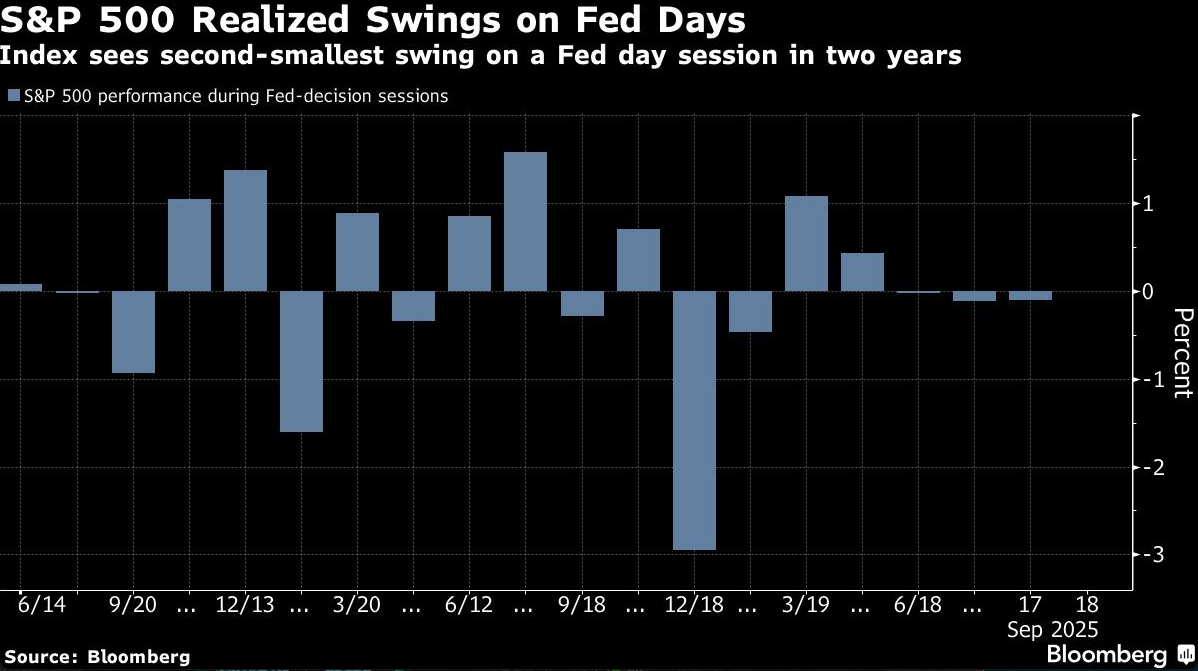
The tech sector was the worst-performing group in the S&P 500 Index, with the benchmark finishing just 0.1% lower to mark the second-smallest Fed day swings for the index in at least two years, according to data compiled by Bloomberg.
Financials, consumer staples and utilities, which pay hefty dividends, benefit from interest rate reductions and are popular with income investors, were by far the best performers in the S&P 500 for the session. The KBW Bank Index, which houses JPMorgan Chase & Co., Bank of America Corp. and Citigroup Inc., jumped 1.3% since lower rates stimulate loan demand and reduce deposit costs for banks.
“Some of this is a ‘sell-the-news trade’ for growth stocks because there was so much desire for rate cuts leading up to this moment that sent US stocks to records,” Ivan Feinseth, chief investment officer at Tigress Financial Partners, said by phone. “After a big rally, tech stocks with rich valuations are due for a breather. There’s still a lot of uncertainty with how tariffs will affect the economy.”

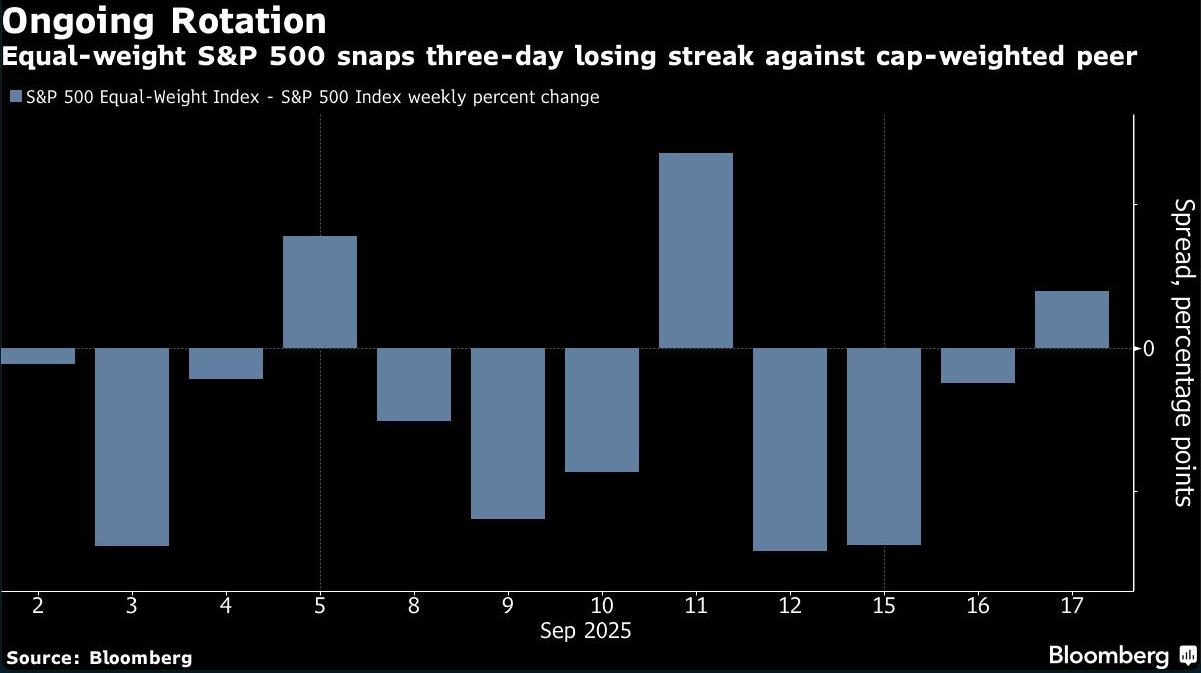
The most speculative corners of the market gave up initial gains. The Russell 2000 Index rose 0.2%, after gaining as much as 2.1%, while the most shorted companies jumped 1%. A Goldman Sachs basket of unprofitable tech companies, which includes firms like Roku Inc. and Peloton Interactive Inc., leaped 1.9%. The S&P 500 Equal Weight Index — a version of the benchmark that gives an equal share to each constituent — edged up 0.1%.
The Fed cut interest rates for the first time since December, as was widely expected, and central bankers also said they favor lowering rates by at least an additional half-point over their two remaining meetings in 2025. But Powell’s comments at the press conference spurred further selling as he struck a slightly hawkish tone, highlighting risks from “somewhat elevated” inflation.
The yield on 10-year Treasuries advanced five basis points to 4.08% on Wednesday.
Generally speaking, technology companies are particularly susceptible to rising yields because many of them are valued on projected profits delivered years in the future. The present value of those future profits are worth less as yields rise.
If inflation is rising while unemployment is going up, “this would be a complicated and challenging situation for the Fed and how much the Fed can lower rates if inflation continues to pick up steam,” said John Cunnison, chief investment officer at Baker Boyer Bank.
This comes at a time when other parts of the economy are showing signs of weakness in the aftermath of tariffs, with US job expansion moderating significantly in August after nonfarm payrolls increased just 22,000 last month amid deep uncertainty over President Donald Trump’s trade policies.
The Cboe Volatility Index — also known as Wall Street’s fear gauge — fell below 16, well under the 20 level typically seen during times of market stress.
“The bigger question for traders now is what does all of this portend to future rate cuts and where the economy is headed,” Cunnison said. “Lower rates will support riskier parts of the stock market, from small caps to non-profitable tech. While deep recession doesn’t seem likely, current equity valuations seem stretched for growth and big tech shares after a big rally.”
A message from Advisor Perspectives and VettaFi: Discover something new! Click here to register for our upcoming webcasts.
Bloomberg News provided this article. For more articles like this please visit
bloomberg.com.
Read more articles by Jessica Menton