Private credit managers have proven their prowess in fundraising, but are falling short on dealmaking. With mountains of cash waiting to be deployed, they are latching onto the artificial intelligence data center boom, hoping to stay relevant as banks reclaim their dominant position in corporate lending.
The world’s largest asset managers, such as real estate investing giant Blackstone Inc., are going all in. Meta Platforms Inc. recently selected Pacific Investment Management Co. and Blue Owl Capital Inc. to lead a $29 billion financing for its data center expansion in rural Louisiana. Ares Management Corp. is aiming to raise more than $8 billion to back facilities across London, Japan and Brazil.
In many ways, investing in digital infrastructure is a natural extension of what private lenders already do. They have been expanding into so-called asset-based finance, a type of lending that is supported by cash flows from, say, credit card receivables. Just like office buildings, data centers get lease income from tenants, who often sign multiyear contracts.
Private lenders are certainly keen to enter the space. They have been struggling to find deals and deploy capital after raising trillions of dollars in recent years. With the syndicated-loan market reopened for junk-rated borrowers and banks once again arranging financing for the biggest leveraged buyouts, alternative managers have to find a new asset class to spend the money.
Operating a data center can be lucrative. For instance, Terawulf Inc., a New York-listed crypto mining operator that has expanded into this arena, signed a 10-year, 60-megawatt contract with Core42, a subsidiary of Abu Dhabi-based tech group G42. On the capital expenditure level, it will be able to break even within five years. But if the company builds and leases so-called powered shells, which, similar to office towers, are bare-bone facilities that only provide electricity, cooling and Internet access, its return on asset can be even higher. One may expect an 85% operating margin.
With this kind of profitability, financiers will want a bite. But private credit lenders believe they have a unique edge over commercial banks, in that they allow AI companies to borrow big without hurting their credit ratings.
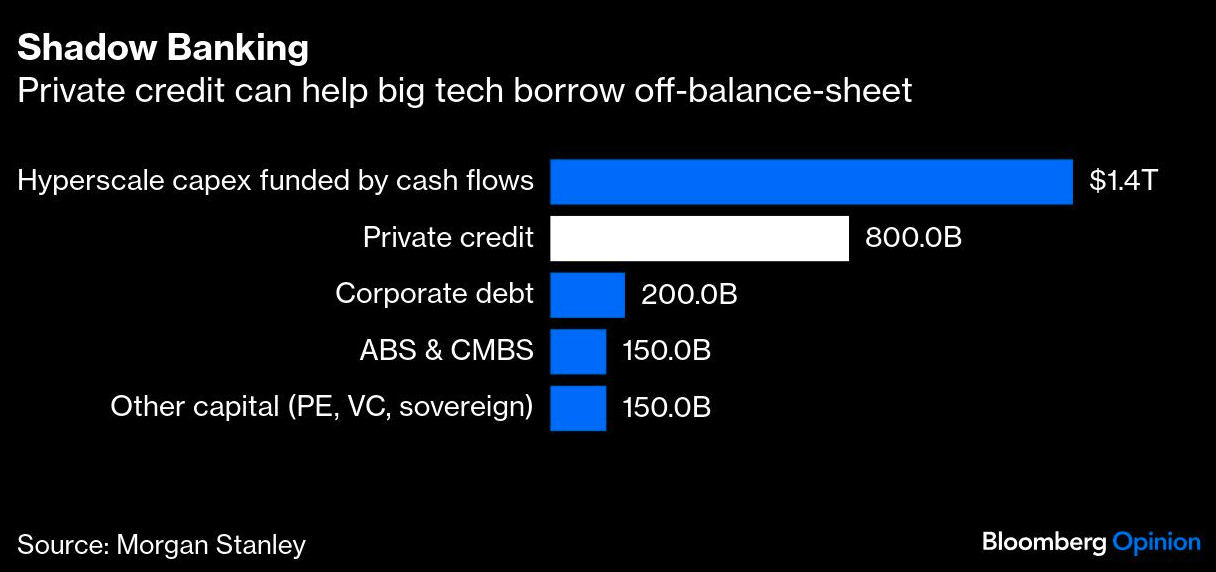
According to Morgan Stanley, a whopping $2.9 trillion will be spent on data centers through 2028. Blue-chip companies such as Alphabet Inc. and Meta can only pay for roughly half of their capital expenditure with cash flows. The $1.5 trillion funding gap will have to be filled externally. As a result, big tech has been relying on private investment firms for firepower, structuring their deals into joint ventures or special purpose vehicles to keep the debt-like fundraisings off their balance sheets. It’s a $800 billion opportunity for private credit, the bank says.
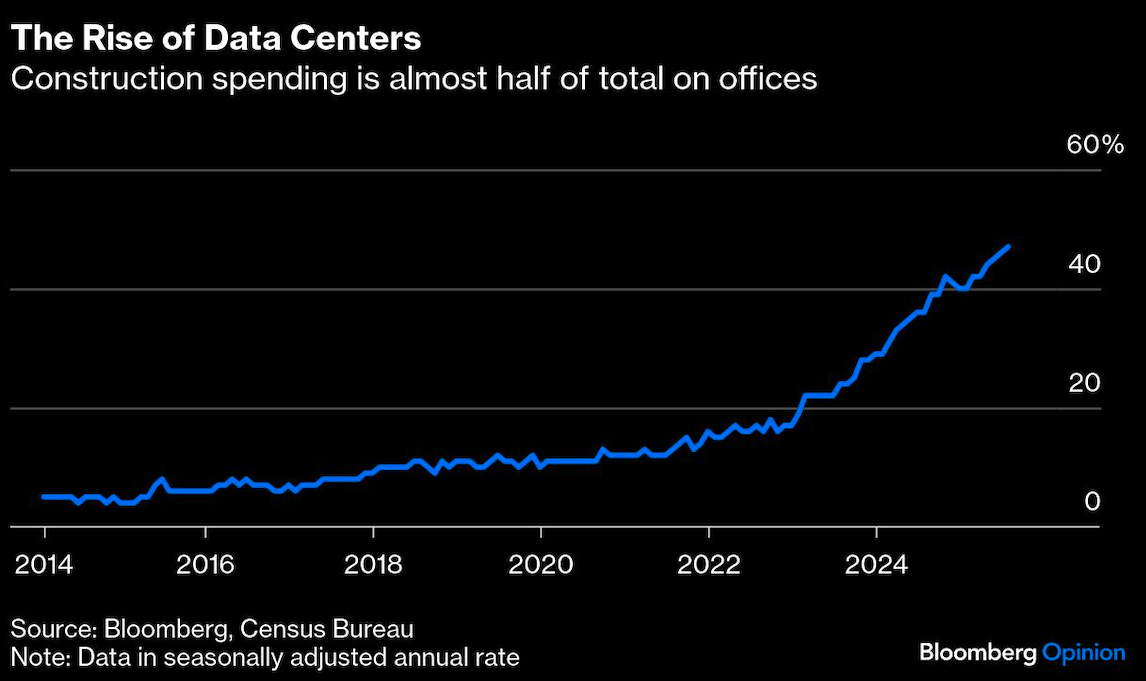
Already, we are seeing a data center boom. In the US, construction spending in July reached $41 billion on an annualized basis, 47% of the total spent on offices. Four years ago, before ChatGPT came about, the ratio was less than 20%. Malaysia is another hub, with clusters in Johor thanks in part to its proximity to Singapore.
But will the math work as more private lending takes place? Overbuilding is definitely a concern. Morgan Stanley says generative AI might only be able to bring in $1 trillion in annual sales in 2028, but global businesses would have spent $2.9 trillion on data centers by then already. What if, five years down the road, tech companies decided AI would not be able to generate blockbuster earnings? Tenants may want rent concessions, or even worse, choose not to renew their leases.
This certainly is a scene that we have encountered with office towers. The Covid-19 pandemic, followed by companies’ slow implementation of return-to-office policies, has created a structural downturn in this corner of commercial real estate.
In addition, once built, data centers might have to spend more on upkeep, thereby eating into margins. For instance, more powerful chips, which Nvidia Corp. churns out every year, are contributing to rising rack density, or the amount of power consumed by equipment housed in a single server rack. This in turn might force operators to upgrade their power supply and cooling systems, or risk losing key tenants for newer facilities. In other words, managing a data center and keeping tenants happy is not as simple as decorating a skyscraper’s lobby during the Christmas season.
For private credit, AI data centers just happen to be in the right place, with the right narrative. But by land grabbing, will the lenders ignore credit quality?
A message from Advisor Perspectives and VettaFi: Discover something new! Click here to register for our upcoming webcasts.
Bloomberg News provided this article. For more articles like this please visit
bloomberg.com.