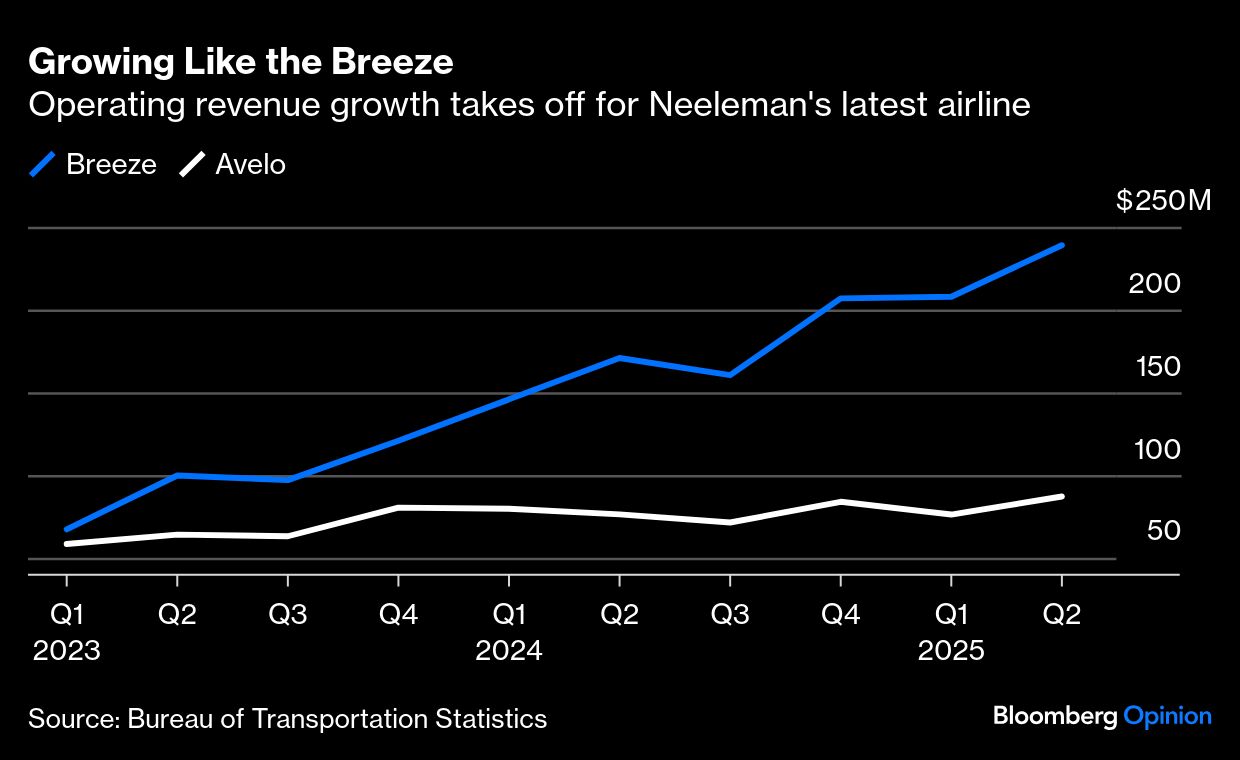
In a tough US market for domestic flying that has put low-cost airlines on the ropes, one startup is rapidly growing revenue by tapping underserved markets through direct flights using smaller aircraft with business-class and basic seating. Breeze Aviation Group Inc. is worth paying attention to not only because of the strategy and the sales results, but also because the founder is David Neeleman.
The entrepreneur has a track record of launching successful airlines, with JetBlue the most prevalent. He also was a co-founder of Morris Air, which Southwest Airlines Co. purchased in the early 1990s, and WestJet Airlines, a Canadian startup that was sold with impeccable timing — at least for Neeleman — just before the pandemic decimated commercial flying. Flyers to South America are familiar with his Brazilian airline – Azul SA, where the 65-year-old Neeleman is the chairman.
The latest market niche that Neeleman is pursuing are direct flights from smaller cities, such as New Haven, Connecticut, Fort Myers, Florida, and Wilmington, North Carolina. He’s using smaller jets – Embraer’s newest regional planes and the Airbus A220, which was developed by Canada’s Bombardier Inc. and then sold to Airbus SE. Even though the jets are small, only carrying about 112 passengers, they offer wide business class seats, a section with extra leg room and basic seating.
Breeze is exploiting the biggest weakness of legacy carriers such as Delta Air Lines Inc. and United Airlines Holdings Inc., which is the limited non-stop flights the carriers offer to passengers in smaller cities. The large legacy airlines rely on partner regional airlines to bring passengers from smaller cities to their big-city hubs. This strategy, which Southwest pioneered by staking a claim to second-tier airports including Dallas Love Field, Baltimore/Washington International Airport and Chicago Midway Airport, may be a road map of how to compete with the large airlines. The US airline market is fairly saturated with flights, but unless passengers live in a hub city such as Atlanta or Dallas, they will likely make at least one stop before their final destination.
The need for airline competition and consumer options is greater than ever as Spirit Aviation Holding Inc., a low-cost carrier that has helped keep airfares in check broadly, shrinks its fleet and reduces flights after declaring bankruptcy in August for the second time this year. If the largest four airlines are the only one left standing, then airfares will rise and choice of direct flights will decline.
Breeze is tiny, for sure, and small airlines come and go fairly regularly. But, its revenue growth makes it hard to ignore. Breeze’s operating revenue jumped 41% in the first half of this year to $447 million from the same period of 2024, according to the Bureau of Transportation Statistics. Avelo, another startup airline looking for a niche, increased operating revenue just 5%.
Southwest, Spirit, Frontier Group Holdings Inc., JetBlue Airways Corp. and other airlines posted sales declines in the first half of the year as flyers, especially those at the back of the plane, spend cautiously more than usual and as the big legacy carries have learned to better compete in this market after suffering losses when Spirit and Frontier were growing rapidly more than a decade ago.
Delta, United and American figured out how to cash in on premium seating and perks instead of giving them away as free upgrades. For those who need to make a connection, a membership gives access to a lounge where food, drink, work or rest can be done in a more private setting. The airlines have turned these fancy rest stops into an opportunity for premium revenue, and that blunts the inability to offer a direct flight.
The low-cost providers grapple with a saturated market that makes it difficult to find routes between two cities that have enough passengers to fill a Boeing 737 or Airbus A320. Most such routes have been identified, claimed and defended. Southwest’s success at filling second-tier anchor airports near large cities with multiple flights captured most of the low-cost real estate. Spirit and Frontier also found smaller airports, especially in Florida, but were more willing to take head on the large airlines.
The legacy airlines responded with a combination of low fares at the back of the plane and extra services, such as seatback screens with free entertainment and no cost for carry-on bags. The aftermath of the pandemic, in which consumers prioritized experiences over physical goods, was a tailwind for the premium products where the large airlines have focused investment.
Breeze has 50 aircraft and Neeleman believes there are enough of these secondary markets to support a fleet of 400. He figures that 125 US cities have lost a quarter of their air service over the last decade as the large airlines drive passengers to their hubs. For a city pair with 15 passengers a day, Neeleman said Breeze can juice that demand to 100 passengers. Neeleman started from Tampa, Florida, and Charleston, South Carolina, and has added flights in New Haven to compete directly with Avelo, another startup that’s focusing on smaller cities. Although adding routes and aircraft is expensive at first, Breeze posted a net profit in the second quarter. “We have some of the highest margins in the industry on routes where we don’t have non-stop competition,” Neeleman said in a Bloomberg TV interview last week.
Smaller planes provide flexibility to tap small markets, although they are less efficient when equally full. But if an airline can increase the frequency of flights between city pairs, it can attract more customers. In short, there is much pain that comes with growth and managing aircraft, maintenance and airline personnel, said Ahmed Abdelghany, a professor at Embry-Riddle Aeronautical University and a former analyst at United. There’s also the danger that if Breeze grows quickly and begins to peel off passengers along the spokes of the legacy carriers’ hubs, the bigger airlines could respond, he said. “It's like a jungle,” Abdelghany said. “If you lose your defensive mechanism or somebody comes in with more power than you, they'll kick you out.”
If Neeleman can repeat history, Breeze’s growth will soon be garnering a lot of attention.
A message from Advisor Perspectives and VettaFi: Discover something new! Click here to register for our upcoming webcasts.
Bloomberg News provided this article. For more articles like this please visit
bloomberg.com.