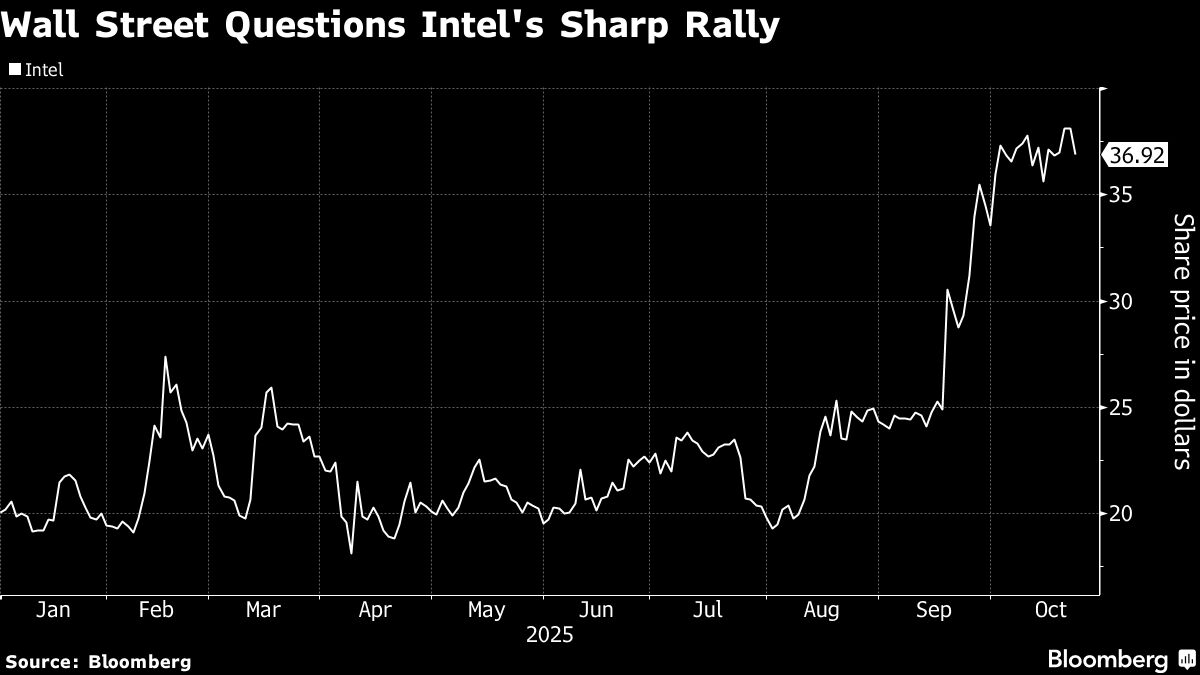
Investors will be looking beyond the bottom line in chipmaker Intel Corp.’s third-quarter earnings after a wave of investments from the White House, Nvidia Corp. and Softbank Group Corp. sent the stock soaring 86% in less than three months.
The rally has been so steep that several analysts cut their ratings in recent weeks due to worries about the shares rising “too far, too fast,” as Bank of America wrote in a note to clients last week lowering Intel to underperform from neutral. The surge in enthusiasm is also making Intel shares increasingly expensive. They’re now priced at 63 times expected earnings over the next 12 months, up from around 20 in January, placing the company among the 15 most expensive members of the S&P 500 Index.
The leap is particularly striking because it has been almost exactly a year since Intel was removed from the Dow Jones Industrial Average, which it joined in 1999, and replaced by rival and artificial intelligence darling Nvidia.
The shares took a hit on Wednesday after the Trump administration said it’s weighing export restrictions against China that target the technology industry, closing down 3.2% at $36.92, which is still well above its consensus 12-month price target of $28.80. The Philadelphia Stock Exchange Semiconductor Index fell 2.4%, with all but one member closing in the red.

There’s broad sentiment on Wall Street that Intel’s latest earnings report, due after the bell on Thursday, is going to disappoint, according to Joe Tigay, portfolio manager of Catalyst Nasdaq-100 Hedged Equity Fund, which holds Intel shares, and the Rational Equity Armor Fund, which unloaded its stake.
“It’s really more about the future,” Tigay said. Rather than focusing on the last quarter, investors want to hear details about how the chipmaker will navigate “current economic issues to get to that down-the-road spot,” he added.
As for the latest results, Wall Street will be looking for indications that Intel’s cost-cutting measures are working. Tigay said he wants to hear comments “about how they’re going to be profitable and what products are going to work and what kind of numbers they expect out of that for next year.”
Intel is expected to report adjusted earnings of 1 cent per share on revenue of roughly $13.2 billion in the third quarter, compared with a loss of 46 cents a share and revenue of $13.3 billion a year ago. The company cut its 2025 expense target in September after selling its majority interest in Altera to Silver Lake.
Investors are also seeking signs that the almost $18 billion in investments the company received this summer are paying off. Indeed, Intel’s stock is benefiting from “the expectation of more announcements to follow,” Cantor analyst C.J. Muse wrote in an Oct. 18 note to clients.
In addition, Intel’s Chief Executive Officer Lip-Bu Tan is also under the microscope. Tan, who took over in March, told investors on his inaugural earnings call that a turnaround would take time. But just a few months later, investors were already losing patience. Now, Intel is dealing with “a still-relatively-new CEO, a new culture, and a not-so-new set of investor questions,” Stifel analyst Ruben Roy wrote in an Oct. 21 note.
One key question from Wall Street is whether Tan wants to reduce losses at Intel’s foundry operation.
“Without government support or other financially stronger chip partners, it will be difficult for Intel’s foundry unit to raise enough capital to continue to build out more fabs at a reasonable rate,” said Dan Morgan, senior portfolio manager at Synovus Trust, which owns Intel shares.
Overall, the message from investors and analysts is that a bet on Intel isn’t about what just happened, it’s about the possibilities for the future. Earnings reports are inherently backward looking, so the results aren’t likely to affect the company’s stock price. Any comments about what’s to come, however, probably will.
“I don’t think a lot of investors are looking at earnings numbers too much,” said Ryuta Makino, research analyst at Gabelli Funds, which had $35 billion in assets under management as of Sept. 30. “I see Intel, in the near term at least, as a trading stock that’s more event-driven, more driven by press releases.”
A message from Advisor Perspectives and VettaFi: Discover something new! Click here to register for our upcoming webcasts.
Bloomberg News provided this article. For more articles like this please visit
bloomberg.com.
Read more articles by Felice Maranz