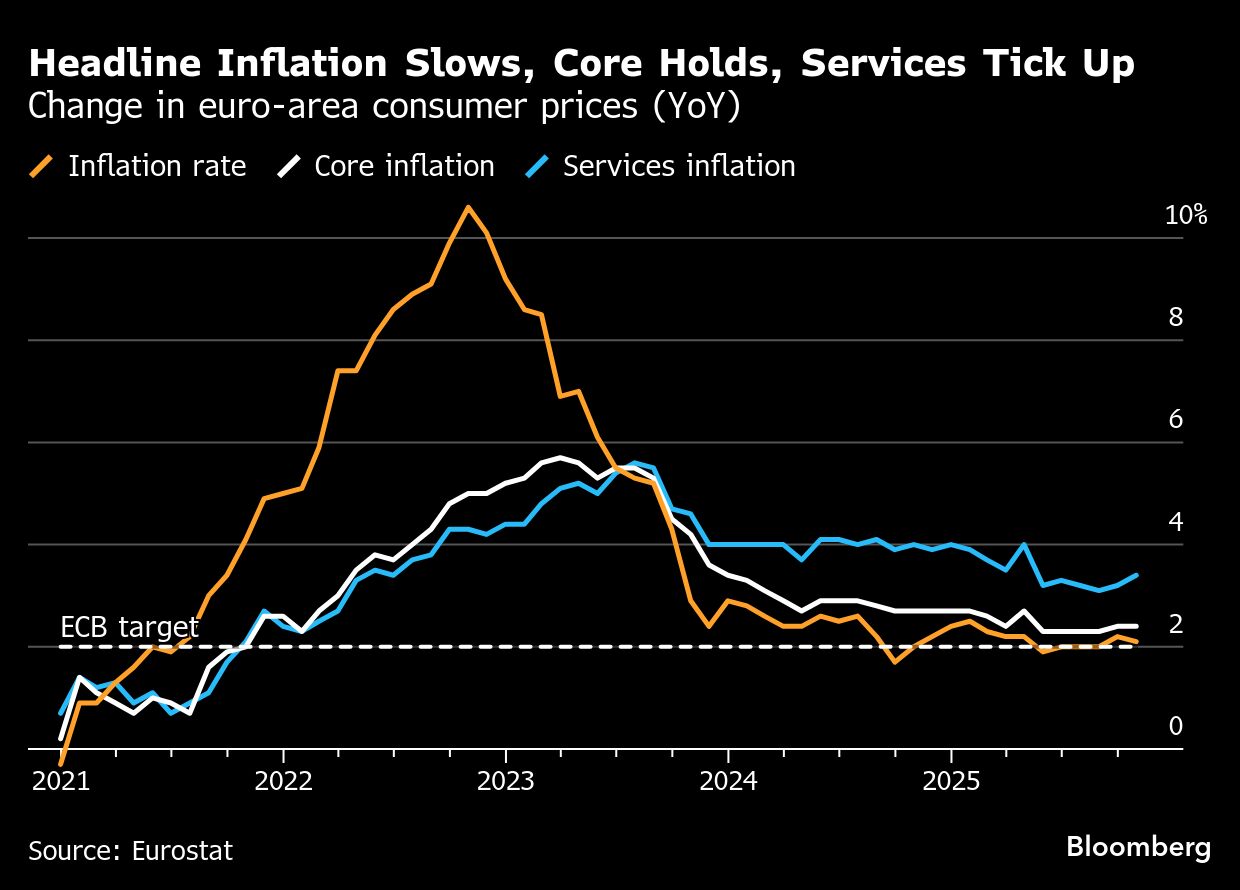
Euro-area inflation eased slightly but stayed above 2%, backing the European Central Bank’s decision to keep borrowing costs where they are.
Consumer prices rose 2.1% from a year ago in October, down from 2.2% in September. That matched the median estimate in a Bloomberg survey. A measure of underlying pressures that strips out volatile components unexpectedly held at 2.4% as the closely watched services component quickened to 3.4%.

The reading comes a day after the ECB kept interest rates at 2% for a third meeting, judging that policy settings are appropriate to keep price gains around their target over the medium term. President Christine Lagarde said Thursday that the assessment of the inflation outlook was broadly unchanged, though it remained more uncertain than usual.
National reports this week showed price pressures building in Spain, easing less than expected in Germany and remaining well below-target in France and Italy.
“At first glance, the inflation problem in the euro zone appears to be solved,” said Joerg Kraemer, chief economist at Commerzbank. But “the persistent underlying inflation argues against the ECB further lowering its key interest rates.”
The ECB expects inflation to dip below 2% next year, followed by a re-acceleration to near the goal in 2027. Fresh quarterly forecasts in December will feature 2028 for the first time, potentially reigniting discussions on whether further monetary easing is necessary.
For now, officials are signaling little reason to act. Lagarde reiterated that “from a monetary-policy point of view, we are in a good place.”
Economic-growth data in recent days supported that stance. Euro-area output rose 0.2% in the third quarter, more than analysts had predicted, in a sign of resilience to the trade disruptions unleashed by US President Donald Trump.
The economy was boosted in particular by France, where companies and households defied political turmoil over its budget. Germany and Italy stagnated, narrowly avoiding recessions.
The ECB warned that a stronger euro and the tariff fallout could still dampen inflation more than expected. On the other hand, prices could be boosted if trade disruptions cause supply-chain snarls.
An ECB document summarizing its recent contacts with companies showed some manufacturers see downward pressure on prices — partly because US tariffs cause more goods from elsewhere to be diverted to the currency bloc. The impact on activity was also assessed as negative.
In the run-up to Thursday’s meeting, policymakers had offered varying assessments of such scenarios. While some had emphasized the risks that could pull inflation lower, others had highlighted those that drive it in the other direction.
A message from Advisor Perspectives and VettaFi: Discover something new! Click here to register for our upcoming webcasts.
Bloomberg News provided this article. For more articles like this please visit
bloomberg.com.
Read more articles by Alexander Weber