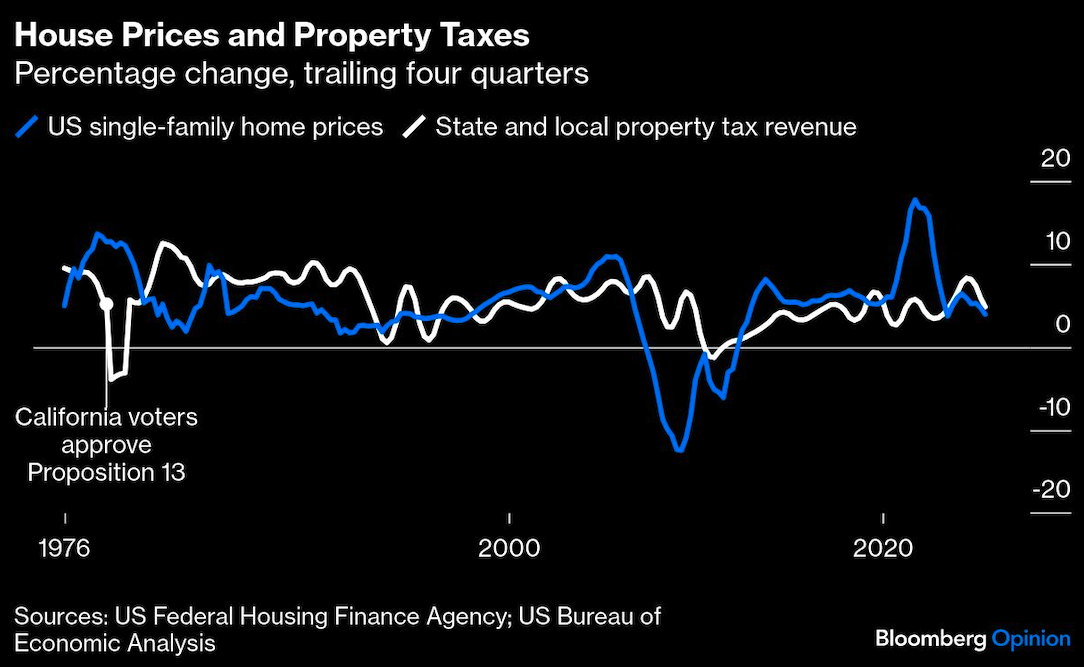
In the 1970s, big increases in house prices in many parts of the US brought big increases in property tax bills, followed by a tax revolt — represented most famously by California’s Proposition 13 in 1978 — with consequences that have reverberated ever since. Even-steeper house-price increases during the Covid-19 pandemic brought a less dramatic rise in property tax revenue nationwide, thanks in part to measures adopted during and after that 1970s tax revolt. But the tax increases were big enough in some places that another revolt has been brewing.

Consequences of the current revolt have so far included inflation-linked floating tax exemptions for owner-occupied homes that were approved last year by Florida and Georgia voters, a 25% property tax cut enacted early this year in Wyoming and a big increase in the homestead tax exemption, with an even bigger increase for the disabled and those 65 and older, that Texas voters backed last week by overwhelming margins (79% to 21% and 78% to 22%, respectively). Activists and politicians in several states have also been promoting the more drastic solution of abolishing some or all property taxes, and although voters rejected one such attempt in North Dakota last year, 2026 is likely to see more of them.
Getting rid of property taxes is a terrible idea. They are among the most economically efficient of taxes, meaning they don’t weigh on economic growth in the way that other taxes can. They are also the source of about 70% of local government revenue in the US, so ditching them means increasing other taxes or eliminating essential services. Sudden sharp increases in property taxes can be pretty terrible, too, and it’s not unreasonable of lawmakers and voters to try to prevent them, but there are effective ways of doing that and messy, economically counterproductive ways.
The economic case for taxing property, in particular the part of property value constituted by land, is that unlike most other taxes, it doesn’t discourage any productive activity. “The annual produce of the land and labour of the society, the real wealth and revenue of the great body of the people, might be the same after such a tax as before,” Adam Smith argued in The Wealth of Nations in 1776, and in recent years economists have consistently found that shifting to property taxes from income or consumption taxes increases gross domestic product growth.
The flip side is that, unlike with income or sales taxes, property tax bills can jump without owners (or the government) doing anything to make them rise. Many less-than-wealthy people whose purchasing power plummeted as inflation raged in 2021 and 2022 saw their property tax bills go way up as house prices rose, which really doesn’t seem fair.
The best remedy, argues Jared Walczak, vice president of state projects at the center-right Tax Foundation and author of a couple of illuminating reports about the current property tax revolt, is a so-called levy limit that restricts how fast tax bills can rise. Massachusetts’ Proposition 2½, a 1980 ballot measure that limits a municipality’s annual increase in property tax revenue (not counting revenue from taxes on new properties) to 2.5%, is among the most durable and successful levy limits. Boston Mayor Michelle Wu recently called for its reconsideration, mainly because in most years since 1980, inflation has been higher than 2.5%, but that seems like a nonstarter politically and Proposition 2½’s restrictions (which also include a 2.5% cap on property taxes as a percentage of assessed value) have arguably protected local governments in the state from more-damaging property tax blowback.
Targeted relief for low-income homeowners, usually in the form of “circuit breakers” that deliver tax credits or rebates when property taxes exceed a certain share of income, can also deliver relief without much economic distortion. Homestead exemptions are somewhat progressive, too, because they deliver proportionately more relief to those with less-expensive houses, but they can remove much of the tax base in areas with low home prices (the new Texas homestead exemption of $140,000 is well above the average home value in many rural counties). And giving special circuit-breaker or homestead-exemption treatment to the elderly, as is common, means favored tax treatment for a group that has experienced huge wealth gains in recent decades.
Most problematic are laws that freeze or limit increases to a home’s assessed value as long as it doesn’t change hands. California’s Proposition 13 included such a freeze (along with a levy limit and other provisions). Florida’s 1992 Save Our Homes amendment put a 3% limit on annual valuation increases. When property values rise a lot, as they have in California and Florida, this creates huge disparities in property tax bills between longtime homeowners and recent purchasers, and with them ever-growing incentives for the long-timers to stay put. California voters have tried to address the latter issue by approving a series of ballot measures that allow 55-and-older homeowners to take their low tax assessments with them when they move, but this amounts to an even bigger subsidy for the elderly at the expense of everyone else.
Property tax breaks for the elderly, demographer Lyman Stone of the conservative Institute for Family Studies argued in an intriguing April report, are effectively anti-family in that they end up shifting tax burdens onto or reducing services for families with young children. Stone compared property tax rates and the fertility gap — the difference between how many children people say they want to have and actual birth rates — across states and found that higher property taxes were correlated with smaller fertility gaps.
Calling for higher property taxes to encourage baby making does not sound like the basis of a successful political movement. But keeping misguided anti-tax activists from destroying what’s good about property taxes is something of a political imperative for local governments in the US right now.
A message from Advisor Perspectives and VettaFi: Discover something new! Click here to register for our upcoming webcasts.
Bloomberg News provided this article. For more articles like this please visit
bloomberg.com.
Read more articles by Justin Fox