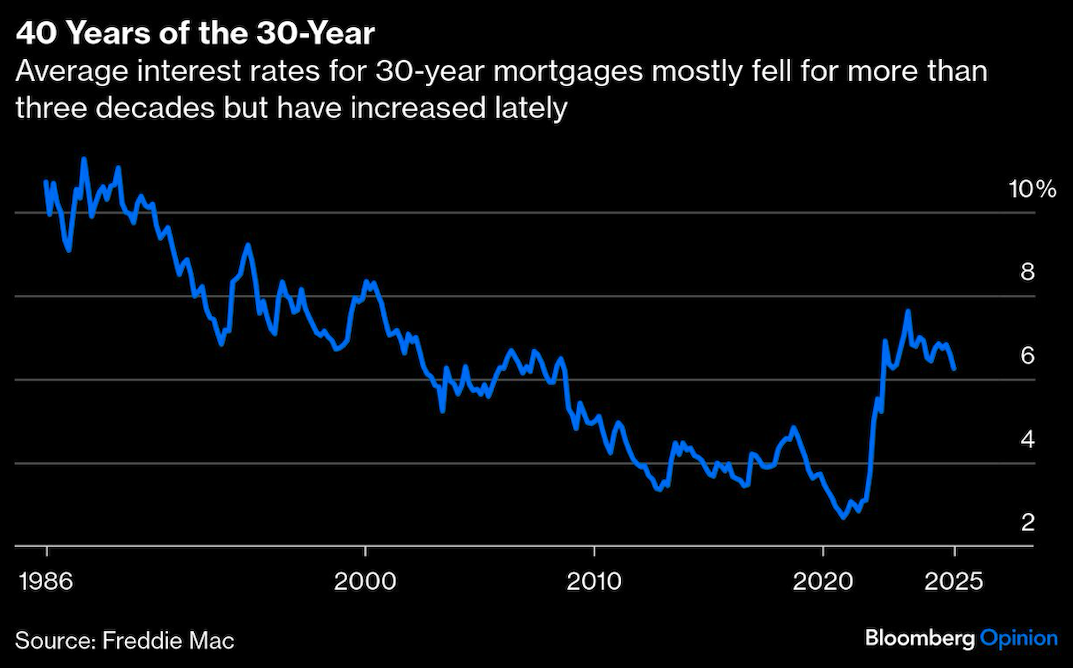
America has a problem with mortgage rates. After decades of them mostly falling, the rate for a 30-year mortgage is stubbornly hovering above 6%, more than twice what it was just a few years ago. That makes it harder not only for first-time homebuyers to afford loans, but also for existing homeowners with cheap mortgages to move. The result is a depressed supply of housing and a less mobile population.
Enter President Donald Trump with a proposed solution that both the left and the right seem to hate: the 50-year mortgage. Much as it pains me to ruin this rare moment of bipartisan harmony, I do not think that a 50-year mortgage is a terrible idea.

First, it would mean lower monthly payments, unless interest rates rise a lot. Yes, buyers who stay in their home for 50 years and pay off their mortgage over that time will pay much more in interest than they would have with a 30-year mortgage. But most people don’t pay off their mortgage at maturity. Depending on interest rates, between 10% and 34% of mortgages each year are paid before they mature — because people move, refinance or just decide to pay off their loan. Most people only live their homes for less than 20 years.
It is true that people who sell their homes before their mortgage matures will get less of the home’s value with a 50-year mortgage compared to a 30-year. But that may be a worthwhile tradeoff for someone who needs or wants a lower monthly payment.
One concern with a 50-year fixed rate is it will be difficult to price, because there is no 50-year bond to benchmark it to. But a lack of viable Treasuries is not a problem. A 30-year mortgage is priced off a 10-year bond because that is the security with a similar duration (a weighted average of payments). So a 50-year fixed-rate mortgage would probably be priced off a 15-year bond — or something in that neighborhood. There is a healthy market for securities with that duration.
Don’t get me wrong: If a 50-year mortgage created a market for a 50-year bond, I’d be thrilled. Many pension funds and other institutional investors are short duration when it comes to paying for our aging population. There is evidence the market doesn’t have much demand for long-term bonds, but this may be a quirk of how the US regulates pensions. If the US internalized this duration mismatch, there would be more demand for long-term assets.
I do have some deep concerns about 50-year mortgages, as you might expect from someone who once wrote that the 30-year fixed-rate mortgage “is a financial product that should not exist” and that homeownership itself is not necessarily the best goal for either individuals or society.
The main worry is that a fixed-rate consumer loan at such a low rate is very risky, even with a home as collateral. Simply keeping the 30-year alive in the US takes a toxic brew of subsidies, regulations and quasi-governmental entities that exist to manipulate mortgage markets. The desire to bring down rates for 30-year mortgages during the pandemic is a big reason there is a housing affordability problem now.
It is not clear what it would take to make a 50-year mortgage a viable product. A proposal to offer 50-year mortgages in the UK has gone nowhere, while in South Korea regulators are concerned that they are contributing to increased household debt. No doubt the US government would be tempted to interfere in the 50-year market — and the scope for interference could be worse.
That said, 30-year mortgages do exist, and a libertarian-ish economist like me has to acknowledge that in some respect the market has spoken. Introducing a 50-year mortgage may be better than other things the government might do to lower mortgage rates, such as financial repression or relaxing lending standards. Then again, I have always been a sucker for long-duration assets.
A message from Advisor Perspectives and VettaFi: Discover something new! Click here to register for our upcoming webcasts.
Bloomberg News provided this article. For more articles like this please visit
bloomberg.com.
Read more articles by Allison Schrager