In the staid world of sovereign wealth and pension funds, an evolution is underway that could rewrite how trillions of dollars get invested.
For decades, these institutional allocators took roughly the same approach to managing the vast piles of cash under their control: They diversified by divvying up the money across asset classes — for example 40% in stocks, 40% bonds and 20% alternatives — then stuck with it by rebalancing now and again when things got out of whack.
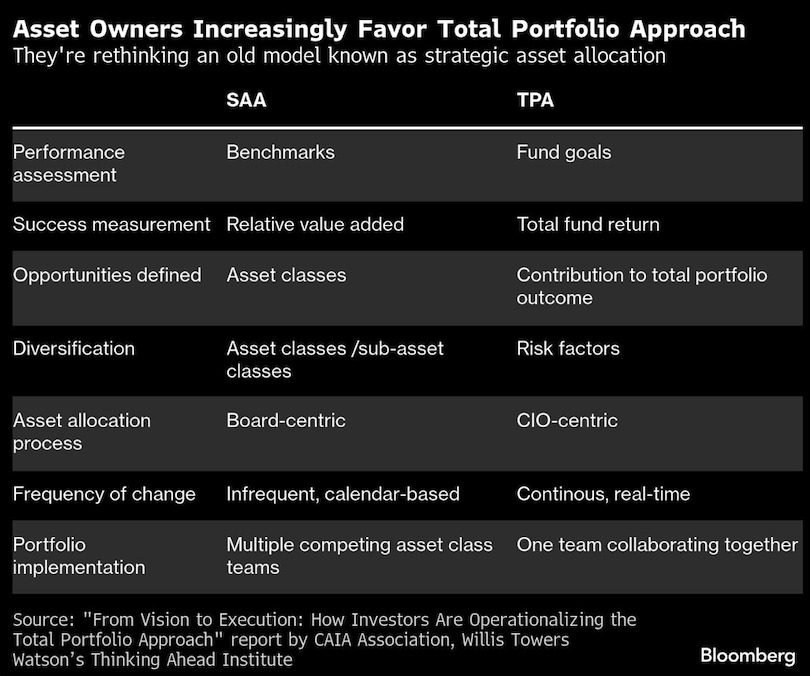
But a growing list of funds is challenging that convention by turning to a method that ditches the asset-class silos. Instead, they pit investments as disparate as, say, public equities and private credit against each other in search of the best bet for the whole portfolio. Dubbed the Total Portfolio Approach, it’s gaining traction fast — and before month-end it may even be the guiding principle of America’s largest public pension.
CalPERS, the California Public Employees’ Retirement System, is voting on whether to adopt TPA next week. A “yes” vote will see the $587 billion fund join an accelerating bandwagon that already includes the likes of Singapore’s sovereign GIC Pte, Australia’s Future Fund and Canada’s CPP Investments.
For many such allocators, adopting TPA will mean making drastic changes in culture, governance and infrastructure. Meanwhile there are plenty of skeptics who see little more than a buzzy acronym. But to its proponents, TPA is a better fit than the old static model — known as Strategic Asset Allocation — for an unpredictable world in which inflation spikes or geopolitical shocks can easily upend market assumptions.
“Your SAA was built with markets in equilibrium,” said Michael Wissell, chief investment officer at the roughly $88 billion Healthcare of Ontario Pension Plan, which uses TPA. “It’s just never been the case. There’s always something out of the equilibrium. And when you use a model that’s predicated on something that just simply isn’t true, you can get yourself into trouble.”
CalPERS Pitch
At CalPERS board meetings in September, Stephen Gilmore, the fund’s new CIO, laid out the rationale for the proposed switch.
“With an SAA you tend to get a problem with asset classes optimizing for their own asset class, so you can have unintended concentration or you can have over-diversification,” Gilmore said. “If you optimize for a whole lot of different asset classes and add it all up, it’s inferior to optimizing for the whole.”
In the platonic ideal of TPA, a board would trust the investment team to make more ad hoc decisions. Staff would freely share information across asset-class teams and would debate whether they should bet on, say, data centers through listed shares or private loans. Quants would dissect the factor exposures of public and private equity alike. The passive benchmarks that previously loomed over every asset class team would be no more.
Under the CalPERS proposal, the fund will go from 11 asset class benchmarks to a single “reference portfolio” of 75% equities and 25% bonds, with an active risk budget of 400 basis points.
In making his pitch, Gilmore cited the superior performance of TPA investors. Although he didn’t adduce specific numbers, a 2024 report co-authored by the consultancy Willis Towers Watson and the Future Fund showed TPA funds beat SAA ones by 1.8 percentage points in annual performance over 10 years (albeit that masked a wide range of returns and risk appetites for each category).
Trade-Offs
Canada’s CPP ranked as the fourth-best sovereign investor from 2015 to 2024, according to the consultancy Global SWF. Head of Total Fund Management Manroop Jhooty attributes its strong returns partly to TPA’s flexibility.
If, for example, a PE allocation has risen to 20% from a target of 15%, an SAA investor might be compelled to offload some PE holdings even if liquidity constraints mean pricing is unfavorable. But a TPA fund can cut listed shares instead, since the framework views both as equities driven by similar forces.
“You’re able to make that trade-off decision that in a classic SAA framework is just a little bit harder to do,” said Jhooty, whose firm runs about $522 billion.
On the flipside, TPA enables asset allocators to identify unintentional concentration. When a hot theme like artificial intelligence is in vogue, every team — from infrastructure to public equity to private credit — may be tempted to shift money there. That risks a dangerous over-exposure to a single industry even as asset allocations remain in line with goals.
The New York City Retirement Systems, which oversees more than $300 billion, has hired three quant managers since 2022 to build analytical tools and models that track the portfolio’s exposure to various risk factors such as liquidity and equity sensitivity.
According to Steven Meier, who this month left NYCRS after three years as CIO, the ultimate goal is to conduct scenario analysis and stress test so that the portfolio is better prepared for the uncertain world. But that doesn’t mean TPA is replacing SAA — rather, it’s “a logical progression” from SAA, he said.
“The Strategic Asset Allocation approach is the basis that we use to make decisions,” Meier said in an interview before his departure. But on its own “it’s a flawed process because it’s built on forward expectations off of historical data,” he said.
‘Fakers’
Meier’s take reflects a lack of consensus on precisely how to define TPA. Some frame it as a whole new investment philosophy, while others see it as upgrading a legacy system for a complex, fast-changing world.
Given the gravitational pull of SAA, the risk is some allocators aren’t able to make the practical changes necessary to implement TPA, according to Jayne Bok, head of investments for Asia at WTW.
“A lot of people are going to say they are already doing it when they are fakers essentially,” she said.
SAA, for all its faults, can be better for governance because the board first agrees on targets for each asset class and each asset team is typically held accountable for performance relative to a passive benchmark. Under TPA, the board has to entrust the investment team with more discretion.
“You risk losing accountability around whether your security selection and asset allocation decisions are adding value,” said Max Townshend, head of investment strategy at the UK-based Local Pensions Partnership Investments, which runs about $36 billion. “If you do SAA right, you can build the governance framework to dynamically manage asset allocation and be just as flexible.”
At Ares Management, which runs $596 billion in mostly private assets, the head of quant research says the rise of TPA reflects increased investor interest in how liquid and illiquid investments interact. But it’s still early days.
“I don’t think right now there’s an established TPA model in the same way that there’s a Canadian and an endowment model,” said Avi Turetsky, referring to two well-known institutional approaches. “Right now TPA in my view is more of an aspiration.”
Gilmore at CalPERs hails from New Zealand’s $51 billion Superannuation Fund, which in Global SWF’s tally ranked as the second-best sovereign investor.
NZ Super’s co-CIO Brad Dunstan says when it first started implementing TPA, everyone was a generalist. But with a larger fund now, it’s organized its staff around five asset class teams. Under TPA, the fund has added a tactical overlay where it assesses the fair value of all its assets and aims to capture bargains and avoid over-priced investments.
TPA “gives us the flexibility to move the portfolio potentially more dramatically,” said Dunstan. “Everybody is pulling in the same direction. You don’t get the infrastructure person saying, ‘Well I just want to invest in this infrastructure investment because it’s my baby.’”
A message from Advisor Perspectives and VettaFi: Discover something new! Click here to register for our upcoming webcasts.
Bloomberg News provided this article. For more articles like this please visit
bloomberg.com.