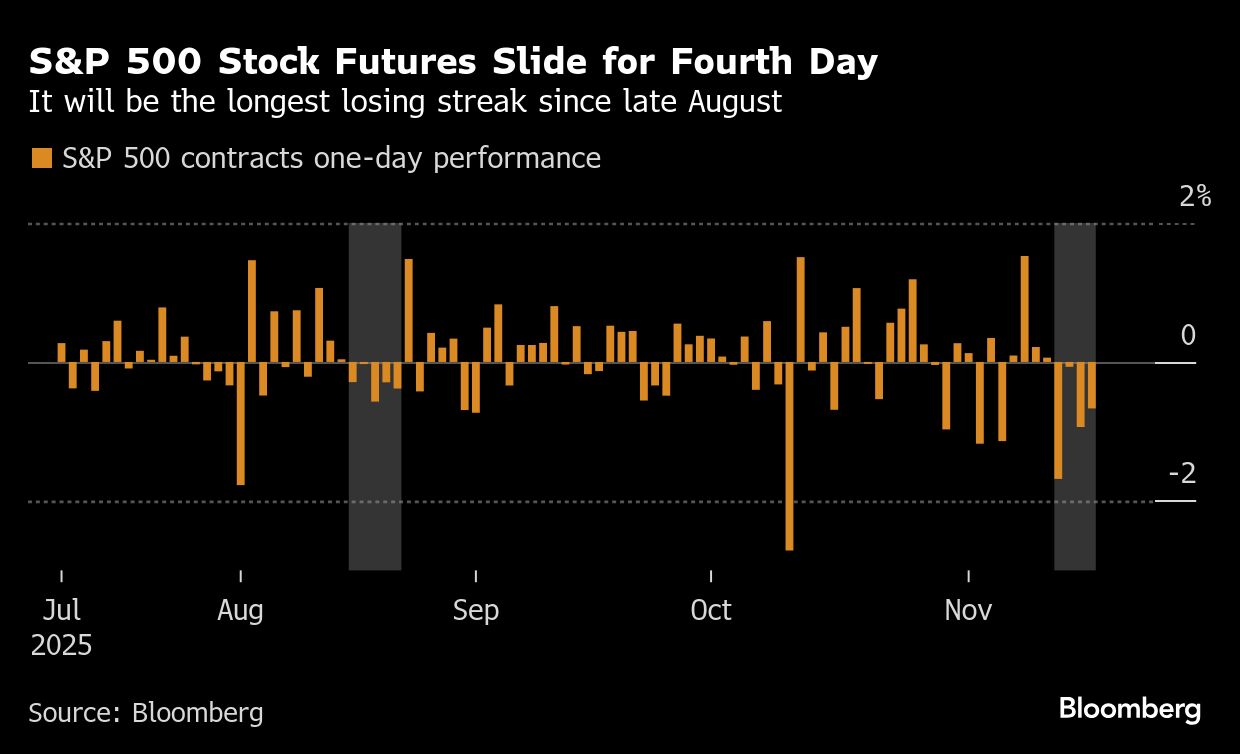
US stocks sank, putting the S&P 500 Index on track for its longest slide since August, as a six-month rally shows signs of cracking following a $1.2 trillion selloff in cryptocurrencies and amid fears around stretched artificial-intelligence valuations.
The benchmark equities gauge dropped for a fourth day, declining 0.7% as of 9:33 a.m. on Tuesday in New York, as investors reconsidered their optimistic expectations for Federal Reserve interest-rate cuts. The technology-heavy Nasdaq 100 Index fell 0.9%. A basket of the Magnificent Seven companies declined 1%. Nvidia Corp., at the center of the AI frenzy, slumped an additional 1.5% ahead of its earnings report on Wednesday. Amazon.com Inc. and Microsoft Corp. fell more than 1% after a ratings downgrade. The Cboe Volatility Index jumped to nearly 24 — above the key 20 level that causes concern for traders.
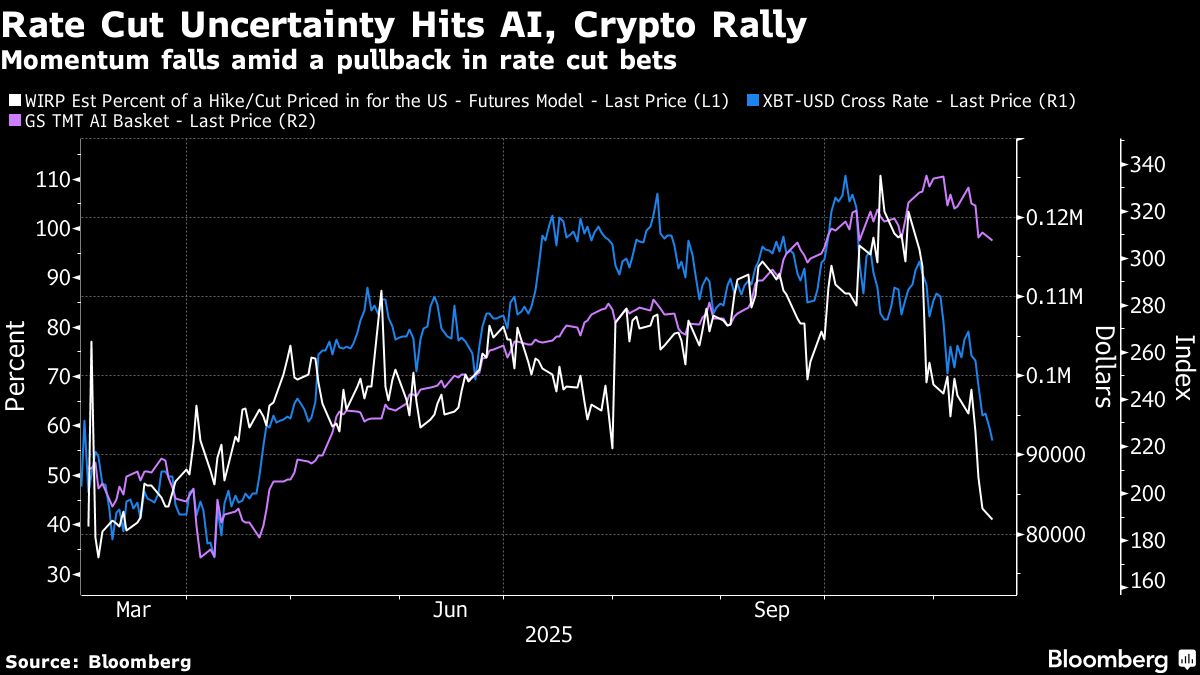
Stock indexes fell globally. Topping the list of worries are AI valuations and whether the Fed will cut rates next month. Traders have less conviction about another reduction in borrowing costs, with swaps now implying a less-than-50% likelihood of a December rate cut. Several policymakers have recently cautioned against a cut, although Fed Governor Christopher Waller repeated his view in favor of lowering rates.
Among other individual stocks, Home Depot Inc. dropped 3.8% after cutting its full-year earnings guidance, warning that some unsteady consumers are hitting the pause button on big-ticket home purchases. Target and Lowe’s will post results Wednesday, followed by Walmart and Gap on Thursday. Bitcoin briefly dropped below $90,000 for the first time in seven months — and traders are betting on more downside. Meanwhile, a Bank of America Corp. survey showed that fund managers’ cash holdings have fallen to levels that have triggered a sell signal in the past.
“Appetite for AI is under pressure from circularity worries and bubble fears,” said Ipek Ozkardeskaya, a senior analyst at Swissquote. “The bad news is that some of the more bullish vibes — AI enthusiasm, massive government stimulus, dovish central-bank expectations — are starting to fade.”

The chorus of warnings about a possible AI bubble grew on Tuesday after JPMorgan Chase & Co. Vice Chairman Daniel Pinto warned that valuations in the industry could be due for a correction. “That correction will also create a correction in the rest of the segment, the S&P and in the industry,” Pinto said at the Bloomberg Africa Business Summit in Johannesburg.
US stocks have come under pressure this month as investors worried the AI-led rally has run too hot. The S&P 500 is trading at about 22 times forward earnings, above its 10-year average of 19. Concerns are also rising about the economic impact of the longest US government shutdown.
Cryptocurrencies, meanwhile. have slumped, with many smaller coins nursing losses in excess of 50% for this year. Digital tokens have lost a combined $1.2 trillion of market value since Bitcoin peaked in October, figures from CoinGecko show.
Dip Buyers
Investors have so far been keen to buy the dip given underlying optimism about US economic growth. On Friday, the S&P 500 reversed losses of as much as 1.4% to end the day little changed and a similar swing looked possible on Tuesday too, as futures rebounded off their session lows.
“We tend to treat market retrenchments as a buying opportunity,” said Marija Veitmane, head of equity research at State Street Global Markets. “The economy is strong enough to support robust earnings growth and yet weak enough to warrant rate cuts.”
Still, there’s higher demand for bearish bets on technology stocks, suggesting faltering confidence in a sustainable rally.
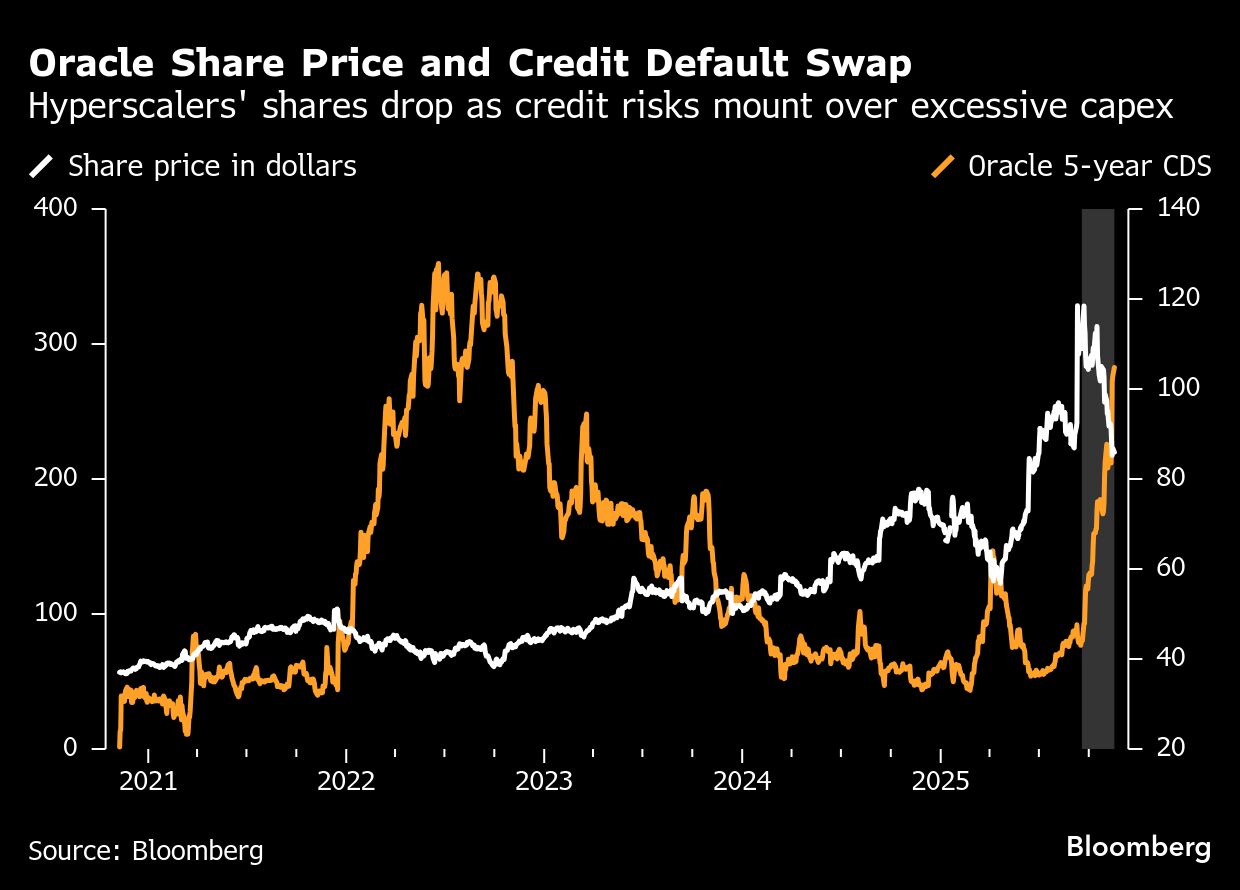
Heavy spending on AI is also raising worries about companies’ capacity to finance such bills. Credit spreads for Oracle Corp. have soared to the highest in nearly three years. In a further sign of growing worries about the space, Microsoft Corp. and Amazon.com, Inc. were both downgraded to neutral from buy at Rothschild & Co Redburn, which said the bull case for generative AI is no longer clear.
BofA’s warning of a potential sell signal came as fund managers’ average cash holdings fell to 3.7%, something that has only occurred 20 times since 2002. Stocks fell and Treasuries outperformed in the following one to three months each time that has happened in the past, BofA strategists said in a note. The survey also showed that for the first time in 20 years, investors said companies are overinvesting.
Nvidia Test
The S&P 500 is now about 3% below its October peak. On Monday, the benchmark index closed below its 50-day moving average for the first time since April. Market breadth has also weakened, with only 54% of S&P 500 constituents trading above their 200-day moving average, according to data compiled by Bloomberg.
All eyes are now on AI bellwether Nvidia’s quarterly earnings report due Wednesday. Meanwhile, swaps traders have pared bets on the possibility of a Fed rate cut in December.
Investors get a long-delayed bit of economic data on Thursday when the US jobs report for September is released, more than a month late because of the government shutdown. It’s part of a data deluge that will guide expectations for how quickly the Fed will continue rate cuts.
Some data is starting to trickle in. Initial jobless claims totaled 232,000 in week ended Oct. 18, according to the US Labor Dept. website showing historical data for claims. Meanwhile, US companies shed 2,500 jobs per week on average in the four weeks ended Nov. 1, according to data released Tuesday by ADP Research.
For Matt Britzman, senior equity analyst at Hargreaves Lansdown, the longer-term outlook for stocks remains intact.
“Pullbacks are never fun but are often healthy, especially in a market that’s showing signs of frothiness,” he said.
A message from Advisor Perspectives and VettaFi: Discover something new! Click here to register for our upcoming webcasts.
Bloomberg News provided this article. For more articles like this please visit
bloomberg.com.
Read more articles by Jessica Menton, Sagarika Jaisinghani